
Dr. Murthy’s Parting Prescription

In this post I review outgoing U.S. Surgeon General Dr. Vivek Murthy’s “Parting Prescription for America” . He reminds us of the importance of rebuilding community through relationships, service, and purpose. The erosion of community leads to disconnection and poor health. Dr. Murthy advocates for a cultural shift towards fulfillment and connection as a path to overall well-being.

Our outgoing Surgeon General Dr. Vivek Murthy has offered final thoughts and a “prescription” for health for our country and for each of us.

He titled it Parting Prescription for America.

In a previous post, I reviewed his career and the health issues he addressed as the 19th and 21st Surgeon General of the United States. Here is a summary of the news release from HHS and a link to his article.

As He Concludes His Second Tenure, 21st U.S. Surgeon General Issues Parting Prescription for America

A week before leaving office, United States Surgeon General Dr. Vivek Murthy released his Parting Prescription for America – PDF. In it he reflects on his personal and professional experiences as our nation’s Surgeon General.
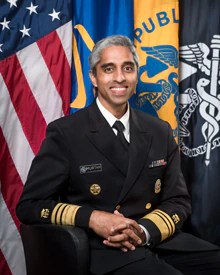
Dr. Vivek Murthy

Throughout his service, Dr. Murthy tried to understand the root causes of pain and unhappiness across our country. As a physician, he believes that health involves more than tests and medications. It includes time to listen and focus on the whole person. As America’s Doctor, he took a similar approach to the nation.

After years of hearing stories from thousands of Americans, reviewing scientific data, and meeting researchers, Dr. Murthy found the sense of community among many Americans had eroded.

In the Surgeon General’s Parting Prescription Dr. Murthy shares his conclusions.

Americans can cultivate health, happiness, and fulfillment by rebuilding community, centered around relationships, service, and purpose.

“Today, we are faced with a profound choice: do we continue with the status quo, marked by pain, disconnection, and division?

Or do we choose a different path—one of joy, health, and fulfillment, where we turn toward each other instead of away from each other; where we choose love over fear; where we recognize community as the irreplaceable foundation for our well-being?

As I finish my tenure as Surgeon General, this is my parting prescription, my final wish for all of us: choose community.”

U.S. Surgeon General Dr. Vivek Murthy

relationships, service, and purpose create an “ecosystem of meaning and belonging”
that are essential for the “triad of fulfillment”.

Dr. Murthy

In contrast, modern culture has become increasingly centered on the triad of success defined by fame, money, and power. We need a cultural shift that moves us toward fulfillment.

In his Prescription, the Surgeon General details each element and how they impact our health:

A Prescription for Relationships

Relationships are the connections we build with friends, family, neighbors, co-workers, and others. Healthy relationships where we feel seen and can be ourselves create joy and lessen stress.

When we lack meaningful relationships, we experience loneliness. A third of adults and half of young people experience loneliness.

Being socially disconnected increases our risk of heart disease, dementia, depression, anxiety, and premature death.

A Prescription for Service

Service includes actions we take that benefit others. But service can have profound benefits to the person serving.

Studies show that service reduces our risk of hypertension, stroke, early death, depression, and cognitive decline. In service, we feel more connected to others.

A Prescription for Purpose

Purpose is an overarching life aim guiding our decisions and actions. It’s not “what” we do, rather “why” we do it.

Purpose supports our physical and mental health. A high sense of individual purpose may reduce the risk of early death, stroke, lung disease, and dementia.

People with a powerful sense of purpose experience lower levels of depression and anxiety and greater resilience in the face of stress.

Dr. Murthy urged Americans to recenter their lives around relationships, service, and purpose – the triad of fulfillment. He calls for a shift in culture, policy, and programs to strengthen community as the critical path to health, happiness, and fulfillment.

Read the complete Parting Prescription for America here.
The illustrations in this post were created by the AI feature of WordPress. They are not associated with Dr. Murthy’s article.

Coincidentally, Dr. Murthy shares a first name with Vivek Ganapathy Ramaswamy, an American entrepreneur and politician. He founded Roivant Sciences pharmaceutical company. Ramaswamy was a Republican candidate in the 2024 presidential election. He withdrew his candidacy and supported Donald Trump.  Wikipedia

Exploring the HEART of Health

I appreciate your time reading this post and invite you to follow this blog and me on social media.

I share information and inspiration to help you transform challenges into opportunities for learning and growth.

Add your name to the subscribe box to be notified of new posts by email. Click the link to read the post and browse other content. It’s that simple. No spam.

I enjoy seeing who is new to Watercress Words. When you subscribe, I will visit your blog or website. Thanks and see you next time.

Dr. Aletha

Dr. Vivek H. Murthy-Our “Family” Doctor

Surgeon General Dr. Vivek H. Murthy, serving since March 2021, addresses public health crises, including mental health, addiction, and social isolation, while advocating for healthier connections.The Surgeon General’s recent report highlights alcohol as the third leading preventable cause of cancer in the U.S.

Keep reading

Why Americans Are Fed Up with Health Insurers

In this post I share a report from a health news site on the anger towards the health insurance industry, highlighted by the murder of Brian Thompson, CEO of UnitedHealthcare. It traces historical resentment towards insurers. Despite dissatisfaction in the system, many Americans express overall satisfaction with their personal care, complicating calls for significant changes.

Like you, I was shocked and saddened by the brutal murder of a man on a street in Manhattan, singled out because he was CEO of a major health insurance company.

And like you, I have been frustrated and angered with the health insurance industry, both as a practicing physician and as a patient.

This article reviews the reasons behind frustration and anger and how they might or might not be addressed.

Rage Has Long Shadowed American Health Care. It’s Rarely Produced Big Change.

This article first appeared on KFF Health News and is republished here under a Creative Commons license.

written by Noam N. Levey, December 18, 2024

Among the biggest-grossing films in America in February 2002 were a war drama about American troops in Somalia (“Black Hawk Down”), an Arnold Schwarzenegger action movie (“Collateral Damage”), and a future Oscar winner about a brilliant mathematician struggling with schizophrenia (“A Beautiful Mind”).

But none of these films topped the box office that month. That title went to “John Q.,” a movie about health insurance.

Or, more precisely, a story about a desperate father — played by Denzel Washington — who takes a hospital emergency room hostage at gunpoint when his HMO refuses to cover a heart transplant for his young son.

John Q.’s violent quest for justice was, of course, fictional. And even in the film, no one ends up dead.

Tragically, that wasn’t the case on the streets of New York City on Dec. 4 when a gunman fatally shot Brian Thompson, CEO of health insurance giant UnitedHealthcare.

Why Americans hate their healthcare

But there was nothing new about the anger at health insurers that Thompson’s shooting unleashed online — and which suspect Luigi Mangione expressed in a document he allegedly wrote.

In fact, eruptions of public rage have shadowed the American health care system for decades.

In the late 1990s and early 2000s, as “John Q.” was hitting movie screens, Americans were revolting against HMOs, whose practice of denying care to plan members to pad their bottom lines made them public enemy No. 1.

Just a few years later, health insurers stoked new ire for rescinding coverage after people were diagnosed with expensive illnesses like cancer. More recently, insurers’ widening use of cumbersome prior authorization procedures that slow patients’ access to care has provoked yet another round of fury.

The cycle of outrage periodically turns on others in the health care industry as well. Exorbitant bills and aggressive collection tactics, such as garnishing patients’ wages, are sapping public trust in hospitals and other medical providers.

And drug companies — perennial poster children for greed and profiteering — have enraged Americans since at least the 1950s, when new “wonder drugs” like steroids were fueling a growing industry.

When Sen. Estes Kefauver, a Tennessee Democrat who had led an investigation of the Mafia, convened hearings in 1959 to probe high prescription prices, his committee received mountains of mail from Americans who reported being fleeced by drugmakers. One retired rail worker told of having to spend more than a third of his retirement income on medicines for himself and his wife.

What Americans want from healthcare

All this public outcry has occasionally sparked change. President Barack Obama and congressional Democrats leveraged anger at spiking insurance premiums in California to get the Affordable Care Act over the finish line in 2010, a landmark achievement that expanded health coverage to millions of Americans.

But more often, cycles of rage have been so much sound and fury, producing only modest reforms. In some cases, public anger has yielded more headaches for patients.

The HMO backlash in the late 1990s and early 2000s, for example, prompted employers — from whom about half of Americans get their health coverage — to embrace high-deductible health plans.

Many employers saw these plans as a way to hold down costs if they couldn’t limit patients’ choice of medical providers through HMOs. These deductibles, which can reach thousands of dollars a year, are driving tens of millions of Americans into debt.

To many on the left who have long argued for a single-payer, government-run health system, the obstacle to more meaningful relief has been the political power of the same industries — health insurers, drug companies, hospitals — that fuel patient anger.

These industries have indeed proven adept at resisting change that threatened their bottom lines. They’ve also benefited from a paradox in how Americans think about their health care.

Patients may get angry. They may even lose faith in the system. This year, public views of health care quality fell to the lowest point since Gallup began asking about it in 2001, with 44% of Americans rating quality as excellent or good, down from a high of 62%.

Yet more than 70% said their own health care is excellent or good.

There is much debate about what accounts for this paradox. Are Americans just grateful to have the health protections they do? Are they satisfied because most don’t have to use the health care system on a regular basis?

Do they simply like their doctor, in the way that voters routinely say they like their own member of Congress but hate Washington politicians? Or do they worry that no matter how frustrating the current system can be, any change risks making the situation worse?

The answer is probably a bit of all of this. Together, such sentiments represent a major challenge for those who hope the current wave of anger at health insurers will drive big improvements.

Will meaningful change happen?

Could that change? Maybe. These are volatile and unpredictable political times. And the pressure of big medical bills is real. Medical debt, in particular, is exacting a fearsome toll on millions of Americans, KFF Health News’ reporting has shown.

But to drive change, advocates looking to harness public anger at the health care industry probably need to rethink their favored solutions. Old ideas like “Medicare for All,” long cherished on the left, or a deregulated health care market, long championed by the right, haven’t swayed Americans so far, no matter how angry they’ve been.

I don’t know when we’ll see meaningful alternatives. One thing that’s almost certainly on the way: Hollywood’s spin on the death of a health insurance executive gunned down in Midtown Manhattan.

KFF Health News is a national newsroom that produces in-depth journalism about health issues and is one of the core operating programs at KFF—an independent source of health policy research, polling, and journalism. Learn more about KFF.

Subscribe to KFF Health News’ free Morning Briefing.

end note

I had forgotten about the movie John Q, but I remember it now. Denzel Washington’s convincing and sympathetic portrayal of a father trying to save his son’s life is moving. I’m going to watch it again (it’s on Amazon Prime and probably other venues; affiliate link).

Exploring the HEART of Health

I appreciate your time reading this post and invite you to follow this blog and me on social media.

I share information and inspiration to help you transform challenges into opportunities for learning and growth.

Add your name to the subscribe box to be notified of new posts by email. Click the link to read the post and browse other content. It’s that simple. No spam.

I enjoy seeing who is new to Watercress Words. When you subscribe, I will visit your blog or website. Thanks and see you next time.

Medical stethoscope and heart on a textured background

Dr Aletha