This post introduces a series about retirement, often viewed as ending one’s career, but it encompasses diverse experiences for each individual, such as new jobs, volunteer work, and personal pursuits like travel, hobbies or education. The series explores retirement preparation, identity shifts, and purposeful living.
What comes to your mind when you hear the word “retirement”? The word comes from the verb retire, which means “to go to sleep”. But most of us don’t plan to spend our retirement sleeping all day.
Most people think of retirement in terms of work. The dictionary definition is “to withdraw from one’s position or occupation; to conclude one’s working or professional career.”
But retirement is more complicated than that. I know people who retire from a career and start another which may be vastly different. Some people retire only to take a part-time job from boredom or financial necessity. Some retirees become so involved in volunteer work, they are busier than when they had a paying job.
Retirement can give you time to pursue a hobby or skill seriously, or to acquire advanced education. And who doesn’t look forward to traveling, visiting family, and exploring the world?
We may find ill health, disability, or advanced age makes working full-time or even part-time impossible. Sometimes unexpectedly, people find themselves assuming the role of caregiver in retirement, for a spouse, parent, child, or grandchild.
In other words, everyone’s retirement looks different; each is unique.
My friend Ric Shields invited me to be a guest on his DoorWays Ministry podcast series to talk about the questions that really matter when it comes to retirement.
Whether retirement is still years away, you’re getting ready for it, or you’re already a seasoned retiree, this series has something for you. We’ll explore how to plan, prepare, and thrive in whatever season of life you’re in.
How do you know when you’re ready to retire?
Can you actually afford to retire?
What happens to your sense of purpose and identity when work is no longer at the center of your life?
Where should you live, and what do you want to leave behind for the people you love?
The series also covers navigating family responsibilities, finding purpose in your next chapter, and protecting yourself and your family from the people who try to take advantage of older adults.
It’s about more than retirement. It’s about making the most of what comes next. Because getting older doesn’t mean your purpose is behind you.
In my episode, Ric and I discuss the HEART of purpose in retirement. It airs in two weeks.
Listen here as Ric introduces the series.
Prepare
Before you listen to any of the podcast episodes, take time to think about what retirement means to you now.
If you are already retired, how is it going? What do you like about it? What would you want to change?
If you aren’t retired, what thoughts or plans have you made about the future? What fears do you have? What goals do you have?
Keep these thoughts in mind as we walk through this series together. Remember, on this blog we find information and inspiration to learn, plan, prepare, and thrive through life’s challenges.
Exploring the HEART of Health
Thank you for reading this post. Please follow this blog and me on social media.
I share information and inspiration to help you transform challenges into opportunities for learning and growth.
Add your name to the subscribe box to be notified of new posts by email. Click the link to read the post and browse other content. It’s that simple. No spam.
I enjoy seeing who is new to Watercress Words. When you subscribe, I will visit your blog or website. Thanks and see you next time.
The cyclospora food contamination issue, highlighted by a record outbreak linked to iceberg lettuce, has raised concerns about food safety amid federal funding cuts affecting health agencies. With over 17,000 cases this summer, experts question the government’s response timing and ability to handle outbreaks, urging better investment in public health infrastructure.
Although the cyclospora food contamination problem has been the subject of humorous memes on social media, illness due to food borne infections is not to be taken lightly.
At home, you are responsible for thoroughly washing the food you prepare. But elsewhere you have little to no control over the safety of the food you are served.
Here is a recap of the public health response to the outbreak of diarrhea due to cyclospora in the United States this summer. It is followed by some practial advice on protecting your families from foodborne illness.
Thanks to Stateline, Oklahoma Voice, and Anna Vollers for the free use of the following article.
A summer of recalls exposes holes in the nation’s food safety net
A summer of food recalls, including the record-shattering cyclosporiasis outbreak tied to iceberg lettuce that has sickened thousands, has raised many Americans’ fears of contracting a foodborne illness.
The recalls have focused attention on the Trump administration’s decision to cut funding and staff at several public health agencies, and prompted questions about whether those changes have made consumers more vulnerable.
In fact, this year’s tally of food recalls is roughly in line with the numbers in recent years. About 48 million people each year get sick from a foodborne illness. But experts worry that the scope, severity, and scale of outbreaks and their associated food recalls are growing.
Cyclospora
While the United States sees some cyclosporiasis cases every year, this year’s outbreak has crushed records: Since May, the federal Centers for Disease Control and Prevention has confirmed more than 17,000 cases, with another nearly 12,000 reported cases still under investigation. The outbreak has resulted in at least 922 hospitalizations and two deaths.
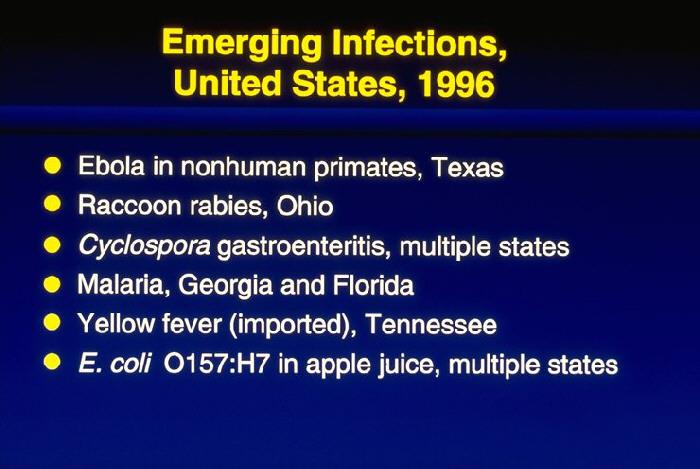
this word slide lists, what in 1996, were those infections that were coming to bear, and reads as follows: “• Ebola in nonhuman primates, Texas; • Raccoon rabies, Ohio; • Cyclospora gastroenteritis, multiple states; • Malaria, Georgia and Florida; • Yellow fever (imported), Tennessee; • E. coli O157:H7 in apple juice, multiple states”.CDC, public domain
Federal officials have blamed this year’s multistate outbreak on processed iceberg lettuce from central Mexico. The lettuce was brought to the U.S. by Taylor Farms, a distributor that supplies foods to thousands of restaurants and grocery stores, including Target, Taco Bell, Whole Foods, Kroger, Walmart, Costco and Jack in the Box.
Quotation
I think there are valid questions around the timing of the response, the time it took for agencies to recognize the outbreak and to start to investigate it, get boots on the ground in Mexico.
The CDC and the Food and Drug Administration are investigating at least six other clusters for which a source hasn’t yet been confirmed.
Cuts at the CDC and FDA haven’t necessarily increased consumers’ chances of food contamination or outbreaks, said Jennifer McEntire, a food microbiologist and the founder of a food safety consulting firm. However, McIntire said, “I do think the cuts may have influenced the way outbreaks unfold.”
“I think there are valid questions around the timing of the response, the time it took for agencies to recognize the outbreak and to start to investigate it, get boots on the ground in Mexico,” she said.
Darin Detwiler, a food safety expert and professor emeritus at Northeastern University, noted that the U.S. is seeing more recalls affecting multiple states, rather than a small area. He added that more recalls are being tied to a problem earlier in the food chain — such as contaminated irrigation water at a large lettuce farm rather than, say, improperly stored deli meat at a sandwich shop — which can spread the pathogen to a far higher number of people and make it harder to track and contain.
“We’re seeing so many people impacted, so many states impacted, and the recalls are dragging on for a long time,” Detwiler. “There’s ambiguity or lack of transparency over who’s even behind a recall.”
The White House dismissed concerns about the federal government’s ability to handle outbreaks.
“The Trump Administration has never cut FDA food inspectors or other frontline personnel for domestic disease response,” White House spokesperson Allison Schuster told Stateline in an email. “
President Trump’s top priority is the health and safety of the American people, and the federal government remains capable of robustly addressing any future outbreaks.”
Fewer Staff, Less Funding
Last year, the Trump administration laid off thousands of employees at federal public health agencies including the CDC, which tracks and responds to disease outbreaks, and the FDA, which oversees and regulates food safety.
While some of the layoffs were reversed through lawsuits or by Congress, the nation’s public health agencies remain at diminished capacity. The CDC workforce has been reduced by 28% since December 2024, according to a Stateline analysis of data from the U.S. Office of Laboratories and Research (OL which responds to outbreaks, was downsized last year by the Department of Government Efficiency from 11 people to three.
Sandra Eskin, a food safety expert who worked in the office of food safety at the U.S. Department of Agriculture during the Biden administration, likened federal public health cuts to the game Jenga, where players construct a tower of wooden blocks and then remove the blocks one at a time while trying not to make the tower fall.
“I think that’s what we’re seeing,” said Eskin, who now leads a public health nonprofit called Stop Foodborne Illness, which advocates for stronger food safety policies. “Whether it’s cuts in staff, cuts in funding that trickle down to the states, or late responses to outbreaks — these are all pieces of wood in that game where you start pulling them out and then the whole thing collapses.”
The federal government also has delayed requiring companies to comply with new food safety rules, included in a law enacted more than a decade ago, that would help regulators track where food comes from and where it’s going during outbreaks.
Detwiler and other experts say the new rules could have helped speed the government’s sluggish response to the cyclospora outbreak investigation after Taylor Farms initially tried delaying the recall.
Last year, the Trump administration also drastically scaled back FoodNet, an early warning surveillance system that required tracking of infections caused by eight different foodborne pathogens. The federal-state collaboration is now only required to track two pathogens: Salmonella and Shiga toxin-producing E.coli. The other six pathogens, including cyclospora, were made optional.
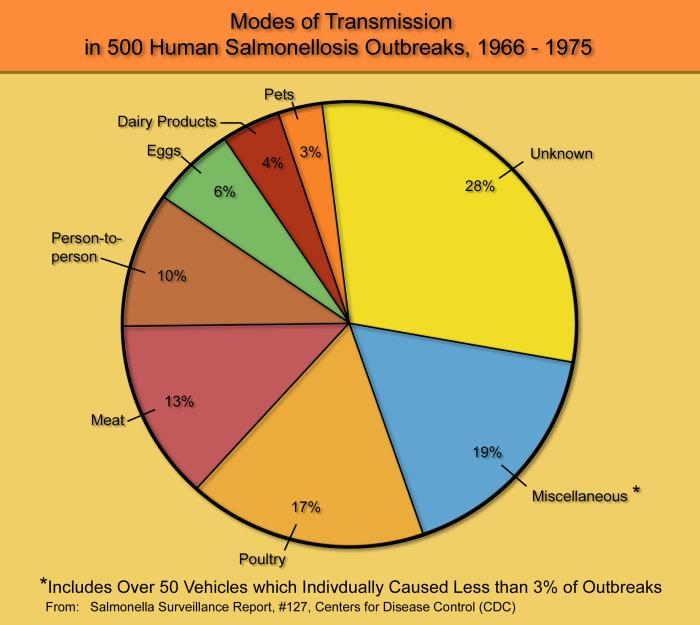
This pie chart illustrates the breakdown of the origins of salmonella infections amongst 500 salmonella outbreaks between 1966 and 1975. Sources of infection included pets (3%), dairy products (4%), eggs (6%), person-to-person (10%), meat (13%), poultry (17%), miscellaneous (19%), and unknown (28%).CDC/ Dr. Mike Miller, public domain
The CDC says the change was made because other surveillance systems monitor those pathogens. But McEntire and other food safety experts want them reinstated on FoodNet.
Funding Cuts’ Impact on States
Infectious outbreaks like cyclosporiasis are typically investigated by state and local health departments, which largely rely on federal dollars distributed through the FDA and CDC. Public health has been chronically underfunded for decades under several administrations, experts say.
But the Trump administration since last year has terminated $5.78 billion in CDC grants — funds that were appropriated by Congress but had not yet been spent.
Michigan, at the center of the cyclosporiasis outbreak with the highest number of cases and clusters, is one of 23 states (plus the District of Columbia) that successfully sued the Trump administration in June 2025 over federal funding cuts.
Changes to federal funding last year affected public health infrastructure across Michigan, a representative from the Michigan Department of Health and Human Services told Stateline. During the cyclosporiasis outbreak, the state used its own resources to bolster local responses.
“While we are able to support this investigation on a local level, sustained investment in public health capacity is essential to ensuring Michigan can respond effectively to future regional and statewide public health threats,” said department spokesperson Lynn Sutfin.
This story was originally produced by Stateline, which is part of States Newsroom, a nonprofit news network that includes Oklahoma Voice, and is supported by grants and a coalition of donors as a 501c(3) public charity.
Oklahoma Voice is part of States Newsroom, a nonprofit news network supported by grants and a coalition of donors as a 501c(3) public charity. Oklahoma Voice maintains editorial independence. Contact Editor Janelle Stecklein for questions: info@oklahomavoice.com.
The graphics used in the article were not part of the original publication.
Keeping Your Family Safe
4 STEPS TO FOOD SAFETY
The CDC offers these tips for food safety.
To prevent food poisoning, follow the four steps to food safety: Clean, Separate, Cook, and Chill. Keep hands and surfaces clean, keep risky foods separate from other foods, cook food properly, and refrigerate promptly.
Some foods are more likely to contain harmful germs, including:
Raw or undercooked poultry, meat, seafood, or eggs
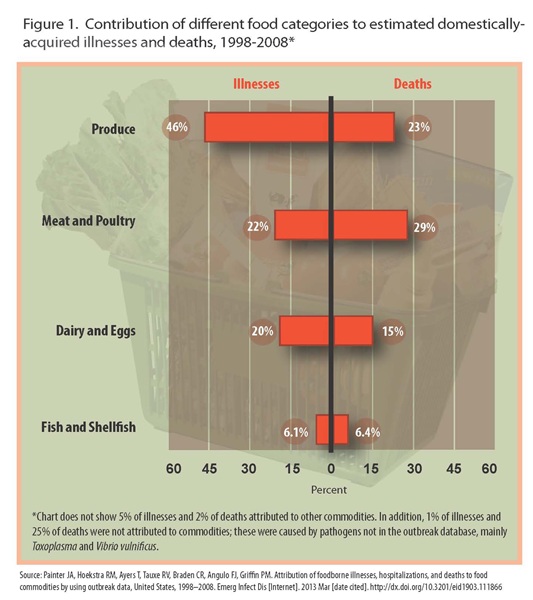
The most common sources of fatal infections were meat and poultry, much due to Salmonella and Listeria, from the CDC website
Next Steps
Take time to consider what you learned from this article and what else you might need to know.
Consider inspecting your own home for how well it protects your family from food-related illness. While much of the health advice we offer now involves the types of food we eat, the basics of food storage and meal preparation are still important.
How important is this to you and what are your next steps? I’d like to know, so please comment. I try to respond to all comments.
Exploring the HEART of Health
Thank you for reading this post. Please follow this blog and me on social media.
I share information and inspiration to help you transform challenges into opportunities for learning and growth.
Add your name to the subscribe box to be notified of new posts by email. Click the link to read the post and browse other content. It’s that simple. No spam.
I enjoy seeing who is new to Watercress Words. When you subscribe, I will visit your blog or website. Thanks and see you next time.