Memorial Day, observed on the last Monday of May in the U.S., honors those who died serving in the armed forces. In 2014, we visited the Vietnam Veterans Memorial in Angel Fire, New Mexico, to participate in a remembrance service and view an engraved brick .
updated May 25, 2025
The United States celebrates Memorial Day on the last Monday of May, a day set aside to remember people who died while serving in the armed forces, although many families use it to remember other deceased loved ones also.
Memorial Day 2014 was special and unique for me and my husband.
We had planned a trip to New Mexico, not realizing we would be there on Memorial Day. I was attending a medical conference. We wanted to visit the Vietnam Veterans Memorial at Angel Fire.
Since my husband is a Vietnam Veteran, I had ordered a brick engraved with his name to be laid on the walkway there. We wanted to see it, and decided to go on Memorial Day, to join the special remembrance service they have on that day.
It was a chilly overcast day, not what we expected for late May. Fittingly, the rain held off until the ceremony ended, then it poured down. I took all of the photos in this post.
on the memorial grounds, the chapel in the background
In the background, I am kneeling to view Raymond’s brick
Inside the chapel, which is never locked; it is open for anyone to enter at any time
A flag and plaque were presented to the family of a fallen soldier
A local military reserve unit provided music.
On an earlier trip Raymond met with the late Dr. Westphall, who founded the memorial in honor of his son David, who died in Vietnam.
“The purpose of the David Westphall Veterans Foundation is to honor America’s veterans and members of its military forces by memorializing the sacrifices they have made and by recognizing the sense of duty and the courage they have displayed as they answered their country’s call to arms.”
Sharing the HEART of remembrance
Thanks for sharing the Angel Fire Memorial with us. If you are ever in northeast New Mexico, don’t miss visiting the memorial, museum, and veterans cemetery which has been added since our last visit. You can also visit nearby Taos and the Taos Pueblo.
I’d love for you to follow this blog. I share information and inspiration to help you transform challenges into opportunities for learning and growth.
Add your name to the subscribe box to be notified of new posts by email. Click the link to read the post and browse other content. It’s that simple. No spam.
I enjoy seeing who is new to Watercress Words. When you subscribe, I will visit your blog or website. Thanks and see you next time.
Most people know and understand what war does to countries- changing boundaries, toppling governments, destroying infrastructure, wasting the land, bankrupting economies. Revanants speaks to the human cost for communities, families, and individuals-driving families apart, killing dreams, interrupting plans, wounding bodies and emotions, and destroying hope. On a global scale, war may be justified but in…
I didn’t want to ever go to Vietnam again when I came home in 1972 after a one-year tour of duty with the United States Army. I was stationed with the Americal Division, 3/18 Field Artillery Battalion near Tra Bong, a major village located about 25 miles west of Chu Lai, the headquarters of the Americal Division, on “China Beach” at the South China Sea.
On April 30, 1975, the United States withdrew from VietNam after many years of involvement in that country’s war. That conflict remains a part of American history- and also a part of the personal history of the men and women and their families who served the military in any capacity during those years. Here is a perspective on that history from my husband Raymond Oglesby.
Heads up: this story contains strong language you might find offensive; it is used to reflect what was thought at the time, not what is known today.
Finding My Way Back
By Raymond Oglesby
in country, 1970
Going to war
I didn’t want to ever go to Vietnam again when I came home in 1972 after a one-year tour of duty with the United States Army. I was stationed with the Americal Division, 3/18 Field Artillery Battalion near Tra Bong, a major village located about 25 miles west of Chu Lai, the headquarters of the Americal Division, on “China Beach” at the South China Sea.
Tra Bong was an artillery base and housed two 8-inch and two 175 self-propelled howitzers. Each gun was capable of launching a 90 to 100 pound projectile 20 to 30 miles. The “firebase” was home to about 120 soldiers. Day and night, we fired the guns.
The US Army trained enlisted men to use weapons to destroy the enemy. Our mission was to route the NVA (North Vietnam Army) and VC (Viet Cong) from South Vietnam. I served as team leader of Fire Direction Control (FDC). We were responsible for working up fire missions and passing them to the gun crews via radio.
Killing the enemy, Vietnamese soldiers didn’t bother me then because I did not see them as human. They would intercept our radio transmissions and curse us in English. We called them Charlie, VC and gooks. Without real names, they did not exist. Despite our superior air, sea, and land capabilities the United States military lost the war, the first war our country has ever lost.
When I came home, I did not talk about my involvement in the Vietnam War for over fifteen years. I only told two or three people what really happened. I thought only another Vietnam vet could understand.
Missing peace
After the Vietnam Veterans’ Memorial was erected in Washington D.C. (1982), I began reading and watching videos about that time in our nation’s history. In Vietnam, we heard nothing about the anti-war demonstrations back in the States. Now I realized that our country’s involvement there had been a misguided effort. The more I learned, the more I wanted to go back to Vietnam, not to feel sorry for myself but to help the country I tried to destroy.
a replica of the Vietnam Memorial Wall in Washington, D.C. visits towns throughout the United States
For Christmas, my wife gave me A Missing Peace, a book written by a Vietnam veteran, Robert Seiple. From it, I learned I was not the only veteran haunted by his war experience. Others sought healing from their shame and anger.
And I discovered how much the Vietnamese people had suffered and still did. Unlike other wars, no restitution was made to rebuild the nation so Vietnam steadily declined economically. He described efforts to help rebuild Vietnam and said anyone can make a difference. He issued a call to “reconciliation”, both within ourselves and between the two countries.
I decided to contact Vets with a Mission (VWAM), one of the agencies listed in the book. VWAM is a non-profit, non-political organization that works to bring healing and reconciliation between our countries. Since 1988, VWAM has taken teams of veterans and other volunteers into Vietnam. At their own expense, they travel to Vietnam to build rural medical clinics, support orphanages, care for homeless children, and work with hospitals.
I began planning a trip there myself, wondering what I would find and how I would feel. I did not understand why God was stirring my heart for the people of Vietnam. Was I a traitor for wanting to aid a former enemy? Some of my friends thought so, saying “Since you were dying to get out, why would you go back?”
Finding peace
In January 1994 I arrived in Vietnam for my first visit after twenty-two years. I was so excited I couldn’t sleep. I ran whenever we stopped to visit a site, especially if I had been there during the war. I empathized with the Vietnamese who were still living in poverty. I no longer saw them as enemies but as fellow humans. They treated us kindly and welcomed us wherever we went.
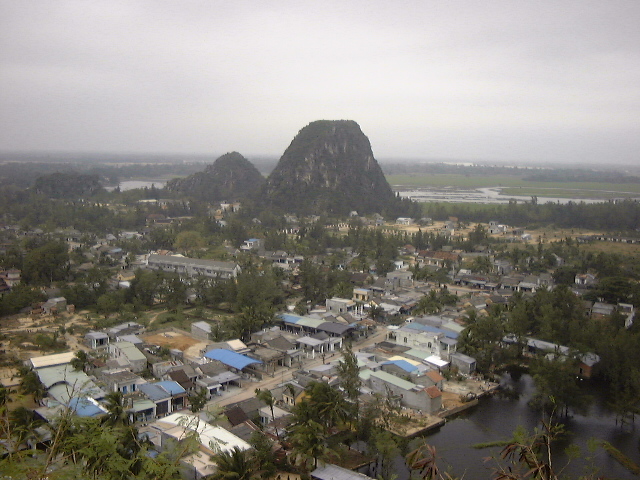
At Tra Bong a crowd of people followed us around, since few Americans have been there since the war. For me the highlight of the trip was a visit to the site of the old firebase.
After walking around the now deserted site, I felt I should kneel to pray for the village people around me. They did not understand what I was doing or saying. Right then, my heart was broken for the Vietnamese people.
As we left, children from the nearby school mobbed our van. My eyes misted with tears as I felt the Lord drawing me back. “You must reach these people for my Kingdom.” I knew then I would go back.
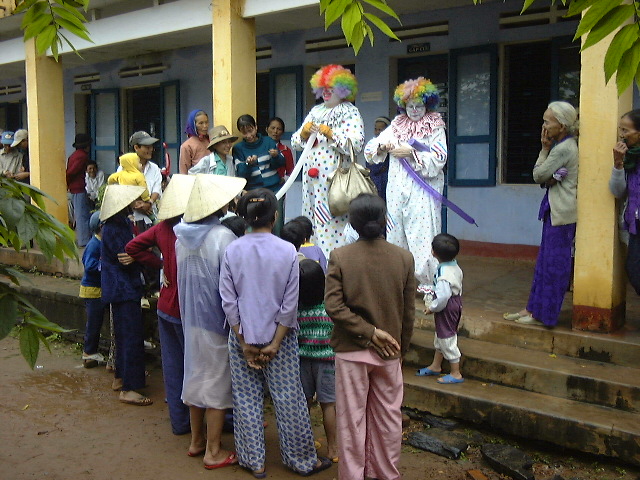
making friends with children during his trip back
Living in peace
I have served on several Vets with a Mission teams, teaching computer applications in schools and hospitals. I have made Vietnamese friends. Some people think I am a traitor by giving aid to a former enemy. I’m not offended or resentful toward them. I only know that God has given me a burden and compassion for the people of Vietnam.
In 1970, I went on a mission of destruction, now I go on a mission of reconstruction. We failed to win the minds of the Vietnamese by bullets, but we are touching their hearts through the love of God.-Raymond
Battle for TraBong: Events and Aftermath
Raymond has written a detailed account of his service at Fire Support Base (FSB)/Landing Zone (LZ) Cindy near Tra Bong Vietnam. The firebase fought a major battle in September 1970. That battle and how it impacted the war in general and one soldier’s life specifically is the subject of his book.
We who served on LZ Cindy in 1969 and after when the unit left in 1971 did a job that had to be done to save more lives than were taken by the enemy. All of us were there because we were asked or drafted to serve this country and help the people of Vietnam survive.
Those of us who did the job on LZ Cindy did the best we could to survive and help those who served with us. It is unfortunate that some of those did not survive, but in war people die, and there is nothing we can do about it.
Please visit and follow Raymond’s tech blog. Based on his 30+ years in the IT industry as a software developer, programmer, and trouble shoooter, he shares his experience, knowledge, and inside information on all things computer. Find it at