When Food Isn’t Safe: Protecting Your Family

The cyclospora food contamination issue, highlighted by a record outbreak linked to iceberg lettuce, has raised concerns about food safety amid federal funding cuts affecting health agencies. With over 17,000 cases this summer, experts question the government’s response timing and ability to handle outbreaks, urging better investment in public health infrastructure.

Although the cyclospora food contamination problem has been the subject of humorous memes on social media, illness due to food borne infections is not to be taken lightly.

At home, you are responsible for thoroughly washing the food you prepare. But elsewhere you have little to no control over the safety of the food you are served.

Here is a recap of the public health response to the outbreak of diarrhea due to cyclospora in the United States this summer. It is followed by some practial advice on protecting your families from foodborne illness.

Thanks to Stateline, Oklahoma Voice, and Anna Vollers for the free use of the following article.

A summer of recalls exposes holes in the nation’s food safety net

by Anna Claire Vollers, Oklahoma Voice
August 31, 2026

Jalapenos. Frozen berries. Beef. Alfalfa sprouts.

A summer of food recalls, including the record-shattering cyclosporiasis outbreak tied to iceberg lettuce that has sickened thousands, has raised many Americans’ fears of contracting a foodborne illness.

The recalls have focused attention on the Trump administration’s decision to cut funding and staff at several public health agencies, and prompted questions about whether those changes have made consumers more vulnerable.

In fact, this year’s tally of food recalls is roughly in line with the numbers in recent years. About 48 million people each year get sick from a foodborne illness. But experts worry that the scope, severity, and scale of outbreaks and their associated food recalls are growing.

Cyclospora

While the United States sees some cyclosporiasis cases every year, this year’s outbreak has crushed records: Since May, the federal Centers for Disease Control and Prevention has confirmed more than 17,000 cases, with another nearly 12,000 reported cases still under investigation. The outbreak has resulted in at least 922 hospitalizations and two deaths.
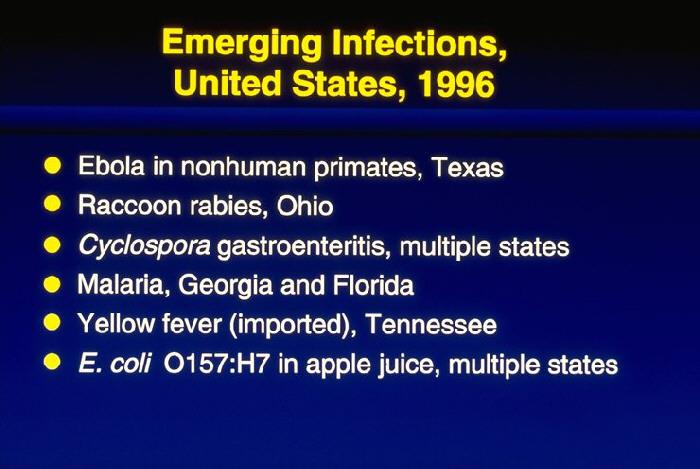
this word slide lists, what in 1996, were those infections that were coming to bear, and reads as follows: “• Ebola in nonhuman primates, Texas; • Raccoon rabies, Ohio; • Cyclospora gastroenteritis, multiple states; • Malaria, Georgia and Florida; • Yellow fever (imported), Tennessee; • E. coli O157:H7 in apple juice, multiple states”.CDC, public domain

Federal officials have blamed this year’s multistate outbreak on processed iceberg lettuce from central Mexico. The lettuce was brought to the U.S. by Taylor Farms, a distributor that supplies foods to thousands of restaurants and grocery stores, including Target, Taco Bell, Whole Foods, Kroger, Walmart, Costco and Jack in the Box.

Quotation

I think there are valid questions around the timing of the response, the time it took for agencies to recognize the outbreak and to start to investigate it, get boots on the ground in Mexico.

– Jennifer McEntire, food microbiologist and founder of Food Safety Strategy

The CDC and the Food and Drug Administration are investigating at least six other clusters for which a source hasn’t yet been confirmed.

Cuts at the CDC and FDA haven’t necessarily increased consumers’ chances of food contamination or outbreaks, said Jennifer McEntire, a food microbiologist and the founder of a food safety consulting firm. However, McIntire said, “I do think the cuts may have influenced the way outbreaks unfold.”

“I think there are valid questions around the timing of the response, the time it took for agencies to recognize the outbreak and to start to investigate it, get boots on the ground in Mexico,” she said.

Darin Detwiler, a food safety expert and professor emeritus at Northeastern University, noted that the U.S. is seeing more recalls affecting multiple states, rather than a small area. He added that more recalls are being tied to a problem earlier in the food chain — such as contaminated irrigation water at a large lettuce farm rather than, say, improperly stored deli meat at a sandwich shop  — which can spread the pathogen to a far higher number of people and make it harder to track and contain.

“We’re seeing so many people impacted, so many states impacted, and the recalls are dragging on for a long time,” Detwiler. “There’s ambiguity or lack of transparency over who’s even behind a recall.”

The White House dismissed concerns about the federal government’s ability to handle outbreaks.

“The Trump Administration has never cut FDA food inspectors or other frontline personnel for domestic disease response,” White House spokesperson Allison Schuster told Stateline in an email. “

President Trump’s top priority is the health and safety of the American people, and the federal government remains capable of robustly addressing any future outbreaks.”

Fewer Staff, Less Funding

Last year, the Trump administration laid off thousands of employees at federal public health agencies including the CDC, which tracks and responds to disease outbreaks, and the FDA, which oversees and regulates food safety.

While some of the layoffs were reversed through lawsuits or by Congress, the nation’s public health agencies remain at diminished capacity. The CDC workforce has been reduced by 28% since December 2024, according to a Stateline analysis of data from the U.S. Office of Laboratories and Research (OL which responds to outbreaks, was downsized last year by the Department of Government Efficiency from 11 people to three.

Sandra Eskin, a food safety expert who worked in the office of food safety at the U.S. Department of Agriculture during the Biden administration, likened federal public health cuts to the game Jenga, where players construct a tower of wooden blocks and then remove the blocks one at a time while trying not to make the tower fall.

“I think that’s what we’re seeing,” said Eskin, who now leads a public health nonprofit called Stop Foodborne Illness, which advocates for stronger food safety policies. “Whether it’s cuts in staff, cuts in funding that trickle down to the states, or late responses to outbreaks — these are all pieces of wood in that game where you start pulling them out and then the whole thing collapses.”

The federal government also has delayed requiring companies to comply with new food safety rules, included in a law enacted more than a decade ago, that would help regulators track where food comes from and where it’s going during outbreaks.

Detwiler and other experts say the new rules could have helped speed the government’s sluggish response to the cyclospora outbreak investigation after Taylor Farms initially tried delaying the recall.

Last year, the Trump administration also drastically scaled back FoodNet, an early warning surveillance system that required tracking of infections caused by eight different foodborne pathogens. The federal-state collaboration is now only required to track two pathogens: Salmonella and Shiga toxin-producing E.coli. The other six pathogens, including cyclospora, were made optional.
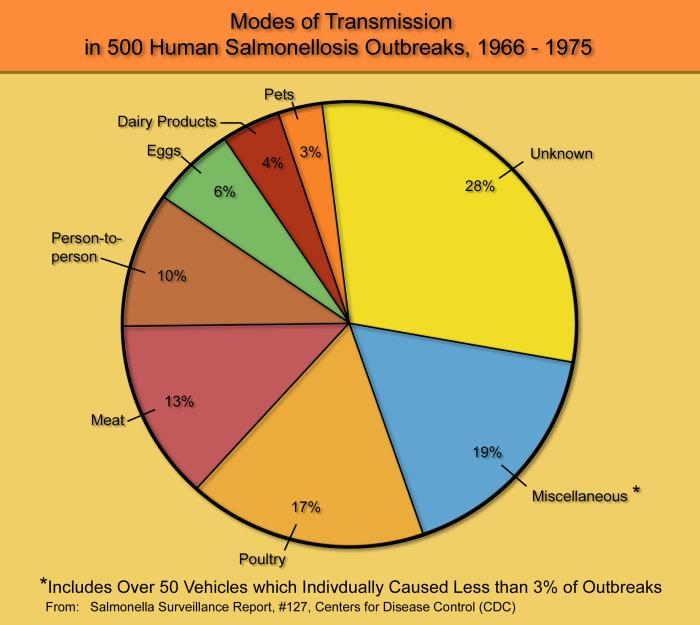
This pie chart illustrates the breakdown of the origins of salmonella infections amongst 500 salmonella outbreaks between 1966 and 1975. Sources of infection included pets (3%), dairy products (4%), eggs (6%), person-to-person (10%), meat (13%), poultry (17%), miscellaneous (19%), and unknown (28%).CDC/ Dr. Mike Miller, public domain

The CDC says the change was made because other surveillance systems monitor those pathogens. But McEntire and other food safety experts want them reinstated on FoodNet.

Funding Cuts’ Impact on States

Infectious outbreaks like cyclosporiasis are typically investigated by state and local health departments, which largely rely on federal dollars distributed through the FDA and CDC. Public health has been chronically underfunded for decades under several administrations, experts say.

But the Trump administration since last year has terminated $5.78 billion in CDC grants — funds that were appropriated by Congress but had not yet been spent.

Michigan, at the center of the cyclosporiasis outbreak with the highest number of cases and clusters, is one of 23 states (plus the District of Columbia) that successfully sued the Trump administration in June 2025 over federal funding cuts.

Changes to federal funding last year affected public health infrastructure across Michigan, a representative from the Michigan Department of Health and Human Services told Stateline. During the cyclosporiasis outbreak, the state used its own resources to bolster local responses.

“While we are able to support this investigation on a local level, sustained investment in public health capacity is essential to ensuring Michigan can respond effectively to future regional and statewide public health threats,” said department spokesperson Lynn Sutfin.

Stateline reporter Anna Claire Vollers can be reached at avollers@stateline.org

This story was originally produced by Stateline, which is part of States Newsroom, a nonprofit news network that includes Oklahoma Voice, and is supported by grants and a coalition of donors as a 501c(3) public charity.

Oklahoma Voice is part of States Newsroom, a nonprofit news network supported by grants and a coalition of donors as a 501c(3) public charity. Oklahoma Voice maintains editorial independence. Contact Editor Janelle Stecklein for questions: info@oklahomavoice.com.

The graphics used in the article were not part of the original publication.

Keeping Your Family Safe

4 STEPS TO FOOD SAFETY

The CDC offers these tips for food safety.

To prevent food poisoning, follow the four steps to food safety: Clean, Separate, Cook, and Chill. Keep hands and surfaces clean, keep risky foods separate from other foods, cook food properly, and refrigerate promptly.

Some foods are more likely to contain harmful germs, including:

  • Raw or undercooked poultry, meat, seafood, or eggs
  • Raw or undercooked sprouts
  • Unwashed fruits and vegetables
  • Cut melon
  • Unpasteurized milk, juice, cider, or soft cheese
  • Raw dough or raw batter made with uncooked flour

Explore this topic further at CDC FOOD SAFETY
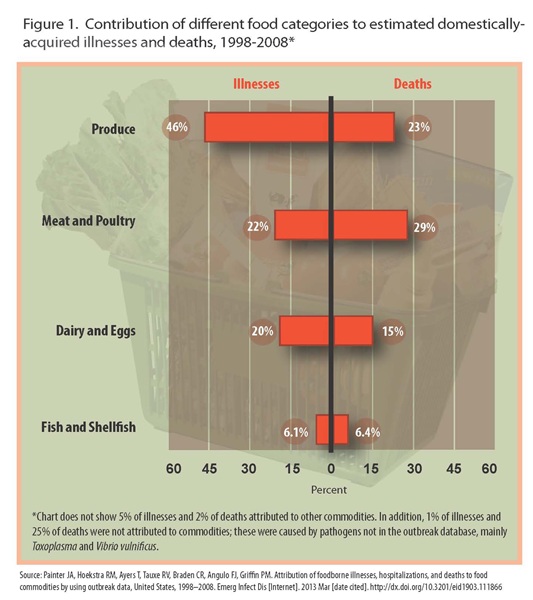
The most common sources of fatal infections were meat and poultry, much due to Salmonella and Listeria, from the CDC website

Next Steps

Take time to consider what you learned from this article and what else you might need to know.

Consider inspecting your own home for how well it protects your family from food-related illness. While much of the health advice we offer now involves the types of food we eat, the basics of food storage and meal preparation are still important.

How important is this to you and what are your next steps? I’d like to know, so please comment. I try to respond to all comments.

Exploring the HEART of Health

I appreciate your time reading this post and invite you to follow this blog and me on social media.

I share information and inspiration to help you transform challenges into opportunities for learning and growth.

Add your name to the subscribe box to be notified of new posts by email. Click the link to read the post and browse other content. It’s that simple. No spam.

I enjoy seeing who is new to Watercress Words. When you subscribe, I will visit your blog or website. Thanks and see you next time.

Dr. Aletha

Are Prescription Drug Ads Helpful to Patients?

The post discusses the prevalence of direct-to-consumer advertising for prescription medications in the U.S., highlighting both its benefits and drawbacks. While ads raise awareness and encourage patients to seek care, they often promote expensive drugs lacking significant advantages over cheaper alternatives. A report from KFF Health is shared.

Repatha. Breztri. Caplyta.Vyvgart. Hytrulo. Eylea HD.Izervay. Entyvio.

Does it look like I’m writing in a language other than English? Are these the names of rock bands you’ve never heard of? Or characters in a video game featuring superheroes and villains?

These are the brand names of prescription drugs that I saw advertised in just one evening of television. And they are not all of the ones aired. Added to these are ads for OTC meds, vitamins, supplements, and other health care products.

When I was practicing medicine, occasionally a patient would ask for a specific drug they heard about from a friend, read about, or saw on television. Usually it was a drug that did not require close surveillance, like a seasonal allergy or heartburn medication.

Instead, all of these drugs treat serious conditions, including several cancers, inflammatory bowel disease, heart disease, schizophrenia, myasthenia gravis, and macular degeneration, conditions for which regular medical surveillance is key to treatment.

One of them caught my attention because my husband receives it. It is an injection that his physician administers in the office every 1-2 months. The physician’s office orders it and bills our insurance for the cost. It is delivered directly to the physician’s office. So, I wonder why it’s marketed to patients?

You may not remember that at one time, in the United States, direct-to-consumer advertising of prescription drugs was not done, although was not specifically banned. Starting in the late 1990s, prescription drug ads began appearing in magazines and then on television.

Direct-to-consumer or DTC, marketing of presciption drugs has its proponents and its critics. So I am sharing with you this article from KFF that presents both sides.

KFF Health News is a national newsroom that produces in-depth journalism about health issues and is one of the core operating programs at KFF — the independent source for health policy research, polling, and journalism.

Should Drug Companies Be Advertising to Consumers?

By Paula Span February 20, 2026

Tamar Abrams had a lousy couple of years in 2022 and 2023. Both her parents died; a relationship ended; she retired from communications consulting. She moved from Arlington, Virginia, to Warren, Rhode Island, where she knew all of two people.

“I was kind of a mess,” recalled Abrams, 69. Trying to cope, “I was eating myself into oblivion.” As her weight hit 270 pounds and her blood pressure, cholesterol, and blood glucose levels climbed, “I knew I was in trouble health-wise.”

blood pressure cuff, pill holder with medication
High blood pressure is often treated with medications.

What came to mind? “Oh, oh, oh, Ozempic!” — the tuneful ditty from television commercials that promoted the GLP-1 medication for diabetes. The ads also pointed out that patients who took it lost weight.

Abrams remembered the commercials as “joyful” and sometimes found herself humming the jingle. They depicted Ozempic-takers cooking omelets, repairing bikes, playing pickleball — “doing everyday activities, but with verve,” she said. “These people were enjoying the hell out of life.”

So, just as such ads often urge, even though she had never been diagnosed with diabetes, she asked her doctor if Ozempic was right for her.

Small wonder Abrams recalled those ads. Novo Nordisk, which manufactures Ozempic, spent an estimated $180 million in direct-to-consumer advertising in 2022 and $189 million in 2023, according to MediaRadar, which monitors advertising.

By last year, the sum — including radio and TV commercials, billboards, and print and digital ads — had reached an estimated $201 million, and total spending on direct-to-consumer advertising of prescription drugs topped $9 billion, by MediaRadar’s calculations.

Novo Nordisk declined to address those numbers.

Should it be legal to market drugs directly to potential patients?

This controversy, which has simmered for decades, has begun receiving renewed attention from both the Trump administration and legislators.

The question has particular relevance for older adults, who contend with more medical problems than younger people and are more apt to take prescription drugs.

“Part of aging is developing health conditions and becoming a target of drug advertising,” said Steven Woloshin, who studies health communication and decision-making at the Dartmouth Institute.

The debate over direct-to-consumer ads dates to 1997, when the FDA loosened restrictions and allowed prescription drug ads on television as long as they included a rapid-fire summary of major risks and provided a source for further information.

“That really opened the door,” said Abby Alpert, a health economist at the Wharton School of the University of Pennsylvania.

The introduction of Medicare Part D, in 2006, brought “a huge expansion in prescription drug coverage and, as a result, a big increase in pharmaceutical advertising,” Alpert added. A study she co-wrote in 2023 found that pharmaceutical ads were much more prevalent in areas with a high proportion of residents 65 and older.

Do prescription ads benefit patients?

Industry and academic research have shown that ads influence prescription rates. Patients are more apt to make appointments and request drugs, either by brand name or by category, and doctors often complyMultiple follow-up visits may ensue.

But does that benefit consumers? Most developed countries take a hard pass. Only New Zealand and, despite the decade-long opposition of the American Medical Association, the United States allow direct-to-consumer prescription drug advertising.

Public health advocates argue that such ads encourage the use and overuse of expensive new medications, even when existing, cheaper drugs work as effectively. (Drug companies don’t bother advertising once patents expire and generic drugs become available.)

In a 2023 study in JAMA Network Open, for instance, researchers analyzed the “therapeutic value” of the drugs most advertised on television, based on the assessments of independent European and Canadian organizations that negotiate prices for approved drugs.

Nearly three-quarters of the top-advertised medications didn’t perform markedly better than older ones, the analysis found.

“Often, really good drugs sell themselves,” said Aaron Kesselheim, senior author of the study and director of the Program on Regulation, Therapeutics, and Law at Harvard University.

“Drugs without added therapeutic value need to be pushed, and that’s what direct-to-consumer advertising does,” he said.

Source:FDA Flickr album

Prescription drug ads-pros vs cons

Opponents of a ban on such advertising say it benefits consumers.

“It provides information and education to patients, makes them aware of available treatments and leads them to seek care,” Alpert said. That is “especially important for underdiagnosed conditions,” like depression.

Moreover, she wrote in a recent JAMA Health Forum commentary, direct-to-consumer ads lead to increased use not only of brand-name drugs but also of non-advertised substitutes, including generics.

The Trump administration entered this debate last September, with a presidential memorandum calling for a return to the pre-1997 policy severely restricting direct-to-consumer drug advertising.

That position has repeatedly been urged by Health and Human Services Secretary Robert F. Kennedy Jr., who has charged that “pharmaceutical ads hooked this country on prescription drugs.”

At the same time, the FDA said it was issuing 100 cease-and-desist orders about deceptive drug ads and sending “thousands” of warnings to pharmaceutical companies to remove misleading ads. Marty Makary, the FDA commissioner, blasted drug ads in an essay in The New York Times.

“There’s a lot of chatter,” Woloshin said of those actions. “I don’t know that we’ll see anything concrete.”

This month, however, the FDA notified Novo Nordisk that the agency had found its TV spot for a new oral version of Wegovy false and misleading. Novo Nordisk said in an email that it was “in the process of responding to the FDA” to address the concerns.

Meanwhile, Democratic and independent senators who rarely align with the Trump administration also have introduced legislation to ban or limit direct-to-consumer pharmaceutical ads.

Last February, independent Sen. Angus King of Maine and two other sponsors introduced a bill prohibiting direct-to-consumer ads for the first three years after a drug gains FDA approval.

King said in an email that the act would better inform consumers “by making sure newly approved drugs aren’t allowed to immediately flood the market with ads before we fully understand their impact on the general public.”

Then, in June, he and independent Sen. Bernie Sanders of Vermont proposed legislation to ban such ads entirely. That might prove difficult, Woloshin said, given the Supreme Court’s Citizens United ruling protecting corporate speech.

Advertising or Education?

Moreover, direct-to-consumer ads represent only part of the industry’s promotional efforts. Pharmaceutical firms actually spend more money advertising to doctors than to consumers.

Although television still accounts for most consumer spending, because it’s expensive, Kesselheim pointed to “the mostly unregulated expansion of direct-to-consumer ads onto the web” as a particular concern. Drug sales themselves are bypassing doctors’ practices by moving online.

Woloshin said that “disease awareness campaigns” — for everything from shingles to restless legs — don’t mention any particular drug but are “often marketing dressed up as education.”

He advocates more effective educational campaigns, he said, “to help consumers become more savvy and skeptical and able to recognize reliable versus unreliable information.”

For example, Woloshin and Lisa Schwartz, a late colleague, designed and tested a simple “drug facts box,” similar to the nutritional labeling on packaged foods, that summarizes and quantifies the benefits and harms of medications.

For now, consumers have to try to educate themselves about the drugs they see ballyhooed on TV.

people in a gym exercising
photo courtesy Amanda Mills, CDC.gov, Public Health Image Library

Abrams read a lot about Ozempic. Her doctor agreed that trying it made sense.

Abrams was referred to an endocrinologist, who decided that her blood glucose was high enough to warrant treatment. Three years later and 90 pounds lighter, she feels able to scramble after her 2-year-old grandson, enjoys Zumba classes, and no longer needs blood pressure or cholesterol drugs.

So Abrams is unsure, she said, how to feel about a possible ban on direct-to-consumer drug ads.

“If I hadn’t asked my new doctor about it, would she have suggested Ozempic?” Abrams wondered. “Or would I still weigh 270 pounds?”

The New Old Age is produced through a partnership with The New York Times.

KFF’s website content is licensed under a Creative Commons Attribution-NonCommercial-NoDerivatives 4.0 International (CC BY-NC-ND 4.0) license that allows for the sharing of their content with attribution.

This information is current as of the date of original publication or update but may have changed by the time you read this. Do not use this information for diagnosis or treatment purposes. Before making health decisions, discuss with a qualified healthcare professional.

Review and Reflect

One person quoted in this article suggests that “more effective educational campaigns can help consumers become more savvy and skeptical and able to recognize reliable versus unreliable information.”

When you see health and medical information online, on television, or in print, are you quick to believe or skeptical?

How do you distinguish between reliable and unreliable information?

Have you ever made a healthcare decision you regret? If so, what will you do differently next time?

Where or from whom will you seek information for your next personal health decision?

Images

The images used in this post are for illustration and are not from the KFF article.

Exploring the HEART of Health

I appreciate your time reading this post and invite you to follow this blog and me on social media.

I share information and inspiration to help you transform challenges into opportunities for learning and growth.

Add your name to the subscribe box to be notified of new posts by email. Click the link to read the post and browse other content. It’s that simple. No spam.

I enjoy seeing who is new to Watercress Words. When you subscribe, I will visit your blog or website. Thanks and see you next time.

Use this search box for related posts on this blog or other topics of interest to you.

Dr. Aletha