Living life, facing death-a review of A Beginner’s Guide to the End

Even as a physician, I was surprised at the claim that only 10% to 20% of us will die without warning. The rest of us will know we have something that will likely take our life. And even if we don’t, we all know we will die eventually, although we tend to think and act as if it’s a well kept secret, and maybe it is.

View post to subscribe to site newsletter.

by B.J. Miller, M.D. and Shoshana Berger

This book’s tag line sums up the content of this book perfectly. I have reviewed other books about death on this blog; they were more biographical, philosophical, and spiritual and touched less on the practical. This book is on the other end of the spectrum; more practical, but also philosophical ,and spiritual. ( And I mean spiritual in a broad sense, not necessarily religious.)

The book begins with a brief biographical section where each author shares their reason for writing a book about death. Dr. Miller, a palliative care physician, had a life-threatening injury. He writes,

I got close enough to see something of death and come back from the ledge, only to realize that it’s in and around us all the time.

Ms. Berger, an editorial director, took care of her dying father. She wrote,

I remember those years as being full of anxiety and grief but also as a time of drawing closer.

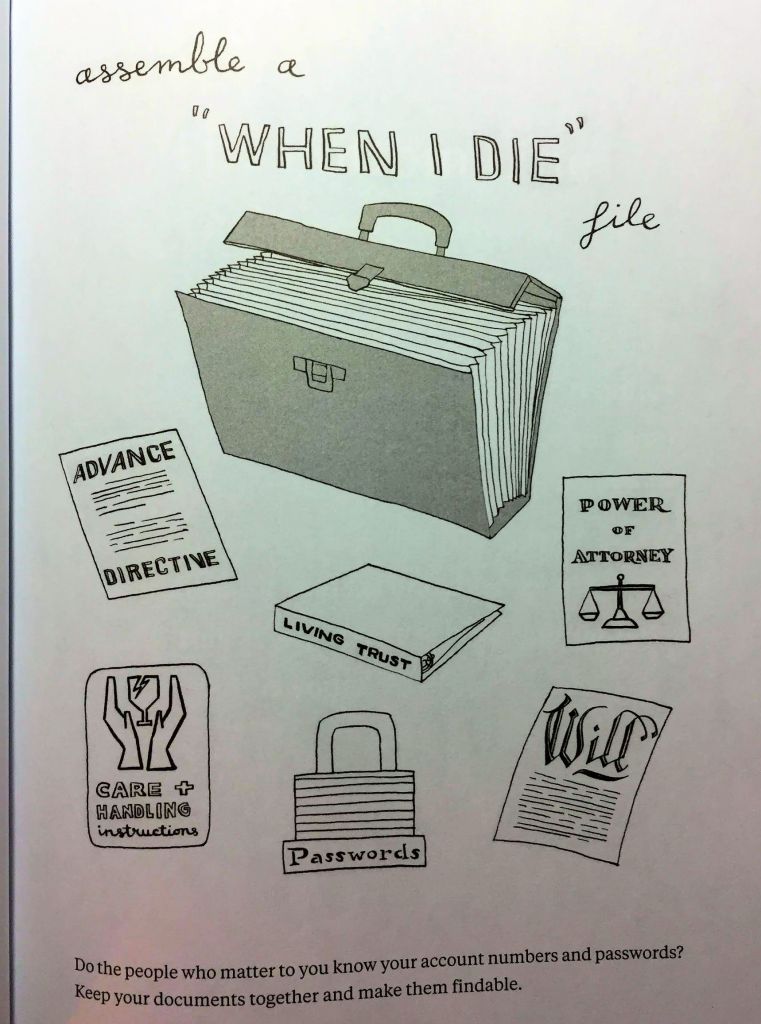
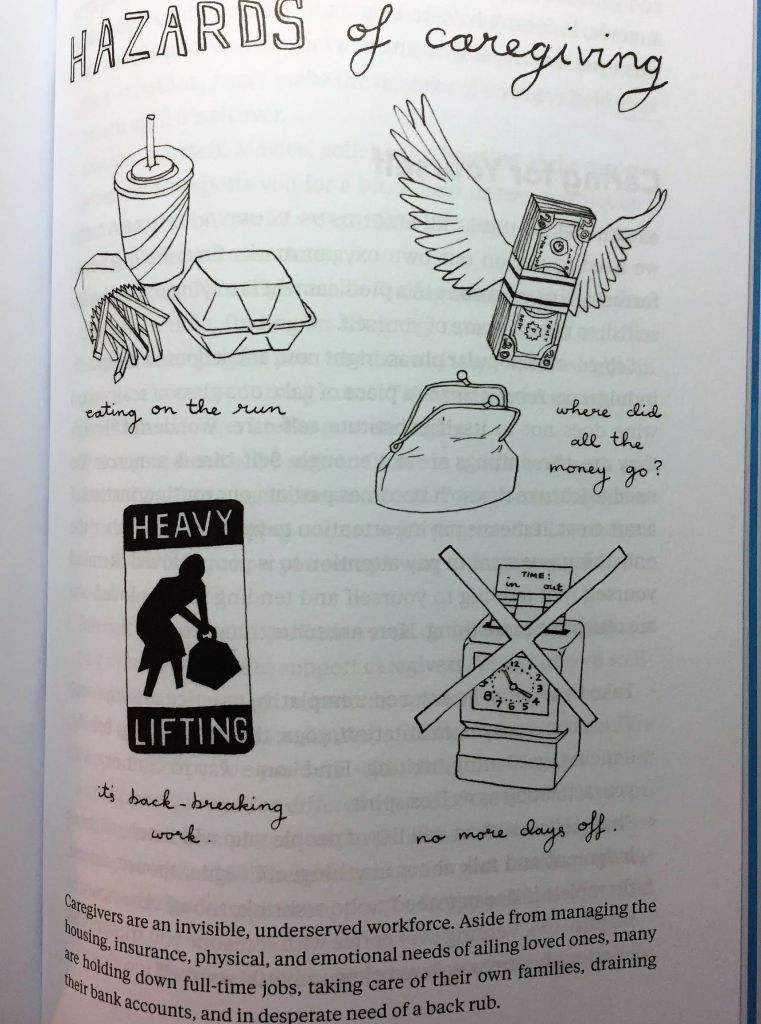
an illustration from the book

How the book unfolds

The book consists of 5 sections that mimic the progression from life to illness to death. Even as a physician, I was surprised at the claim that only 10% to 20% of us will die without warning. The rest of us will know we have something that will likely take our life. And even if we don’t, we all know we will die eventually, although we tend to think and act as if it’s a well kept secret, and maybe it is.

The sections are as follows

  • PLANNING AHEAD
  • DEALING WITH ILLNESS
  • HELP ALONG THE WAY
  • WHEN DEATH IS CLOSE
  • AFTER

Although you could read the book straight through, you might want to skip to sections you need at whatever stage you are in. Chapter titles clearly tell you what to expect from their content. Here are some examples-

  • Yes, There’s Paperwork.
  • Can I Afford to Die?
  • I’m Sick
  • Love, Sex, and Relationships
  • Hospital Hacks
  • Care for the Caregiver
  • It’s Your Body and Your Funeral
  • Grief
  • How to write a Eulogy and an Obituary
  • Celebrating a Life

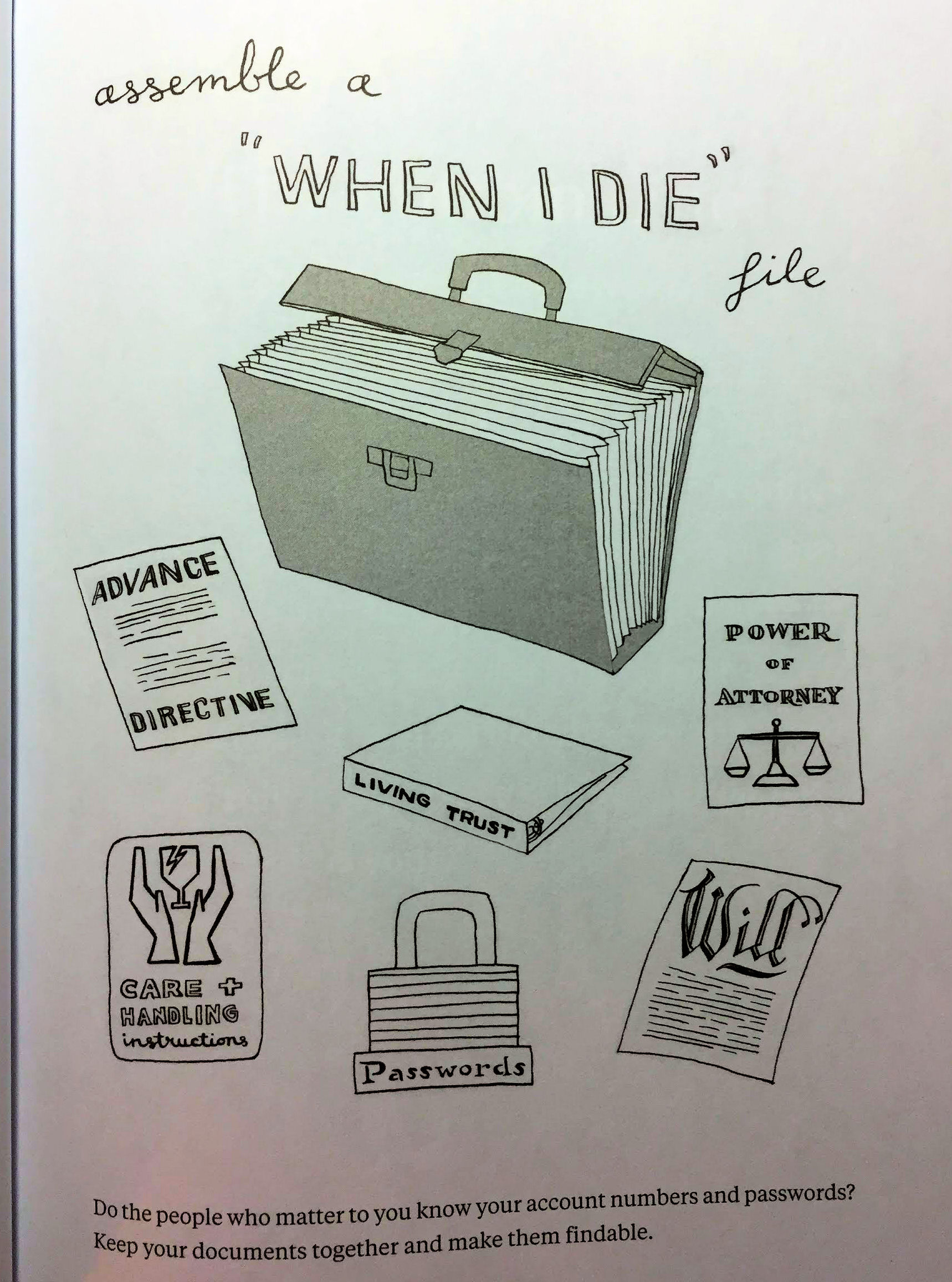
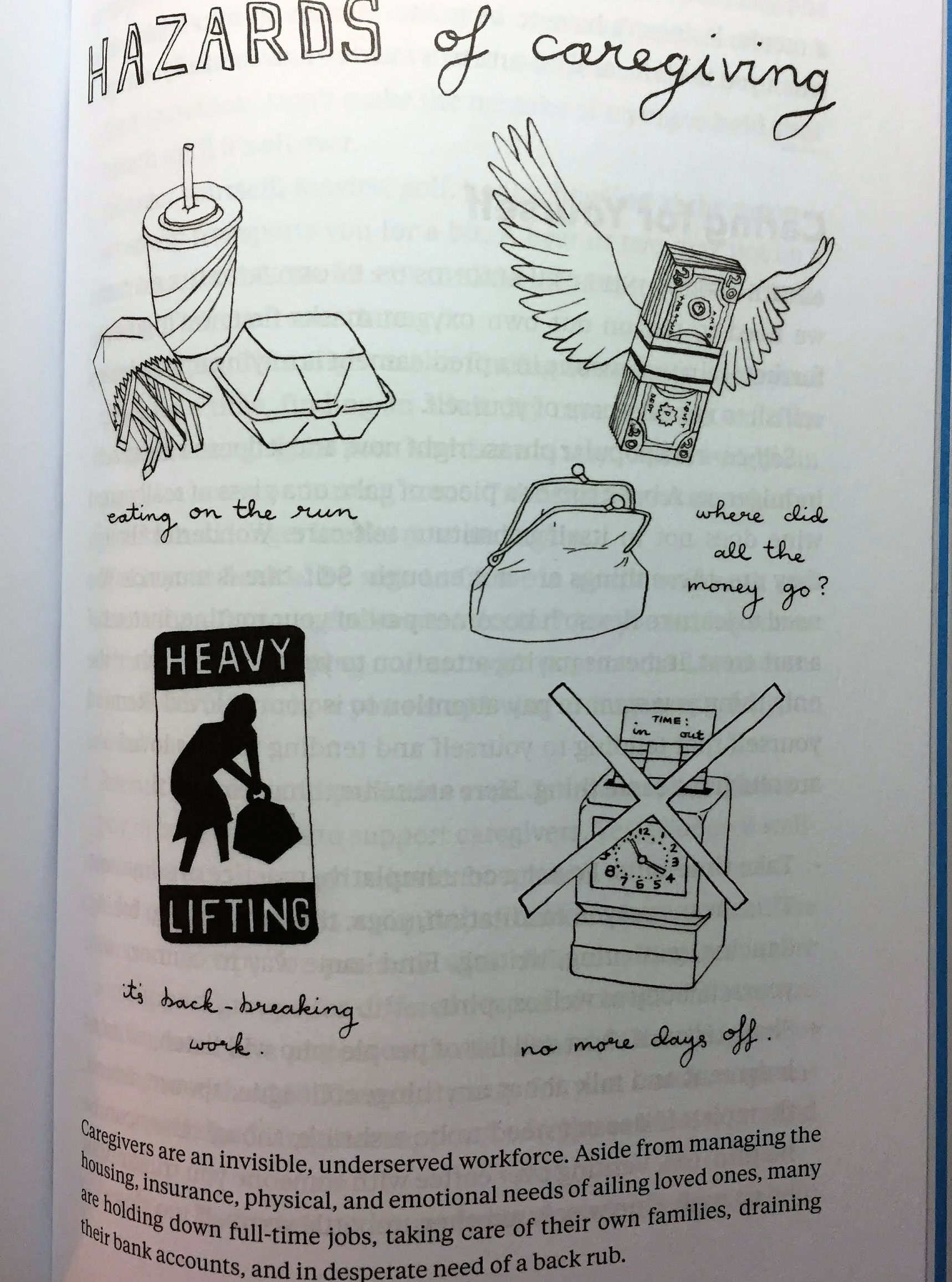
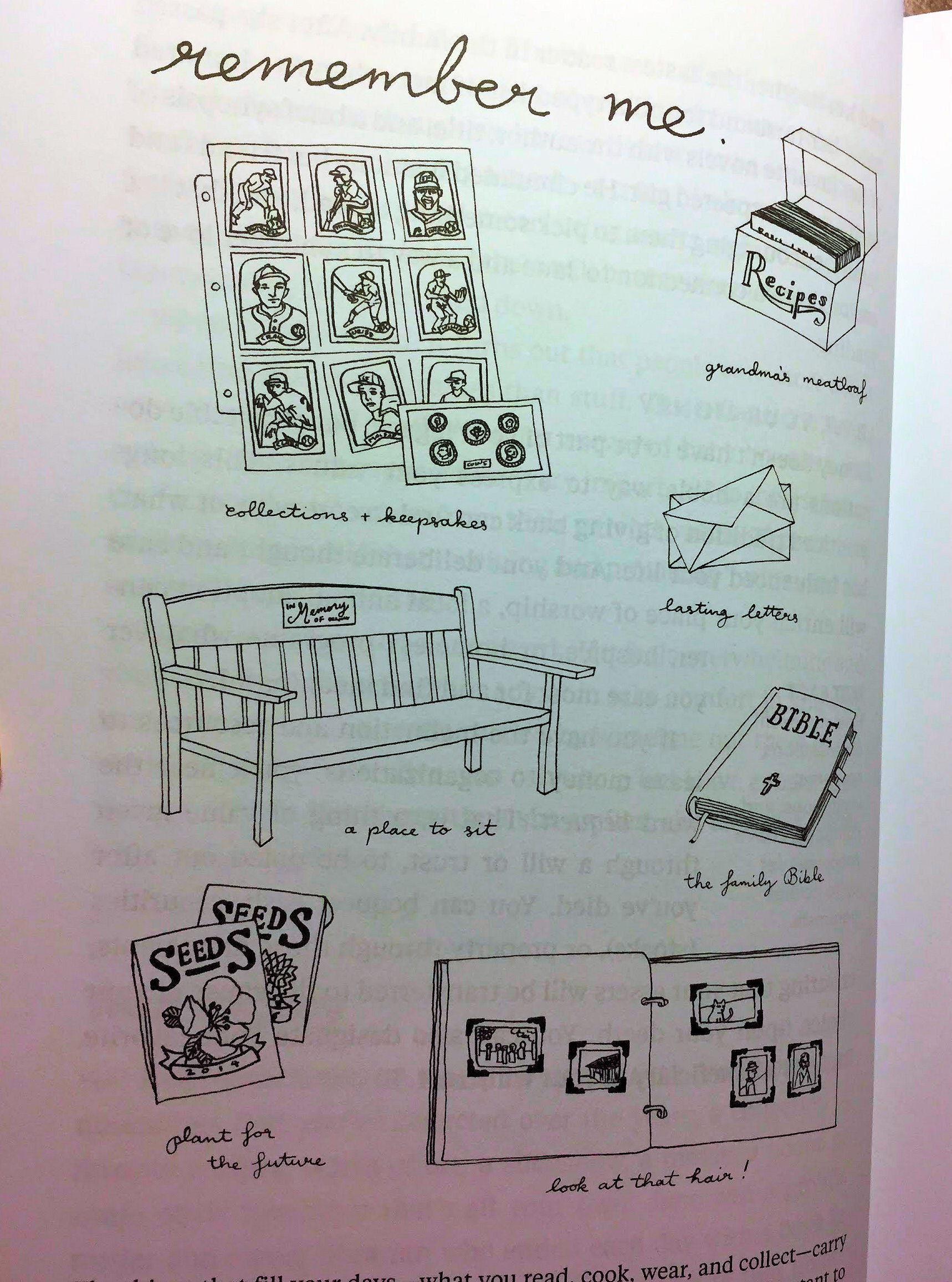
There are no photographs, charts, graphs, or info graphics, but scattered throughout are illustrative sketches that convey helpful information in a non threatening way. I have used some screenshots of a few of them to illustrate this post.

The authors conclude the book with Last Words, Acknowledgments, Resources (an extensive list), Notes, and Index.

Read this book

As much as I hope you don’t need it right now, unfortunately you do need it right now. So whatever stage of living, or dying, you or a loved one may be in, you will find something helpful here.

Find the book at your local library like I did, or get it from one of these book sellers; this would be a good book to keep on hand. (These affiliate links pay a commission to support this blog, while you pay nothing extra. )

Dr. Miller’s TED talk on WHAT REALLY MATTERS AT THE END OF LIFE

Here is another post from this blog about the dying experience

What books teach us about dying

an excerpt-

I reviewed these books  because understanding how other people and their families have faced death may relieve our dread, anxiety, or fear  about dying and death. Often it is not death itself that we fear but the dying process -the pain , disability, dependence, isolation, unfulfilled dreams.

In an essay  for JAMA, Dr. Zachary Sager, a geriatric and palliative care physician in Boston Massachusetts, described his response to  working with dying patients-

“I witnessed how people could be simultaneously resilient and fragile. I was moved by the connectedness between individuals.

I accept that death offers not only the expected reflection on life and mourning but an opportunity for a unique form of growth and healing. ”

The books I reviewed share  common themes, and events yet are each unique as are the people in them who demonstrate both resilience and fragility.

sharing the HEART of life and death

Dr. Aletha

Hell and Back-a breast cancer story

Hell & Back is a memoir by pediatric ENT (ear, nose, throat) physician Tali Lando Aronoff, M.D. who finds her perfect life upended in ways she never imagined would happen to her.

View post to subscribe to site newsletter.


The sorrows of death compassed me, and the pains of hell gat hold upon me: I found trouble and sorrow.


Psalm 116:3, KJV, public domain


Wife and mother

Just based on the title, you know this isn’t a happy story.

The main character, Tali, seems to have the perfect life. She is a pregnant young woman with a husband who adores her and two beautiful children. They have good jobs, a nice house, a nanny who is good with the kids. She has a loving and supportive extended family.

Then her father is diagnosed with an incurable brain tumor. She develops life threatening preeclampsia. She has an emergency caesarean section, delivering her baby prematurely.

Then she finds a lump in her breast. It is cancer- that has already spread.

Oh, did I tell you she is a physician with a busy surgical practice?

Hell & Back: Wife & Mother, Doctor & Patient, Dragon Slayer

by Tali Lando Aronoff, M.D.

Hell & Back is not a novel. It is a memoir by pediatric ENT (ear, nose, throat) physician Tali Lando Aronoff, M.D. who finds her perfect life upended in ways she never imagined would happen to her.

(By way of disclosure, I have never met Dr. Aronoff. After reading about her, I asked for a complimentary copy (PDF) of her book in exchange for a review. This blog post has affiliate links which will help fund this blog if a purchase is made. )

Doctor and patient

A physician’s illness can be awkward, both for us and for those who take care of us. Other doctors may assume we know more about our diseases than we do and fail to give us the same information they would give to “real” patients. We, on the other hand, often try to help them out by diagnosing ourselves, or minimizing our symptoms because we don’t want to bother them, or seem like complainers. Either approach impacts our care negatively.

But being a physician can be an advantage and it certainly was for Dr. Aronoff since she had friends who specialized in breast surgery, oncology (cancer), radiation therapy, and plastic surgery, all of which she would need. Recently out of training,  they had the most up to date knowledge in their fields. They helped her get to the right doctors, including getting appointments quickly.

But being a physician didn’t spare Dr. Aronoff pain from her mastectomy and the expanders (used to make room for eventual breast reconstruction). She still had to cope with  the debilitating side effects of chemo- fatigue, nausea,appetite loss, and hair loss- all the while caring for 3 small children.

A physician’s friends and family may assume that because we are healers, we are brave, strong, and can take care of ourselves. Dr. Aronoff found her closest friends understanding and supportive, and many went above and beyond, driving her to appointments, taking her kids to activities, and bringing meals.

“The naked truth”

When she lost her hair, she tried wearing wigs and found them uncomfortable so opted for scarves instead. This made her illness obvious, so when she went out in public people noticed her. She described becoming a “Synagogue Celebrity”, with people in her community posting sightings of her on Twitter because she “looked so good”.


“I smiled at praises..inside though, I was slipping, retreating into myself. But I didn’t dare let them see. With time and practice, I learned to navigate and embrace the dichotomy. I realized that projecting courage may not reveal the whole truth, but it’s not always a lie either.
Eventually, as the months passed, I regained my courage, I still had fight in me. So, I saved the naked truth for a handful of my trusted few.”

Daughter and doctor


Dr. Aronoff shared a poignant yet humorous moment celebrating Chanukah with her extended family while in the middle of chemotherapy that made her nauseated and weak.  She knew this would be the last time they would celebrate with her father, who had a terminal malignant brain tumor, so she made the 3 hour car trip to her parents’ home.


“In the glow of candlelight, I watched my father from the corner of my eye, burning his image onto my brain. I knew in my gut it would be the last year we’d celebrate together. We sang the ancient chant Hanerot Halalu about the miracle of the small jug of oil that burned for eight days. My family sure as hell needed some miracles these days too.”  

When the evening was over, they loaded the kids into the car for the long ride home.


“Alex (her husband) and I smiled at each other optimistically, anticipating a smooth ride back home with sleeping children. I hugged everyone goodbye and kissed my father lightly on the cheek. And just when I thought I was in the clear…(her daughter) Scarlett leaned over and vomited all over me!”


Who should read this book and why

Despite pieces of levity, this book is serious and hard hitting at times. Dr. Aronoff does not mince words, nor does she shy away from frank talk about intimate issues and raw emotions. If 4-letter words offend you, you may not want to read this book.

Dr. Aronoff’s book outlines the basics of diagnosis, staging, and treatment of breast cancer but I don’t think she intends it as a definitive patient guide. She does not imply that her experience is what other breast cancer patients should expect; rather she emphasizes that every patient’s journey may be different.

If you have had breast cancer, you may or may not identify with her experience. If you have not had cancer, her experience may motivate you to get a screening mammogram, explore your genetic risk, and consider what you can change in your lifestyle to decrease your  risk of getting breast cancer. (I’ll include some references for this at the end.)

“Dragon Slayer”

I won’t leave you hanging; this story has a happy ending. Dr. Aronoff is now disease free, and back working at her practice.She is a “survivor” but the threat of a recurrence will always loom over her. She may never know for sure if she is “cured”.

I invite you to visit her website to see photos of her before, during, and after treatment, and to read a sample chapter of her book.

Interlude-Women’s Cancer Stories

Dr. Eleonora Teplinsky talked to Dr. Aronoff for her podcast series Interlude. Listen to the interview at the above links.

Check out these breast cancer resources

Breast cancer screening

Understanding your breast cancer risk


Breast cancer is not exclusively a women’s disease, it happens to men also.

Risk factors for breast cancer in men

The Susan G. Komen Foundation offers this printable resource

Coping with a Breast Cancer Diagnosis


Informacion en espanol- Cáncer de mama

Shop To Fight Breast Cancer! Every Purchase Helps Give Free Hospital Mammograms To Women In Need!

Again thanks to Dr. Aronoff for giving me her book and sharing her story with all of us. I think we all have learned something that might help us or someone we know.

Dr. Aletha