For the Love of God-St Patrick and St Paul

Saint Patrick, born in 4th century Britain, was kidnapped to Ireland but later escaped. He returned as a missionary on March 25, 433, converting many people and establishing churches despite initial conflict with local chieftains. Saint Paul, a significant biblical writer, spread Christianity around the eastern Mediterranean, emphasizing God’s love through his letters.

Saint Patrick

Saint Patrick was not born in Ireland, although he is considered the Irish patron saint. He was born in Roman-controlled Britain in the 4th century.

Kidnapped and taken as a slave to Ireland, he later escaped but returned as a missionary, bringing the Christian Gospel to Ireland.

Patrick arrived in Slane, Ireland on March 25, 433. There are several legends about what happened next, with the most prominent claiming he met the chieftan of one of the druid tribes, who tried to kill him.

After an intervention from God, Patrick was able to convert the chieftain and preach the Gospel throughout Ireland. There, he converted many people -eventually thousands – and he began building churches across the country.

catholic.org/saints

Saint Paul

Saint Paul, the Apostle Paul, was also a missionary to the part of the Roman world surrounding the eastern Mediterranean Sea. Paul identified himself as a “slave of Jesus Christ” (Romans 1:1).

Much of the New Testament contains Paul’s writings, including the letter written to the early Christians in Rome. Today, Christians read, share, and memorize these verses, which so aptly express the foundation of our faith—God’s unchanging love.

And we know that God causes all things to work together for good to tose who love God Romans 8:28
graphic from the Lightstock.com collection, affiliate link.

“Can anything ever separate us from Christ’s love?

Does it mean he no longer loves us if we have trouble or calamity, or are persecuted, or hungry, or destitute, or in danger, or threatened with death? 

No, despite all these things, overwhelming victory is ours through Christ, who loved us.

Romans 8:35, 37, by the Apostle Paul

Greece

 These are photos from my tour of Greece, visiting the sites where the Apostle Paul started churches in the first century.


exploring the HEART of faith, hope, and love

I’d love for you to follow this blog. I share information and inspiration to help you transform challenges into opportunities for learning and growth.

Add your name to the subscribe box to be notified of new posts by email. Click the link to read the post and browse other content. It’s that simple. No spam.

I enjoy seeing who is new to Watercress Words. When you subscribe, I will visit your blog or website. Thanks and see you next time.

Dr. Aletha


The Apostle Paul wrote a letter to the church in Corinth Greece. In it he described what love truly is. It became the 13th chapter in the book of 1st Corinthians and contains these words.

faith, hope, love spelled out in wooden block letters
Faith Hope and Love, a graphic from Lightstock.com affiliate

In this review of a personal memoir, I tell you how an Irish family faced and coped with significant health challenges.

I Found My Tribe-a book review

“I Found My Tribe” by Ruth Fitzmaurice is a poignant memoir about finding community and support in the face of her husband’s motor neuron disease. Ruth navigates the complexities of caregiving, friendship, and longing for a different life, offering a glimpse into the challenges and resilience of her family.

Keep reading


What Is My Reader Rewards Club?

My Reader Rewards Club is a great way to earn free books and Bibles for yourself, friends, and family! Your journey to earning free faith-based products starts HERE.

You can also earn points when you:

(If you sign up through these links, I can earn free books that I may review for this blog.)



King, Obama, and Healthcare

Dr. Martin Luther King, Jr. was a prominent leader in the Civil Rights Movement, delivering his famous “I Have a Dream” speech during the March on Washington. Barack Obama, the first African-American U.S. President, fulfilled his promise of universal healthcare coverage with the Affordable Care Act. Steps to improve health apply to everyone, with special emphasis on African-American health issues.

updated February 8, 2024

Dr. Martin Luther King, Jr.

The Reverend Dr. King led the Civil Rights Movement in the United States from the mid-1950s until his death by assassination in 1968.

“Of all the forms of inequality, injustice in health care is the most shocking and inhumane.” — Dr. Martin Luther King, Jr. 

“In 1963, Dr. King helped lead the March for Jobs and Freedom, more commonly known as the “March on Washington,” which drew over a quarter-million people to the National Mall. It was here that he delivered his famous “I Have a Dream” speech, which cemented his status as a social change leader and helped inspire the nation to act on civil rights.” from The King Center

Barack Obama-44th U.S. President

In 2008, Democratic candidate Barack Obama ran for President of the United States and won, becoming the 44th President and the first African-American to win the office.

Former President Obama running with his dog
President Obama kept fit exercising with his dog- photo compliments Pixabay 

Obama’s Healthcare Achievement

As a candidate for president, Obama pledged to enact universal health care coverage for the country, a promise he fulfilled with the support of a Democratic Congress.

The Patient Protection and Affordable Care Act, often shortened to the Affordable Care Act (ACA), nicknamed ObamaCare, is a United States federal statute enacted by the 111th United States Congress and signed into law by President Barack Obama on March 23, 2010.


Universal Healthcare Coverage -“Obamacare”

The term “Obamacare” was first used by opponents, then embraced by supporters, and eventually used by President Obama himself. Together with the Health Care and Education Reconciliation Act of 2010 amendment, it represents the U.S. healthcare system’s most significant overhaul and expansion of coverage since  Medicare and Medicaid in 1965.


 African-American Health

To commemorate and celebrate the contributions to our nation made by people of African descent, American historian Carter G. Woodson established Black History Week. First celebrated in 1926, the week was expanded into Black History Month in 1976 as part of the nation’s bicentennial.

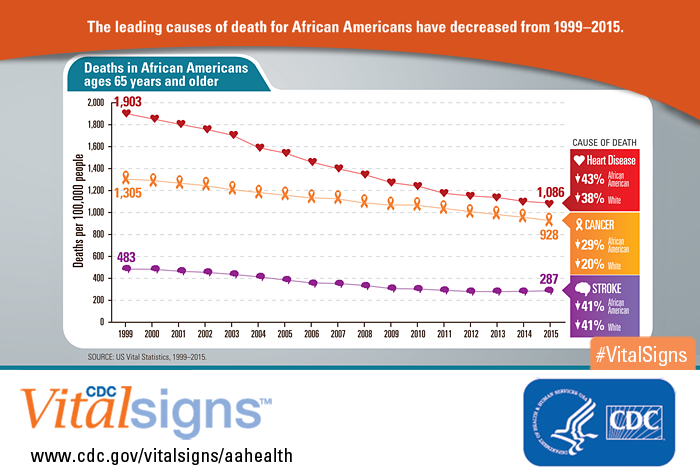
Each year, the U.S. President proclaims February as National African American History Month. Heart disease, cancer, and stroke are the leading causes of death for African Americans.

The leading causes of death for African Americans have decreased from 1999-2015.
CDC Vitalsigns

High blood pressure causes  most heart attacks and strokes in the United States. About 2 out of every 5 African American adults have high blood pressure, and less than half of them have it under control. African American adults are much more likely to suffer from high blood pressure (hypertension), heart attacks, and stroke deaths than white adults.

Cancer is the second leading cause of death among black people in the United States. Black men get and die from cancer at higher rates than men of other races and ethnicities. White women have the highest rates of getting cancer, but black women have the highest rates of dying from cancer.

Steps to Improving Health

People of any ethnic background can prevent heart disease, cancer, stroke, and other serious or chronic diseases by living a healthy lifestyle. Here’s how

  • Eat a healthy diet with fruits, vegetables, whole grains, and fat-free or low-fat milk and milk products. Choose foods low in saturated fats, cholesterol, salt (sodium), and added sugars.
  • Exercise regularly. Adults aim for 2 hours and 30 minutes (or 150 minutes total) of exercise, spread out during the week, and broken up into smaller times during the day.
  • Be smokefree. call 1-800-QUIT-NOW (1-800-784-8669) or 1-855-DÉJELO-YA (1-855-335-3569 for Spanish speakers) for free resources, including free quit coaching, a free quit plan, free educational materials, and referrals to other resources where you live.
  • Limit alcohol use, which can lead to long-term health problems, including heart disease and cancer. If you drink, do so in moderation, which is one drink a day for women and two for men.
  • Know your family history . There may be factors that could increase your risk for heart disease and stroke.
  • Manage any medical condition you might have by collaborating with healthcare professionals for best practices to control and monitor your status.


  I learned the quote on health attributed to Dr. King was never in written form, but was in an unrecorded speech. Many people verify the gist of the statement, but with some changes; he may have said “inhuman” rather than “inhumane, for example. For a discussion of this controversy, see this article by Amanda Moore.


exploring and sharing the HEART of health

I’d be honored for you to follow Watercress Words.

I’d love for you to follow this blog. I share information and inspiration to help you transform challenges into opportunities for learning and growth.

Add your name to the subscribe box to be notified of new posts by email. Click the link to read the post and browse other content. It’s that simple. No spam.

I enjoy seeing who is new to Watercress Words. When you subscribe, I will visit your blog or website. Thanks and see you next time.

  Dr. Aletha