Republicans-“Our Right to Keep and Bear Arms”

Lawful gun ownership enables Americans to exercise their God-given right of self-defense for the safety of their homes, their loved ones, and their communities

What is your chief concern about the United States right now? Is it inflation, gasoline prices, wages, schools, gun violence, access to healthcare, housing, immigration, crime, taxes,integrity in government or any number of important issues?

In the United States we are having a national election this year . We won’t elect another president until 2024 but we are electing all 435 members of the House of Representatives who serve for two years and a large number of Senators who serve for six years.

Here I start a series of blog posts that review each major party’s platform on healthcare and related issues. I take this information directly from the website of each party’s platform and include the link so you can read the complete document. This is not commentary or opinion since there’s enough of that online now; we need to inform ourselves and thoughtfully consider where we stand as individuals. I suspect most of us will be somewhere between the polarizing extremes.

Whether you are registered as a Republican, Democrat, Independent, or some other party, ultimately you will vote for a person, so I think it’s most important to study the candidates to see what they propose and promise to do. They may not agree with every part of their party’s platform, but generally will align with its values. So I read the platforms, and encourage you to do also.

Several recent episodes of gun violence at a grocery, a school, a church, and a medical office have made that issue high profile, so I’m starting with it.

Since the Republican party is in the minority in Congress, I will start with their position on gun control. In a separate post I will present the Democratic position.

The Second Amendment: Our Right to Keep and Bear Arms

(This is in section “A Rebirth of Constitutional Government”)

“We uphold the right of individuals to keep and bear arms, a natural inalienable right that predates the Constitution and is secured by the Second Amendment.

Lawful gun ownership enables Americans to exercise their God-given right of self-defense for the safety of their homes, their loved ones, and their communities.”

Republicans support

firearm reciprocity legislation to recognize the right of law-abiding Americans to carry firearms to protect themselves and their families in all 50 states

support constitutional carry statutes and salute the states that have passed them

oppose any effort to deprive individuals of their right to keep and bear arms without due process of law.

condemn frivolous lawsuits against gun manufacturers and the (past)Administration’s illegal harassment of firearm dealers

oppose federal licensing or registration of law-abiding gun owners, registration of ammunition, and restoration of the ill-fated Clinton gun ban.

call for a thorough investigation — by a new Republican administration — of the deadly “Fast and Furious” operation perpetrated by Department of Justice officials who approved and allowed illegal sales of guns to known violent criminals

(for reference, here is the text of the Second Amendment to the Constitution )

A well regulated Militia, being necessary to the security of a free State, the right of the people to keep and bear Arms, shall not be infringed.

Here is the link to the 2016 Republican Party Platform

Note: the Republican party did not write a new platform in the 2020 election year, rather affirmed the 2016 document.

exploring the HEART of health and safety

This post is dedicated to the victims of the mass shooting at the Saint Francis Natalie Building in Tulsa Oklahoma.


Stethoscope and Apple isolated on a white background

Dr Aletha

Questions and answers about monkeypox

Predominant symptoms of monkeypox include fever, rash ,enlarged lymph nodes, muscle aches, and chills. Most patients with monkeypox have a mild illness. Symptom onset is 7-13 days after exposure, but can be as long as 3 weeks.

updated October 1, 2022

Several poxviruses infect humans, ranging from the deadly smallpox to the contagious but not serious molluscum contagiosum. Now more than 30 countries, including the United States are experiencing an outbreak of monkeypox, which the World Health Organization is calling a”a public health emergency of international concern.”

What is monkeypox?

Monkeypox, an orthopoxvirus, was first isolated in the late 1950s from a colony of sick monkeys in Copenhagen Denmark. The virus is related to the variola, smallpox, and vaccinia, coxpox, viruses. The first known human case was found in the Democratic Republic of the Congo in 1970.

Where is monkeypox found?

Since routine smallpox immunization ended, most cases have occurred in Central and West Africa. Sporadic cases have been reported in several non-endemic countries, typically in returning travelers.

A person with monkeypox can spread it to others from the time symptoms start until the rash has fully healed and a fresh layer of skin has formed. The illness typically lasts 2–4 weeks

Centers for Disease Control and Prevention
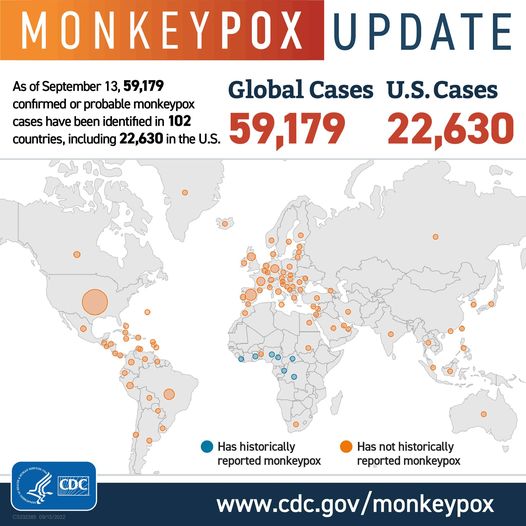
As of September 13, 2022 there are 59,000 global cases and 22,000 United States cases of monkeypox.
worldwide cases of monkeypox as of SEPTEMBER 13, 2022

How does it spread?

The virus is typically acquired through contact with an infected animal’s bodily fluids or through a bite.

Human-to-human transmission can also occur through close contact with infectious skin lesions. Direct contact with lesions that contain the virus can easily transmit the disease .

Transmission can also occur through large respiratory droplets, and prolonged face-to-face contact (eg, within 6 feet for ≥3 hours in the absence of personal protection equipment [PPE]).

What are the symptoms of monkeypox?

Onset of monkeypox infection is 5 days to 3 weeks after exposure.

Predominant symptoms of monkeypox include

  • fever,
  • rash,
  • enlarged lymph nodes,
  • sore throat,
  • muscle aches,
  • chills,
  • headache

The rash is similar to that of smallpox or chickenpox. The illness usually lasts 2 to 4 weeks.

How do doctors diagnose monkeypox?

Doctors usually suspect monkeypox based on symptoms, especially a suspicious rash. Testing is done on specimens collected by swabbing monkeypox lesions, but should only be obtained by professionals wearing appropriate PPE.

CDC is working with state and local health officials to identify people who may have been in contact with individuals who have tested positive for monkeypox, so they can monitor their health.

CDC website
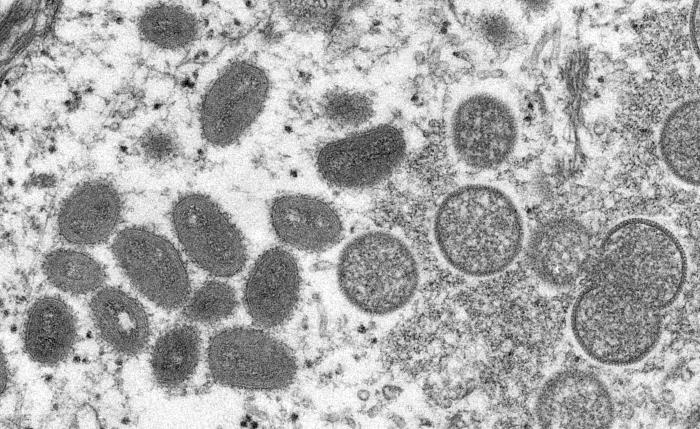
This electron microscopic (EM) image depicted a monkeypox virion, obtained from a clinical sample associated with the 2003 prairie dog outbreak. It was a thin section image from of a human skin sample. On the left were mature, oval-shaped virus particles, and on the right were the crescents, and spherical particles of immature virions.

This electron microscopic (EM) image depicted a monkeypox virion, obtained from a clinical sample associated with the 2003 prairie dog outbreak. It was a thin section image from of a human skin sample. On the left were mature, oval-shaped virus particles, and on the right were the crescents, and spherical particles of immature virions. credit CDC, Cynthia S. Goldsmith, Russell Regnery

What treatments are available?

Most patients have mild disease and recover with home supportive care, similar to influenza, COVID, and other viral infections. For the seriously ill patient, medically supervised supportive care is necessary until recovery.

The antiviral agents, tecovirimat and brincidofovir, approved for treatment of smallpox in the United States, work for monkeypox in animals and are likely to work in humans.

Can monkeypox be prevented?

When a rash is present, persons with suspected monkeypox should be considered infectious and be isolated until all scabs separate and results of testing are negative.  

Detailed information on infection control precautions to reduce transmission of monkeypox in the home is on the CDC website.

Persons with close contact with an infected animal or person should be monitored for symptoms for 21 days after their last exposure .

Detailed information on the approach to monitoring after an exposure can be found on the CDC website.

Is there a vaccine?

The JYNNEOS vaccine is approved for prevention of smallpox and monkeypox. It is the primary vaccine being used during this outbreak in the U.S.

The ACAM2000 vaccine is an alternative to JYNNEOS. It is also approved to help protect against smallpox and monkeypox.

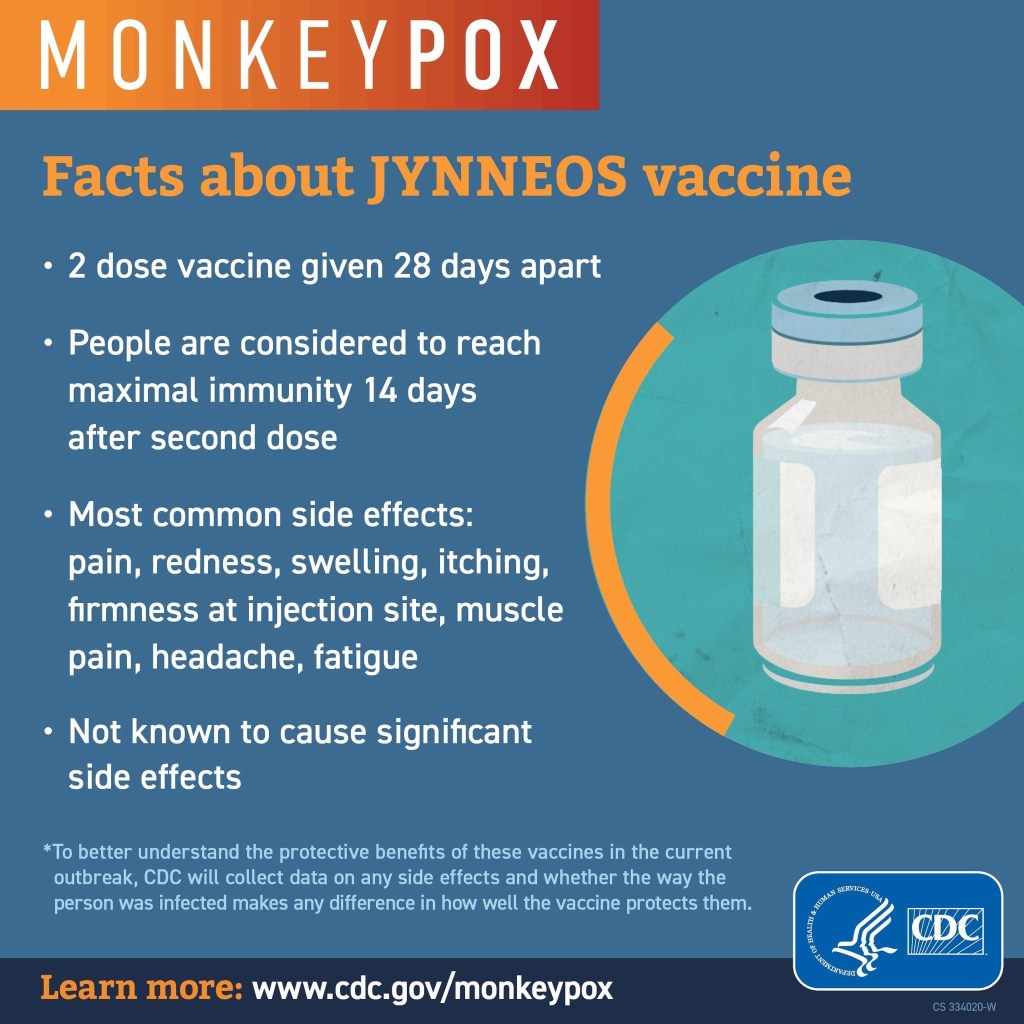
Facts about JYNNEOS vaccine 
2 dose vaccine, maximum immunity 14 days after dose 2

Is monkeypox fatal?

In Central Africa, the fatality rate is approximately 10 percent, generally in the second week of illness.

In the 2003 outbreak in the United States, none of the 34 confirmed cases died, although a few became seriously ill, requiring hospitalization.

Exploring the HEART of international health

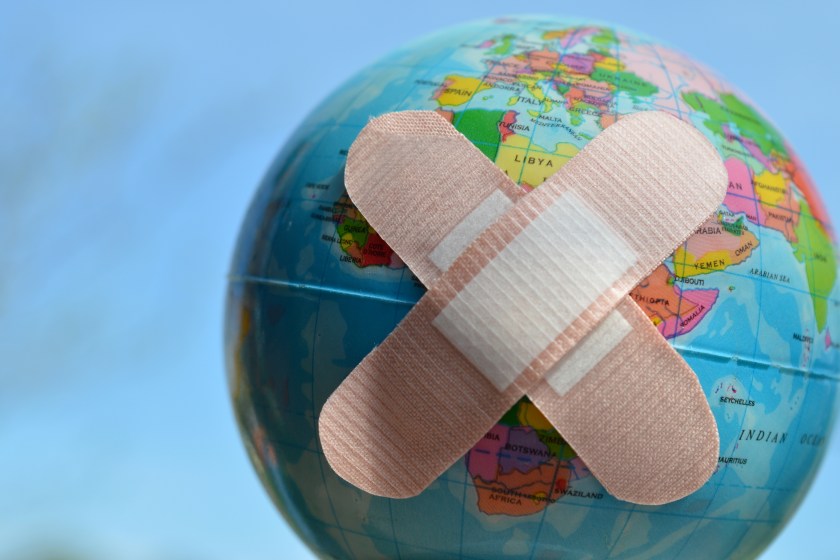
a world globe with crossed bandaids

Dr Aletha

cover image by Jerney Furman