How Congress oversees the federal health care-industrial complex is almost as byzantine as the U.S. health system itself.
Julie Kovner, KFF
This is the third in a series about the Federal government’s role in healthcare in the United States. Some of the content comes from an article at KFF by Julie Kovner, Congress, the Executive Branch, and Health Policy.
This post outlines how Congress-the House of Representatives and the Senate-oversee and fund healthcare.
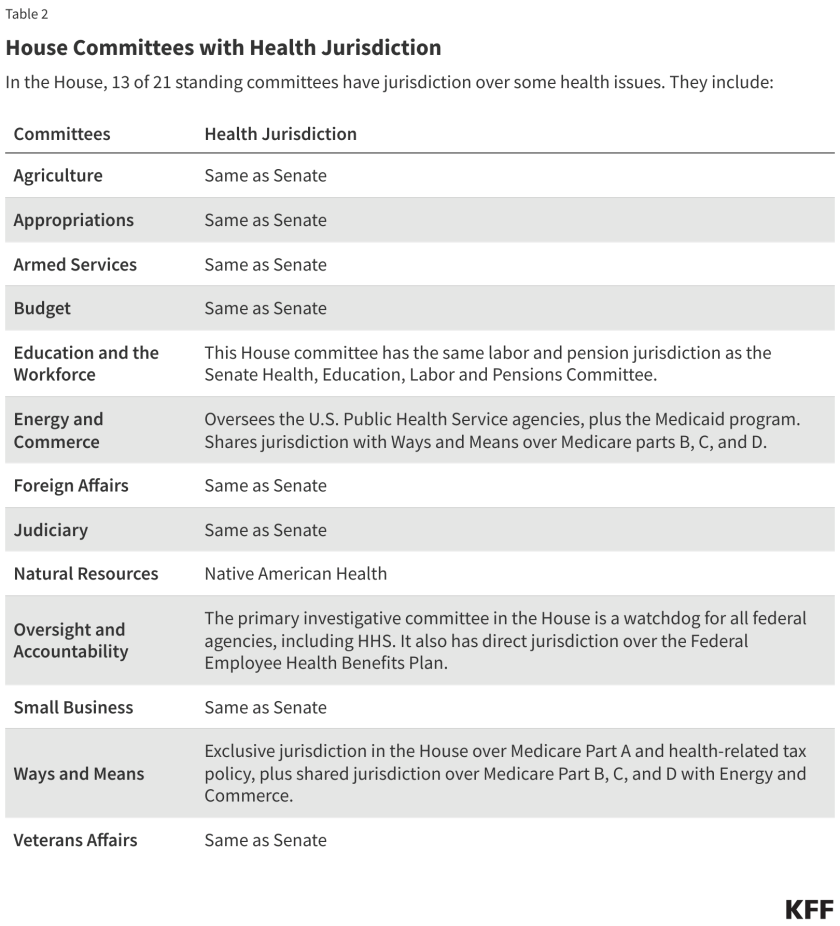
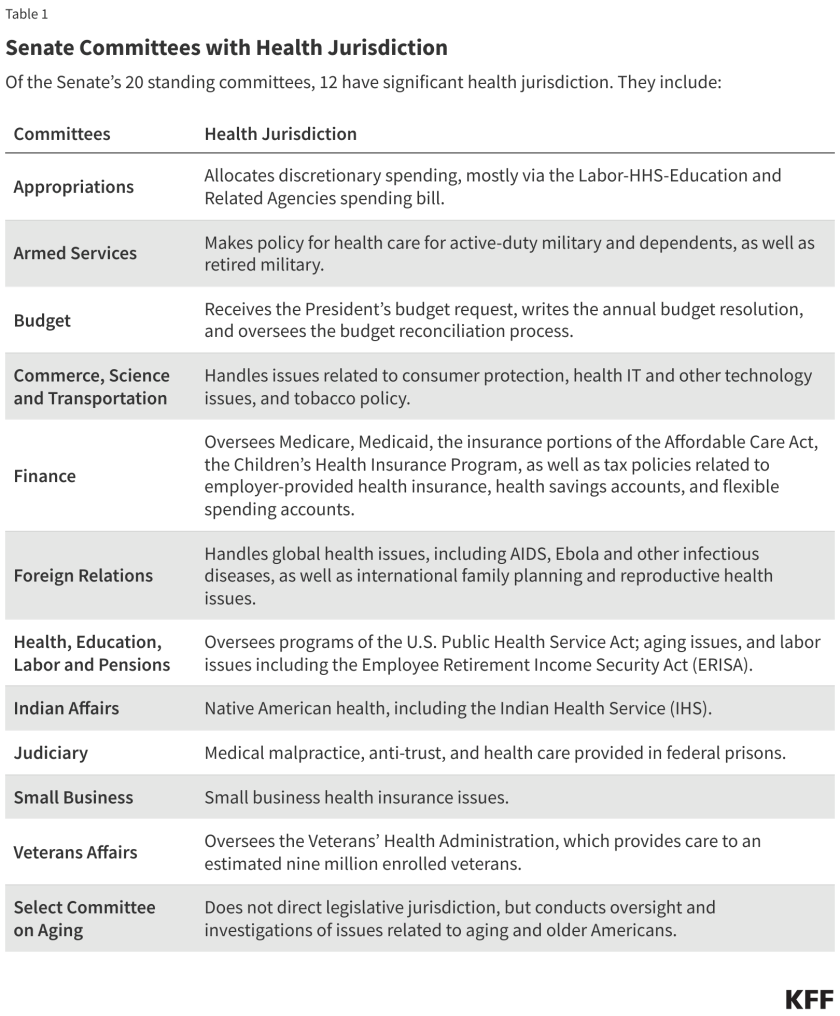
More than two dozen committees in the House and Senate have jurisdiction and responsibility for various health agencies and policies (see Tables 1 and 2 below).
Three major committees in each deal with most health issues.
The House of Representatives
(See Table 2 below)
The Ways and Means Committee, which sets
- tax policy,
- oversees Part A of Medicare (because it is funded by the Social Security payroll tax) and
- shares jurisdiction over other parts of the Medicare program with the Energy and Commerce Committee.
- oversees tax subsidies and credits for the Affordable Care Act and
- tax policy for most employer-provided insurance.
The Energy and Commerce Committee has
- sole jurisdiction over the Medicaid program in the House and
- shares jurisdiction over Medicare Parts B, C, and D with Ways and Means.
- oversees the U.S. Public Health Service, including the Food and Drug Administration, the National Institutes of Health, and the Centers for Disease Control and Prevention.
The amounts allocated for many of those programs are determined by the House Appropriations Committee through the annual Labor-Health and Human Services-Education and Related Agencies spending bill.
The Senate
(See Table 1 below)
In the Senate, responsibility for health programs is divided somewhat differently.
The Senate Finance Committee, which, like House Ways and Means, is in charge of tax policy, oversees all of Medicare and Medicaid and most of the ACA. (Affordable Care Act).
The Senate counterpart to the House Energy and Commerce Committee is the Senate Health, Education, Labor and Pensions Committee, which has jurisdiction over the Public Health Service (but not Medicare or Medicaid).
The Senate Appropriations Committee, like the one in the House, sets actual spending for discretionary programs as part of its annual Labor-HHS-Education spending bill.
Rovner, J., Congress, the Executive Branch, and Health Policy. In Altman, Drew (Editor), Health Policy 101, (KFF, January 2025) https://www.kff.org/health-policy-101-congress-and-the-executive-branch-and-health-policy/ (date accessed). 2/8/2025
Executive vs Legislative Branches
We’ve looked at the multiple agencies in the Executive branch of government that are concerned with healthcare. Similarly, multiple committees of Congress oversee these agencies and the policies that govern them.
In a later post, I’ll outline the process for developing policies and a budget to pay for them.
About the Capitol
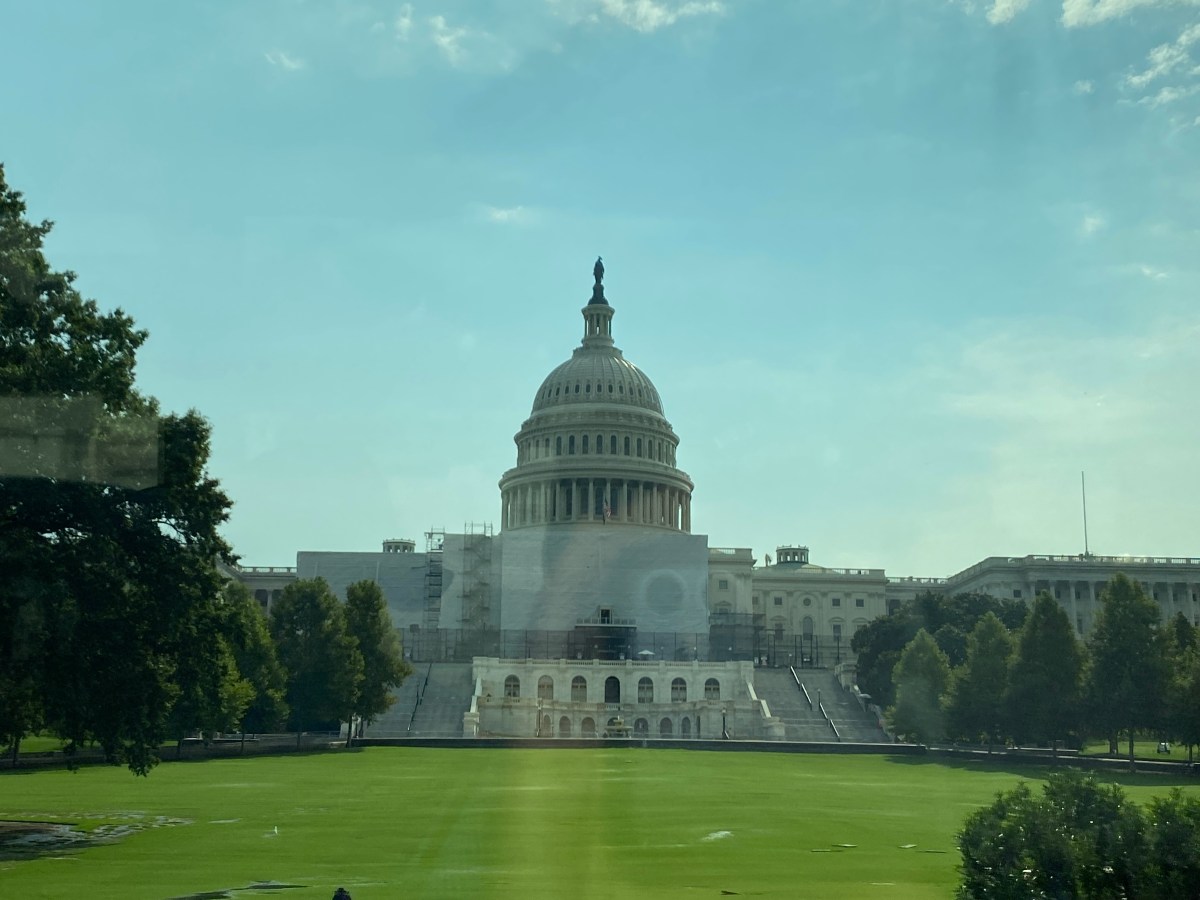
The cover photo for this post is the U.S. Capitol, the home of the Senate and House of Representatives. I took this photo while touring Washington, DC in August 2022.
“On January 6, 2021, a crowd stormed the 16-acre United States Capitol Building complex in Washington, D.C., hoping to overturn the results of the 2020 presidential election. Rioters scaled the walls and smashed the windows of the U.S. Capitol as Congress voted to certify the state-by-state results, halting the count until January 7.
The final figures for the material repair of the U.S. icon, including mental health counseling for traumatized staffers, members of Congress, and Capitol employees, came in at $30 million.
Antique period-appropriate mahogany kept by the U.S. Forest Service for 100 year was required to repair the damaged window and door frames, while another $25,000 was needed to restore six damaged sculptures and two paintings from the House’s collection.
The damages would have been much worse, notes Smithsonian Magazine, had quick-thinking staffers not worked to reverse the HVAC system and blow out the tear gas and fire extinguisher residue filling the halls of the building, while others worked to hide the House’s ceremonial silver mace from 1841 and silver inkstand from 1819.
According to (Architect of the Capitol) Blanton, the AOC had received a $300 million appropriation from Congress solely for new windows and a camera system on top of the $30 million for repairs.
Although the reinforced windows are still being designed, Blanton did point out that a number of security upgrades have already been implemented. Both interior and exterior doors have been reinforced, damaged windows have been repaired, and security kiosks and lighting around the Capitol have been upgraded, all outside of the $300 million.”
(This is quoted and edited for length from an article at The Architect’s Newspaper, January 6, 2022)
Exploring the HEART of Health
I’d love for you to follow this blog. I share information and inspiration to help you transform challenges into opportunities for learning and growth.
Add your name to the subscribe box to be notified of new posts by email. Click the link to read the post and browse other content. It’s that simple. No spam.
I enjoy seeing who is new to Watercress Words. When you subscribe, I will visit your blog or website. Thanks and see you next time.
Dr. Aletha

Dr. Aletha -at the Lincoln Memorial looking toward the Washington Monument in Washington DC
- About Dr. Aletha
- How to Use this Site
- Make Your Life Easier
- Search by Category
- Share the HEART of health
- my Reader Rewards Club
- RoboForm Password Manager

 watercress words by Dr Aletha