
Updated September 6, 2026
Labor Day
A novel by Joyce Maynard
(This post has affiliate links for commissions.)
Most of us don’t expect Labor Day weekend to change our lives. As a holiday, it doesn’t seem to have a purpose; it doesn’t celebrate or commemorate anything other than the end of summer. We use it as an excuse to take another day off from work and school.
When I saw and purchased the book, I didn’t recognize it as the book from which the movie Labor Day was made. I’m glad, because I probably would not have bought it.
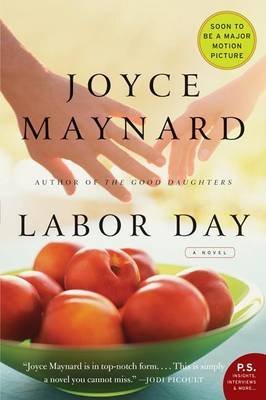
I find that reading books after the movie or vice versa is seldom satisfying. Often, characters and settings are changed so the storyline is confusing.
And invariably, the movie version leaves out much of the character development that a writer can express with words. I didn’t feel that way here. But more about that later.
(There are multiple affiliate links in this post; their use supports this blog.)
Labor Day, the characters: a woman, a man, a boy
Henry, who narrates the story, lives with his divorced mom in a small town. At 13, Henry seems more mature than he should need to be, while his mother Adele seems childish and naive for a grown woman. As the story unfolds, you wonder if Adele’s eccentric behavior is due to something more than immaturity.
Adele and Henry are in a store buying clothes for school when a man they don’t know approaches them, asking for help. Frank seems nice enough, and asking for help might not be a problem except for the fact that is is bleeding, and evasive about why.
He asks Adele to take him to her house, and either due to fear or poor judgment, she says yes. Both she and Henry seem to realize that something dramatic is about to change in their lives, but what it is, they can only guess at this point.
Labor Day– the story
As the novel progresses, we learn several story lines.
The main storyline, narrated by young Henry, tells what transpires between the three of them over Labor Day weekend. Weaving throughout are the back stories of what brought them all to this point.
Henry has reached manhood by the end of the book, at which time we learn what happened to these characters years after this memorable Labor Day weekend.
If you want to believe, or already know, that the worst of situations can have a happy ending, the final chapter will please but not surprise you.
Joyce Maynard writes in closing remarks at the end of the book,
“Maybe it’s an impossibly romantic and idealistic story. No doubt ….it would be a very poor idea for a woman to bring home a strange man, as Adele does that Thursday before Labor Day. Perhaps this book should carry a warning label: DO NOT TRY THIS AT HOME.”
How this book explores health
Health themes addressed in Labor Day are heavily weighted around sexuality so if you are uncomfortable with those this book/movie may not appeal to you.
These topics include
- Puberty and Adolescent sexuality
- Adult sexuality, both in and outside of marriage
Other health issues explored in the story include
- Pregnancy and pregnancy loss
- Emotional/mental dysfunction
- Marital dysfunction and divorce
- Childhood disability
- Trauma and death
Young Henry reflects on his feelings as Adele drove them home with Frank along.
“In the seat next to her, I studied my mother’s face, to see if her expression changed, when Frank said these things. I could feel my heart beating, and a tightness in my chest-not fear exactly, but something close, though oddly pleasurable.
I had it when my father took Richard and the baby and me, and Marjorie, to Disney World, and we got into our seats on the Space Mountain ride.
Today is my lucky day, Frank said. Yours too, maybe.
I knew right then, things were about to change. We were headed into Space Mountain now, into a dark place where the ground might give way, and you wouldn’t even be able to tell anymore where this car was taking you.
If this had occurred to my mother, she didn’t let on. She just held the wheel and stared straight ahead same as before, all the way home.”
Ms. Maynard explains that as fiction this novel’s unfolding was
“a rare occasion, where a writer imagines a world in which goodness and honorable behavior might be rewarded and love might carry the day.”
Labor Day
movie adaptation by Jason Reitman
Labor Day as a movie starred Kate Winslet as Adele and Josh Brolin as Frank.
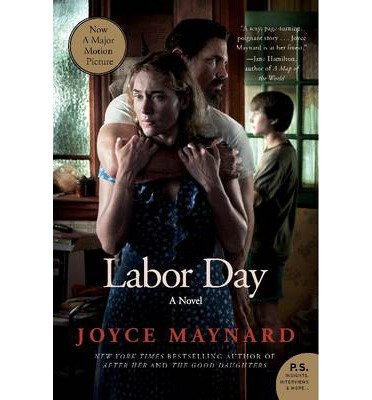
Once I started reading the book, I remembered the movie, and cannot imagine any other actress portraying Adele; Ms. Winslet aptly portrayed Adele’s quiet strength as well as her fragility .
Young Henry is solidly played by Gattlin Griffith while Tobey Maguire as the adult Henry narrates the story and then appears in the movie’s final scenes.
Josh Brolin brought the mysterious stranger to life. (By the way, his father is also an actor, James Brolin, and the singer Barbra Streisand is his step-mother.)
The movie sticks faithfully to the novel. The backstories are not developed as much as in the book which is typical with the time limitation of a movie adaptation.
See below for a spoiler alert if you’ve already read/seen the book/movie, or don’t care about learning the ending too soon.
Another unlikely romance
Labor Day reminded me of another book I read and reviewed, about the relationship between a woman, a man, and a boy. Here is my review of

Say Goodbye for Now- a book review
This post reviews Say Goodby for Now. Dr. Lucy lives alone except for the menagerie of injured animals she has doctored back to life. She likes her life the way it is, until she opens her home to three unexpected and unlikely guests. The book references important historical events.
Keep readingExploring the HEART of health
Thanks for joining me to “celebrate” Labor Day and consider an unconventional look at life and love in Joyce Maynard’s novel and movie, Labor Day. You can watch the movie on Amazon Prime.
What decision have you made that didn’t turn out as expected? What did you learn from that experience and how will it help you navigate life in the future?
Thank you for reading this post. Please follow this blog and me on social media.
I share information and inspiration to help you transform challenges into opportunities for learning and growth.
Add your name to the subscribe box to be notified of new posts by email. Click the link to read the post and browse other content. It’s that simple. No spam.
I enjoy seeing who is new to Watercress Words. When you subscribe, I will visit your blog or website. Thanks and see you next time.
Dr. Aletha

A true-life romance also from Joyce Maynard
Joyce Maynard wrote a memoir, THE BEST OF US, about her true-life romance which didn’t end as happily as her fictional one did, but did change her life forever. Here is a brief review.
Ms. Maynard’s story started with a failed marriage/bad divorce leaving adult children torn between the two parents, persistent anger and bitterness, and attempts to ease the pain with a series of bad choices in lovers, followed by a complicated adoption attempt.
Finally we can breath a sigh of relief when she meets a man and seems to have found true love at last. But that comes to an abrupt halt when he is diagnosed with cancer.
From then on she poignantly describes a life turned upside down as she enters new territory as a caregiver. As she relates how their lives changed, we as the readers are changed also, learning to recognize what is truly important in life. As the author admits,
“success, money, beauty, passion, adventure, possessions- have become immaterial. Breathing would be enough.”
Read this book if you want your assumptions about life and death to be challenged and changed.
Spoiler alert: a major plot of Labor Day
At the book’s end, Joyce Maynard wrote a final piece, “Don’t Try This at Home-How I Came to Write This Novel”, in which she explains why she chose to make an escaped convicted murderer (Frank) a main character in her novel.
Because she herself once struck up a long-distance friendship with a man in prison.
She admits,
“I resemble that impossibly romantic woman who drove a man home with her, feeling no fear for herself or her son-though the man had blood dripping down his leg-because she saw in him something of her own wounded self.”
Her convict story does “not have a happy ending” she wrote
“it taught me…to trust less and steer clear of the kind of man whose wounds on the outside may be fewer than those within.”
- About Dr. Aletha
- How to Use this Site
- Make Your Life Easier
- Search by Category
- Share the HEART of health
- my Reader Rewards Club
- RoboForm Password Manager


