It seems every month, week, and day there is an event for awareness of some condition, disease, disability or other designated group. I can’t keep track of all of them, much less observe them all, but September is designated for awareness of two conditions that I want to mention.
Childhood cancer is ,fortunately, an uncommon disease compared to other conditions but still ranks within the top 5 causes of death in children and adolescents. Because so relatively few cases occur, there has not been as much research done and therefore not as many drugs or treatments available as other diseases.
One of the first patients I cared for when I started practicing over 30 years ago was a 5 year old boy who developed a brain tumor. With treatment he lived about a year following diagnosis, leaving his parents and siblings devastated. I am sad to realize that he would now be a young man, probably with children of his own.
About 6 weeks ago, my friend’s 13 year old son was diagnosed with a form of leukemia. Both she and her husband are physicians so they are familiar with the seriousness of his illness, as well as the potential risks of the treatment. But they are fighting the disease with the best medical care available, as well as many people’s prayers,and are hopeful for a full recovery.
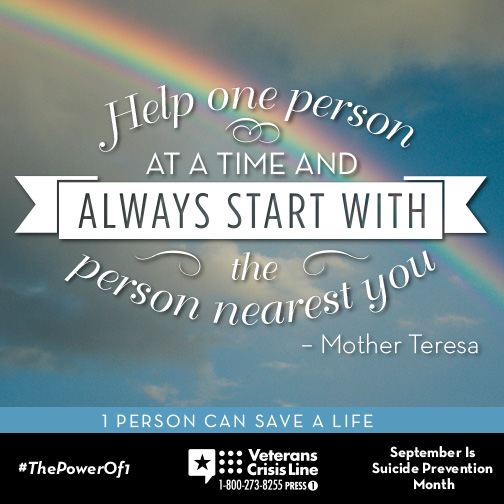
September is also recognized as Suicide Prevention Month.
Leading causes of death in the United States by age, most recent statisticsAs the chart illustrates, suicide ranks within the top ten causes of death for everyone except the youngest and the oldest of us. And like other forms of violence, suicide should be preventable.
The Veteran’s Administration has made the prevention of veteran suicide a priority. It is a tragedy that any person would cause their own death. And it is hard to understand how someone who has survived the rigors of military training and service would later want to take their own life.
My husband, a VietNam veteran, recently reached out to a young veteran whose family is concerned. While serving in Afghanistan, this soldier’s team was ambushed; one soldier was blown apart by an IED (improvised explosive device). The veteran finds it hard to talk about what happened, and has become withdrawn. My husband shared his traumatic experience in VietNam and encouraged the ex-soldier to find someone to talk to and process the feelings about what happened. And we are praying for peace and healing also.
If you know a veteran, follow this link to learn how you can recognize behavior that might lead to suicide and how you can help.
If you are a veteran, I thank you for serving our country and urge you to receive the help that you gave us; call the crisis line at 1-800-272-8255, press 1 .
Contact the veterans’ crisis line for help.This is a short post so I encourage you to visit the links which have information worth your time. And please share what you learn on your blogs, social media and email. Let’s all be “aware”- you may save a life.
Exposure to violence leads to multiple types of mental and behavioral disorders :depression, post-traumatic stress disorder, anxiety, sleep and eating disorders, substance abuse and suicide attempts. Adults who experienced childhood trauma struggle with stress due to finances, family and jobs. Abused children often commit crime as adults.
I read the newspaper article in disbelief, then grief; a family of five, parents and three children, murdered in their home in my community. Even more shocking, the assailants were their other two teen-aged children!
Things like this just don’t happen here, a suburban city that is quiet, peaceful and secure. Statistically, one of the safest cities in our state and even the country. But that doesn’t make us immune- violence can happen anywhere to anybody.
“siblings charged with first-degree murder in stabbings of family members”
I know. Two of my husband’s relatives were murdered. One of them survived multiple wounds from a vicious assault, only to die from a second attack. The other one died from an in-home attack, a case that is still open and cold- the killer has never been arrested and brought to justice.
I served as the doctor at a summer camp for children in foster care . Almost all had suffered physical abuse .
“Mother accepts plea deal, prison time for committing child neglect, abuse “
What is interpersonal violence?
The World Health Organization defines interpersonal violenceas
“the intentional use of physical force or power, threatened or actual, against another person, group or community that results in or has a high likelihood of resulting in injury, death, psychological harm, maldevelopment, or deprivation.”
The major agencies that track statistics on interpersonal violence, call it
“a pervasive public health, social and developmental threat.”
“a leading cause of death, particularly in children, adolescents and young adults.”
“Reporter, photographer shot and killed during live report”
Did you know that exposure to violence can
Cause immediate physical wounds and
Result in long-lasting mental and physical health conditions?
Violence matters because it
Directly affects health care cost and payments
Indirectly stunts economic development
Increases inequality
Erodes human capital
Violence causes physical injuries many of which are fatal or leave permanent disability. Other results include sexually transmitted infections, including HIV, and unintended pregnancy and pregnancy complications.
“Elderly woman beaten to death by two people she lived with. “
Medical effects of violence
Violence contributes to several chronic medical conditions although the exact relationship is not clear. These include heart disease, cancer, chronic lung disease (possibly due to smoking), diabetes, alcohol abuse and obesity.
“Rape charges filed against man accused of attacking pregnant woman “
Mental and emotional effects of violence
Exposure to violence leads to multiple types of mental and behavioral disorders :depression, post-traumatic stress disorder, anxiety, sleep and eating disorders, substance abuse and suicide attempts. Adults who experienced childhood trauma struggle with stress due to finances, family and jobs. Abused children often commit crime as adults.
“Teen suspected in violent crime spree arrested”
Our health care system encourages prevention, but tends to focus on the prevention of cancers, heart disease, infectious disease and dementia.
But given the far reaching consequences of interpersonal violence,preventing the resulting health problems is just as important. The multiple factors that contribute to violence makes that a daunting task.
Violence is a public health, social and political problem. Physicians, mental health professionals, teachers, and law enforcement deal with the effects in the course of our work every day.
Opportunities for prevention
The article concludes with a summary of “opportunities for prevention.” The emphasis is on starting in childhood to address the factors than can lead to violence and to focus on the family unit and schools.
What can we do to prevent violence ?
Early childhood visitation
Parenting training
School-based social-emotional learning approach
Early childhood education , Head Start as an example
Public policy; for example , addressing laws related to alcohol sales, since alcohol consumption is associated with violence
Therapeutic approaches , including CBT- cognitive behavioral therapy
“Mothers band together to protect Chicago neighborhood”
Read a true story about surviving violence
( this is an affiliate link; at no extra cost to you, this blog may receive a commission if you buy through this link; thanks.)
The astonishing story of one man’s recovery in the face of traumatic loss—and a powerful meditation on the resilience of the soul
On July 23, 2007, Dr. William Petit suffered an unimaginable horror: Armed strangers broke into his suburban Connecticut home in the middle of the night, bludgeoned him nearly to death, tortured and killed his wife and two daughters, and set their house on fire. He miraculously survived, and yet living through those horrific hours was only the beginning of his ordeal.
Broken and defeated, Bill was forced to confront a question of ultimate consequence: How does a person find the strength to start over and live again after confronting the darkest of nightmares?
In The Rising, acclaimed journalist Ryan D’Agostino takes us into Bill Petit’s world, using unprecedented access to Bill and his family and friends to craft a startling, inspiring portrait of human strength and endurance.
To understand what produces a man capable of surviving the worst, D’Agostino digs deep into Bill’s all-American upbringing, and in the process tells a remarkable story of not just a man’s life, but of a community’s power to shape that life through its embrace of loyalty and self-sacrifice as its most important values. Following Bill through the hardest days—through the desperate times in the aftermath of the attack and the harrowing trials of the two men responsible for it—The Rising offers hope that we can find a way back to ourselves, even when all seems lost.
Today, Bill Petit has remarried. He and his wife have a baby boy. The very existence of this new family defies rational expectation, and yet it confirms our persistent, if often unspoken, belief that we are greater than what befalls us, and that if we know where to look for strength in trying times, we will always find it.
Bill’s story, told as never before in The Rising, is by turns compelling and uplifting, an affirmation of the inexhaustible power of the human spirit.
reprinted from a Goodreads review
Exploring the HEART of understanding and preventing the health effects of violence
All the quotes about violent crimes that I used in this post I found in recent news headlines. They are all from true events.
please help support this blog; consider starting with the cost of a beverage
Choose an amount
$5.00
$25.00
$50.00
Or whatever works for you
$
I welcome and appreciate your support, it helps fund this blog and share the HEART of health all over the world.
Excess funds are donated to health related charities. Dr. Aletha
Shootings in the United States have resulted in numerous casualties across diverse demographics. An active shooter poses a significant threat, necessitating preparedness. The recommended response includes three strategies: RUN to safety, HIDE if escape is impossible, and FIGHT as a last resort. Prioritizing personal and collective safety is crucial.




 watercress words by Dr Aletha