Top Tips for UV Protection and Eye Health

UV Awareness Month highlights the risks of ultraviolet radiation, which can damage skin and lead to cancer. The American Academy of Dermatology advises practicing sun safety by seeking shade, wearing protective clothing, and using sunscreen. Healthy Vision Month emphasizes eye health, also by sun protection, healthy habits and smoking cessation to protect vision.

It’s UV Awareness Month!

What is UV, you ask? UV is ultraviolet radiation. We need to be aware of it because UV radiation, aka sunlight, can cause damage to human skin, including cancer.

This information is current as of the date of original publication or update. It may have changed by the time you read this. I invite you to fact-check what you read here.

This information is not intended for diagnosis or treatment. Before making health decisions, discuss with your physician or other qualified healthcare provider to decide what is right for you.

UV is the root cause of most skin cancers. The American Academy of Dermatology, AAD, encourages us to take precautions. The AAD recommends that the public #PracticeSafeSun year-round by following three simple steps while outdoors:

  • Seek shade when appropriate
  • Wear sun-protective clothing
  • Apply a broad-spectrum, water-resistant sunscreen with an SPF of 30 or higher

Here are some examples of suitable products to consider, which include affiliate links.

Healthy Vision Month

This year for Healthy Vision Month, learn why you should make eye health a priority. Protecting your overall health preserves your vision health.

UV radiation can damage eyes as well as skin. Protecting the eyes from sunlight with quality sunglasses is just as important as wearing sunscreen.

Healthy habits like eating well and being active can lower your risk for diseases and conditions that can lead to eye or vision problems, like diabetes or high blood pressure. Follow these tips for healthy vision:

  • Eat healthy foods. Include plenty of dark, leafy greens like spinach, kale, and collard greens. Eat fish that are high in omega-3 fatty acids, like salmon, tuna, and halibut.
  • Get active. Being physically active helps you stay healthy. It lowers your risk of conditions that can cause vision problems, like diabetes, high blood pressure, and high cholesterol.
  • Quit smoking. Smoking isn’t just bad for your lungs — it can hurt your eyes, too! Smoking increases your risk of macular degeneration and cataracts.

When you’re ready to quit, call 1-800-QUIT-NOW (1-800-784-8669) for free support. You can also check out the resources on Smokefree.gov

Take an Eye Health Trivia Test

Read more about sun and smoking here

Protecting Your Skin: Risks of Smoking and UV Exposure

Skin health is a significant concern for many, reflected in the multi-billion dollar skincare industry. Common skin issues can arise from lifestyle habits, notably smoking and excessive sun exposure. Smoking accelerates aging and skin diseases, while UV light causes damage and skin cancers. Preventative measures are essential for maintaining skin health.

Exploring the HEART of Health

I’d love for you to follow this blog. I share information and inspiration to help you turn health challenges into health opportunities.

Add your name to the subscribe box to be notified of new posts by email. Click the link to read the post and browse other content. It’s that simple. No spam.

I enjoy seeing who is new to Watercress Words. When you subscribe, I will visit your blog or website. Thanks and see you next time.

Use this search box for related posts on this blog or other topics of interest to you.

Dr. Aletha

Maximizing Skin Health and Beauty: Exploring Skin Care Concerns

Skin health and beauty are prominent in today’s society, driving a multi-billion dollar industry. As a family physician, I’ve seen various skin issues, some stemming from diseases, lifestyle habits, and medical conditions. Understanding skin layers and cells is helpful. Excessive sun exposure can lead to photoaging and increase the risk of skin cancer, emphasizing the need for UV protection measures.

Skin health and beauty- big business

Browse social media or news sites online and you notice skin health and appearance is a priority for most people. Sales for skin care products and services is a multi-billion dollar industry. If you’re on social media, you’ve probably seen posts from friends who are involved in direct-selling companies for skin care, maybe you are also.

As a family physician, I treated skin problems frequently. Some of them were due to skin diseases, but some resulted from lifestyle habits, other medical conditions, and even medical treatments. While some of these may be unavoidable, others are preventable.

Skin Deep- cells and layers

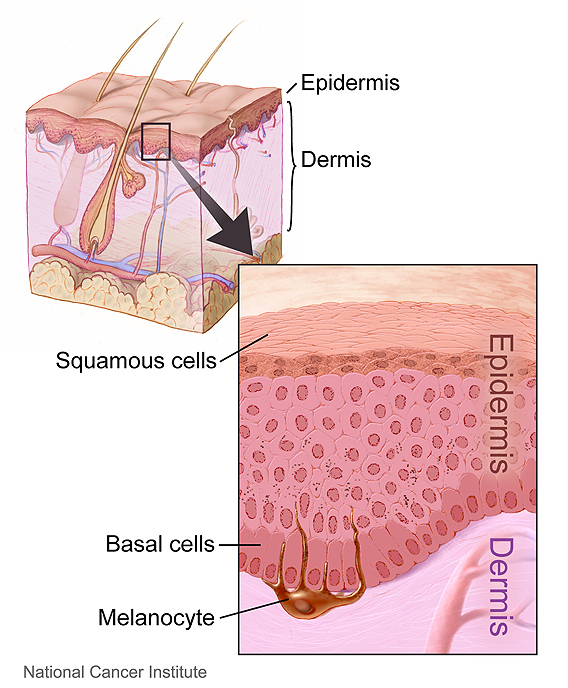
First, let’s take a deeper look at our skin, it’s more complex than you may realize. It has two layers-

the top layer, the epidermis

the lower layer, the dermis

Layers of the Skin diagram

The layers of the skin (epidermis and dermis), as well as an inset with a close-up view of the types of cells in the skin (squamous cells, basal cells, and melanocytes). Source: National Cancer Institute Creator: Don Bliss (Illustrator) This image is in the public domain and can be freely reused. Please credit the source and, where possible, the creator listed above.

Skin disease and trauma involve damage to one or both layers of the skin- the dermis or epidermis, or to the individual cells- squamous cells, basal cells, or the melanocytes-the cells with pigment that give our skin color.

Cancers can develop in any cell of the skin. Melanoma is cancer of the melanocytes.

(This photo is for illustration only and should not be used to diagnose a skin lesion. See a physician if you have a skin lesion that concerns you. )

photo of melanoma skin cancer

a melanoma skin lesion-Source: National Cancer Institute Creator: Unknown Photographer- This image is in the public domain and can be freely reused. Please credit the source

Ultraviolet light-an avoidable risk to skin health and appearance

Basking in sunlight may enhance your mood, but too much of it can damage your skin.

The signs of photo-aging are obvious to physicians-

  • yellowing of the skin complexion
  • dry and rough texture with wrinkling,
  • unevenly pigmented skin tone with dilated blood vessels.
  • stretched out
  • easy bruising

Visit this link from the Canadian Dermatology Association to see what photoaged skin looks like

Photoaging

Photoaging is premature aging of the skin caused by repeated exposure to ultraviolet radiation (UV), primarily from the sun but also from artificial UV sources, such as tanning beds. Besides aging, excess sun exposure can cause

  • Burns
  • Rash due to increased sun sensitivity when taking certain medications
  • Cancers- skin cancers are the most common type of cancer.

How to limit UV light exposure 

Learn more about the effects of sun exposure from familydoctor.org at this link.

What sun exposure does to our skin.

a cute monkey checks out his face in a mirrow

We all care about our appearance, including this cute monkey. Photo by Andre Mouton on Pexels.com

exploring the HEART of skin health

I appreciate your time and interest in exploring and sharing the HEART of health with me. And I especially appreciate your sharing my posts wherever you hang out.

I’d love for you to follow this blog. I share information and inspiration to help you turn health challenges into health opportunities.

Add your name to the subscribe box to be notified of new posts by email. Click the link to read the post and browse other content. It’s that simple. No spam.

I enjoy seeing who is new to Watercress Words. When you subscribe, I will visit your blog or website. Thanks and see you next time.

Dr. Aletha