Maximizing Skin Health and Beauty: Exploring Skin Care Concerns

Skin health and beauty are prominent in today’s society, driving a multi-billion dollar industry. As a family physician, I’ve seen various skin issues, some stemming from diseases, lifestyle habits, and medical conditions. Understanding skin layers and cells is helpful. Excessive sun exposure can lead to photoaging and increase the risk of skin cancer, emphasizing the need for UV protection measures.

Skin health and beauty- big business

Browse social media or news sites online and you notice skin health and appearance is a priority for most people. Sales for skin care products and services is a multi-billion dollar industry. If you’re on social media, you’ve probably seen posts from friends who are involved in direct-selling companies for skin care, maybe you are also.

As a family physician, I treated skin problems frequently. Some of them were due to skin diseases, but some resulted from lifestyle habits, other medical conditions, and even medical treatments. While some of these may be unavoidable, others are preventable.

Skin Deep- cells and layers

First, let’s take a deeper look at our skin, it’s more complex than you may realize. It has two layers-

the top layer, the epidermis

the lower layer, the dermis
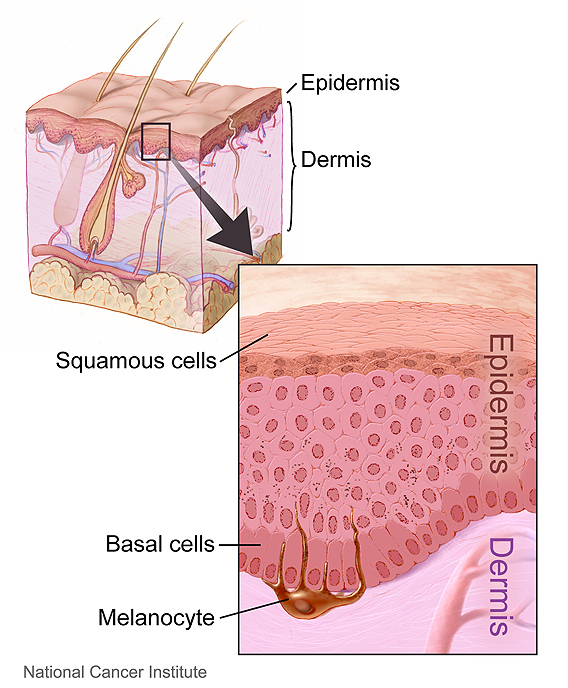
Layers of the Skin diagram

The layers of the skin (epidermis and dermis), as well as an inset with a close-up view of the types of cells in the skin (squamous cells, basal cells, and melanocytes). Source: National Cancer Institute Creator: Don Bliss (Illustrator) This image is in the public domain and can be freely reused. Please credit the source and, where possible, the creator listed above.

Skin disease and trauma involve damage to one or both layers of the skin- the dermis or epidermis, or to the individual cells- squamous cells, basal cells, or the melanocytes-the cells with pigment that give our skin color.

Cancers can develop in any cell of the skin. Melanoma is cancer of the melanocytes.

(This photo is for illustration only and should not be used to diagnose a skin lesion. See a physician if you have a skin lesion that concerns you. )

photo of melanoma skin cancer

a melanoma skin lesion-Source: National Cancer Institute Creator: Unknown Photographer- This image is in the public domain and can be freely reused. Please credit the source

Ultraviolet light-an avoidable risk to skin health and appearance

Basking in sunlight may enhance your mood, but too much of it can damage your skin.

The signs of photo-aging are obvious to physicians-

  • yellowing of the skin complexion
  • dry and rough texture with wrinkling,
  • unevenly pigmented skin tone with dilated blood vessels.
  • stretched out
  • easy bruising

Visit this link from the Canadian Dermatology Association to see what photoaged skin looks like

Photoaging

Photoaging is premature aging of the skin caused by repeated exposure to ultraviolet radiation (UV), primarily from the sun but also from artificial UV sources, such as tanning beds. Besides aging, excess sun exposure can cause

  • Burns
  • Rash due to increased sun sensitivity when taking certain medications
  • Cancers- skin cancers are the most common type of cancer.

How to limit UV light exposure 

Learn more about the effects of sun exposure from familydoctor.org at this link.

What sun exposure does to our skin.

a cute monkey checks out his face in a mirrow

We all care about our appearance, including this cute monkey. Photo by Andre Mouton on Pexels.com

exploring the HEART of skin health

I appreciate your time and interest in exploring and sharing the HEART of health with me. And I especially appreciate your sharing my posts wherever you hang out.

I’d love for you to follow this blog and follow me on social media.

I share information and inspiration to help you transform challenges into opportunities for learning and growth.

Add your name to the subscribe box to be notified of new posts by email. Click the link to read the post and browse other content. It’s that simple. No spam.

I enjoy seeing who is new to Watercress Words. When you subscribe, I will visit your blog or website. Thanks and see you next time.

Dr. Aletha

5 spring health risks you need to prepare for now

With more hours of sunlight and warmer weather you may spend more time outdoors.While that may mean greater fitness from the physical activity, you will be at risk of several outdoor injuries. Be proactive and prevent warm weather ailments with these tips.

Remember it’s Spring forward to Daylight Saving Time

Most of the United States changes to Daylight Saving Time on the second Sunday of March every year

So you will either be going to bed an hour later than usual, or awakening an hour earlier.

sleep

Either way, your body will tell the difference until your sleep cycle adjusts; I know mine always does.  WebMD offers these tips to make the change easier.

If getting a good night’s sleep is a persistent problem for you, check out the information I shared in this post.

Expert advice to sleep well every night


We welcome the  first day of Spring  in the northern hemisphere, with the occurrence of the vernal equinox which occurs around March 20 every year.

This link to The Weather Channel explains what the vernal equinox means.

graphic of the earth explaining equinox and solstice
original source not known


With more hours of sunlight and warmer weather you may spend more time outdoors.While that may mean greater fitness from the physical activity, you will be at risk of several outdoor injuries. Be proactive and prevent warm weather ailments with these tips.

insect bites and stings

Protect yourself against mosquitoes and other insects.

5 insect repellents to keep you safe this summer


sun exposure

Protect your skin with  sunscreen while you’re outside.

(These are affiliate links placed here for your convenience. This blog can earn a commission from sales from these links. This does not imply endorsement of these products.)


blisters and other wounds

Protecting your feet.

Whether walking, jogging,  gardening, or sports, our feet can take a beating from outdoor activity.

You probably don’t worry much about blisters- until you get one. Then the pain can inhibit walking, or even  wearing a shoe.

At worst, blisters can become chronic wounds, get infected, and threaten limbs in susceptible persons like those with diabetes or poor blood flow.

Ways to prevent blisters include-

  • Proper fitting shoes, not too tight or too loose
  • Breaking shoes in before activity likely to cause a blister, like running, dancing, long walks, sports
  • Wearing absorbent cushioned socks, perhaps 2 pair together
  • Applying protective padding over pressure points on the feet. Even plain paper tape can accomplish this, according to this study published in the New York Times.


I own and wear several pairs of Skechers sports shoes. (affiliate link)


environmental allergies

What to do about seasonal allergies

Often called “hay fever”, allergic rhinitis doesn’t cause a fever but it can make us miserable with its characteristic symptoms-

  • runny nose, sneezing, congestion
diagram of the nose and sinuses
Allergies commonly affect the nose, throat, sinuses, ears, and eyes.
  • scratchy, itchy, or tickly throat
  • cough
  • ear itching and pressure
  • watery, itchy, red eyes
  • Even those  people who have these symptoms year round may have seasonal exacerbations, usually spring and fall.

    Here is information about allergy management from the American College of Allergy to discuss with your doctor.

    Seasonal Allergies

    exploring the HEART of health this spring

    Thank you for  viewing  the advertisements and using the affiliate links  that fund this blog; with your  help, we can grow, reach more people, and support worthy causes that bring health and wholeness to people around the world.


    Dr. Aletha


    5 spring health risks you need to prepare for now- watercresswords.com