updated June 14, 2025
In other posts, I’ve discussed the roles of the President and Congress in healthcare. We looked at the healthcare agencies under the Executive branch and the Congressional committees that oversee these agencies.
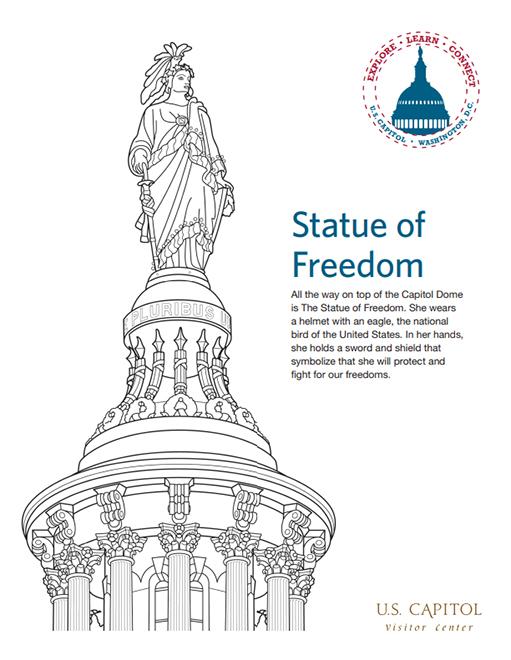
This post shares how regulations are created and a simple outline of how a bill becomes law, from the U.S. Capitol website.
In this post, I also introduce you to the Library of Congress. As with any library, the Library of Congress has a librarian. The Librarian of Congress is appointed by the President and serves for 10 years. The position is considered nonpolitical and nonpartisan.
When I wrote this post, I didn’t anticipate the current Librarian would be fired three months later. Dr. Carla Hayden had another year to serve when she received an email addressed “Dear Carla”, terminating her position. Read further in this post to learn about this distinguished public servant.
How Congress Makes Laws
There are many different ways, both simple and complex, in which a bill becomes law. One way in which this happens is:
- A member of Congress introduces a bill into his or her legislative chamber.
- The presiding officer of that chamber refers the proposed legislation to one or more committees, depending on its subject.
- Committee members review the bill and decide whether to hold public hearings, to combine it with related draft legislation, to propose amendments, to recommend that the chamber in which it was introduced consider it favorably, or to set it aside for possible later review.
- If the committee, or committees, return the bill to the chamber of the body in which it was introduced, members debate the measure and may consider further amendments.
- The bill is then considered by the full chamber. If it passes, the measure is referred to the other chamber, where this process begins anew.
- When a majority in the House, and in the Senate, agree the bill should become law, it is signed and sent to the president.
- The president may sign the act of Congress into law, or he may veto it.
- Congress can then override the president’s veto by a two-thirds vote of both the House and Senate thereby making the vetoed act a law.
A (Very Brief) Explanation of the Regulatory Process
by Julie Rovner, KFF
Congress writes the nation’s laws but doesn’t account for every detail in legislation. So, it often leaves key decisions about interpretation and enforcement to the various executive departments.
Those departments write (and often rewrite) rules and regulations according to a very stringent process laid out by the 1946 Administrative Procedure Act (APA). The APA is intended to keep the executive branch’s decision-making transparent and to allow public input into how laws are interpreted and enforced.
Proposed Rulemaking
Most federal regulations use the APA’s “informal rulemaking” process, also known as “notice and comment rulemaking,” which consists of four main parts:
- Publication of a “Notice of Proposed Rulemaking (NPRM)” in the Federal Register, a daily publication of executive branch activities.
- Solicitation to the public to submit written comments for a specific period (usually from 30 to 90 days).
- Agency consideration of public reaction to the proposed rule; and, finally
- Publication of a final rule, with an explanation including how the agency took the public comments into account and what changes were made from the proposed rule. Final rules also include an effective date, which can be from 30 days to more than a year in the future.
When time is of the essence, federal agencies may truncate that process by issuing “interim final rules,” which can take effect even before the public has chance to comment. Such rules may or may not be revised later.
Not all federal interpretation of laws uses the APA’s specified regulatory process. Federal officials also distribute guidance, agency opinions, or “statements of policy.”
Future Outlook
Given how fragmented health policy is in both Congress and the executive branch, it should not be a surprise that major changes are difficult and rare.
Add to that an electorate divided over whether the federal government should be more involved or less involved in the health sector, and huge lobbying clout from various interest groups whose members make a lot of money from the current operation of the system, and you have a prescription for inertia.
One potential wildcard—in June of 2024, the Supreme Court overturned a 40-year-old precedent, known as “Chevron deference,” that gave the benefit of the doubt in interpreting ambiguous laws passed by Congress to federal agencies rather than judges. Overturning Chevron will likely make it easier for outsiders to challenge federal agency actions, but it will be some time before the full ramifications become clear.
Another problem is that when a new health policy can dodge the minefield of obstacles to become law, it almost by definition represents a compromise that may help it win enough votes for passage, but is more likely to complicate an already byzantine system further.
Unless the health system completely breaks down, it seems unlikely that federal policymakers will be able to move the needle very far in either a conservative or a liberal direction.
Now that both the Presidency and Congress are Republican-controlled, I wonder if “major changes” may occur more easily. Will there be less need for compromise with a Congress controlled by one party? Dr. Aletha
Rovner, J., Congress, the Executive Branch, and Health Policy. In Altman, Drew (Editor), Health Policy 101, (KFF, January 2025) https://www.kff.org/health-policy-101-congress-and-the-executive-branch-and-health-policy/ (March 1, 2025).
KFF’s website content is licensed under a Creative Commons Attribution-NonCommercial-NoDerivatives 4.0 International (CC BY-NC-ND 4.0) license that allows for the sharing of their content with attribution.
The Library of Congress
The Library of Congress is the largest library in the world, with millions of books, films and video, audio recordings, photographs, newspapers, maps and manuscripts in its collections. The Library was founded in 1800, making it the oldest federal cultural institution in the nation.
On August 24, 1814, British troops burned the Capitol building (where the Library was housed) and destroyed the Library’s core collection of 3,000 volumes. On January 30, 1815, Congress approved the purchase of Thomas Jefferson’s personal library of 6,487 books for $23,950.
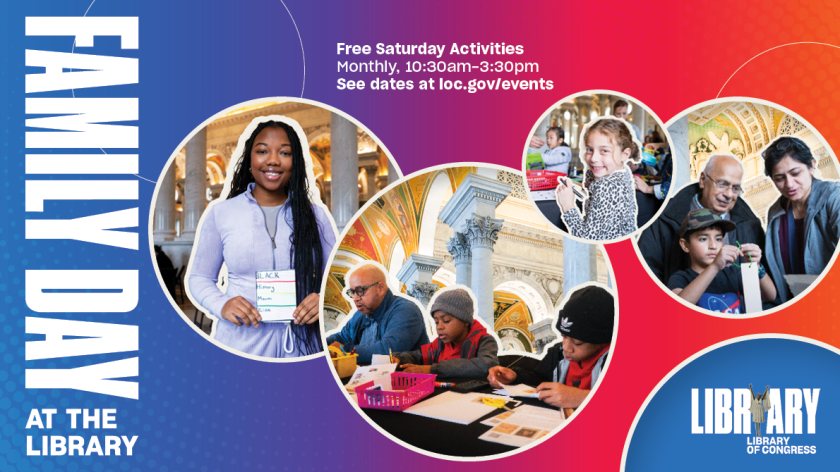
The Library is the main research arm of the U.S. Congress and the home of the U.S. Copyright Office. Each working day the Library receives some 15,000 items and adds more than 10,000 items to its collections.
The cover photo for this post is from the Library of Congress website.
Since 1931, the Library has provided books to the blind in braille and on sound recordings. The National Library Service for the Blind and Print Disabled has replaced its inventory of recordings on audio cassettes with newly developed Digital Talking Books and digital playback equipment.
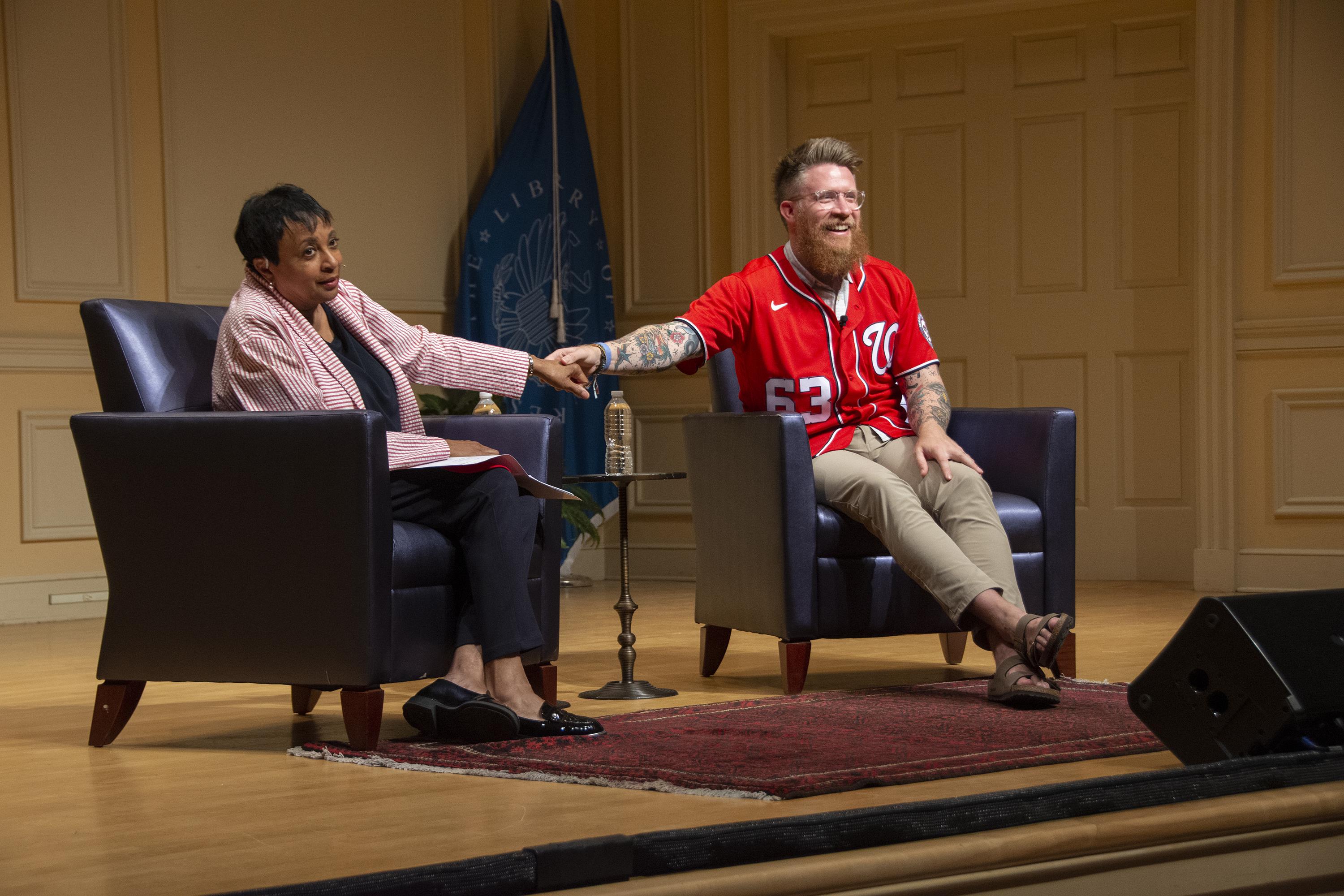
Dr. Carla Hayden, Librarian of Congress
Carla Hayden was sworn in as the 14th Librarian of Congress on September 14, 2016. Dr. Hayden, the first woman and the first African American to lead the National Library, was nominated by President Barack Obama on February 24, 2016, and confirmed by the U.S. Senate.
“Her vision for America’s national library, connecting all Americans to the Library of Congress, redefined and modernized the Library’s mission:
to engage, inspire, and inform Congress and the American people with a universal and enduring source of knowledge and creativity.
During her tenure, Dr. Hayden prioritized efforts to make the Library and its unparalleled collections more accessible to the public.
Through her social media presence, events, and activities, she introduced new audiences to many of the Library’s treasures – from Frederick Douglass’ papers, to the contents of President Abraham Lincoln’s pockets on the night of his assassination, to James Madison’s crystal flute made famous by Lizzo.
By investing in information technology infrastructure and digitization efforts, she enabled the American people to explore, discover, and engage with this treasure trove of America’s stories maintained by the Library of Congress, even if they never visit the Library’s buildings in and around Washington, D.C.”
Previously, Dr. Hayden was the CEO of the Enoch Pratt Free Library in Baltimore, Maryland. She was the deputy commissioner and chief librarian of the Chicago Public Library, an assistant professor of library and information science at the University of Pittsburgh, and library services coordinator for the Museum of Science and Industry in Chicago. She began her career with the Chicago Public Library as the young adult services coordinator and as a library associate and children’s librarian.
source, Library of Congress website, accessed June 14, 2025, edited slightly for length
Exploring the HEART of Health
Thank you for reading this post. Please follow this blog and me on social media.
I share information and inspiration to help you transform challenges into opportunities for learning and growth.
Add your name to the subscribe box to be notified of new posts by email. Click the link to read the post and browse other content. It’s that simple. No spam.
I enjoy seeing who is new to Watercress Words. When you subscribe, I will visit your blog or website. Thanks and see you next time.
Dr. Aletha
Use this search box to find other posts on this topic or any other you want information about.
- About Dr. Aletha
- How to Use this Site
- Make Your Life Easier
- Search by Category
- Share the HEART of health
- my Reader Rewards Club
- RoboForm Password Manager