How Congress Regulates the U.S. Healthcare System

Here we look at how Congress oversees the federal healthcare system through two dozen committees in the House and Senate. Key committees include the House Ways and Means and Energy and Commerce, alongside the Senate Finance and Health, Education, Labor and Pensions Committees. They manage Medicare, Medicaid, and health policy funding.

How Congress oversees the federal health care-industrial complex is almost as byzantine as the U.S. health system itself.

Julie Kovner, KFF

This is the third in a series about the Federal government’s role in healthcare in the United States. Some of the content comes from an article at KFF by Julie Kovner, Congress, the Executive Branch, and Health Policy.

This post outlines how Congress-the House of Representatives and the Senate-oversee and fund healthcare.

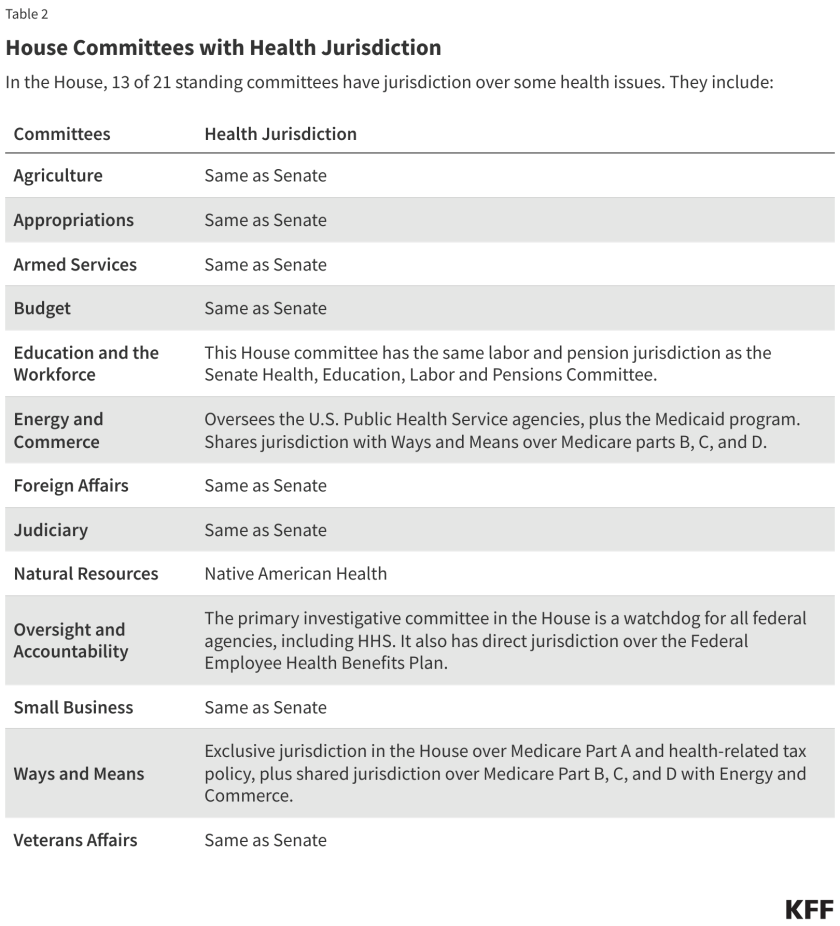
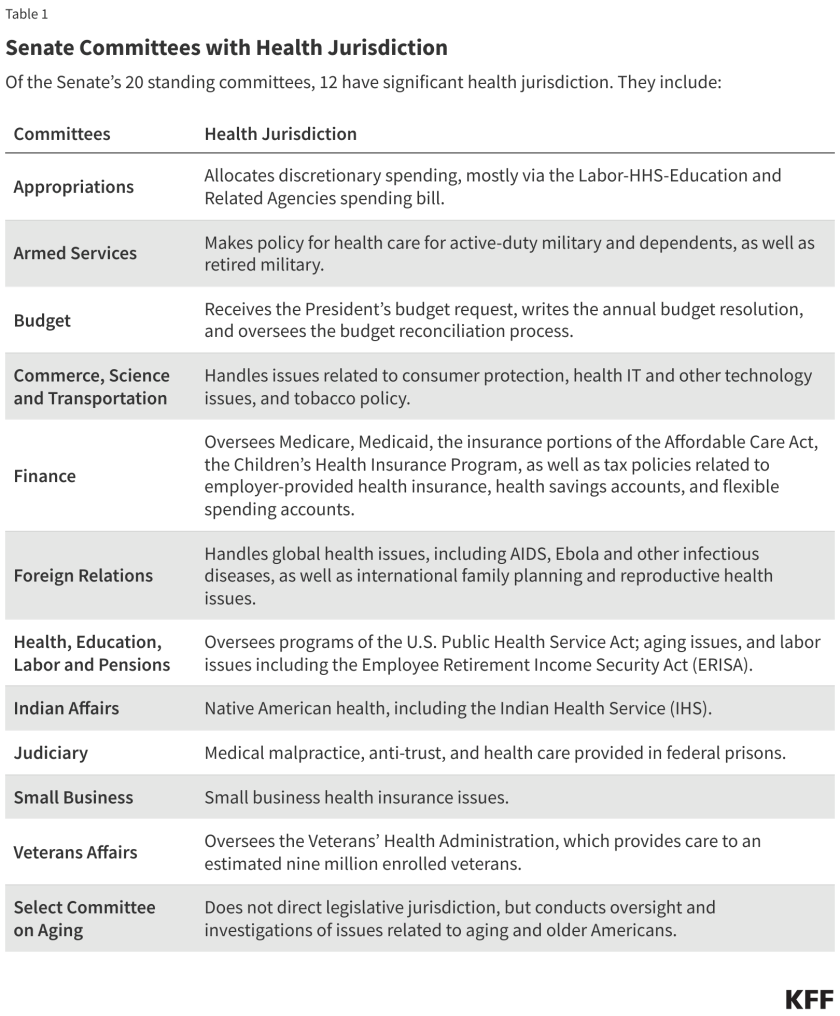
More than two dozen committees in the House and Senate have jurisdiction and responsibility for various health agencies and policies (see Tables 1 and 2 below).  
The seal of the United States Congress
PRINTABLE AVAILABLE AT VISITTHECAPITOL.GOV

Three major committees in each deal with most health issues.   

The House of Representatives

(See Table 2 below)

The  Ways and Means Committee, which sets

  • tax policy,
  • oversees Part A of Medicare (because it is funded by the Social Security payroll tax) and
  • shares jurisdiction over other parts of the Medicare program with the Energy and Commerce Committee.
  • oversees tax subsidies and credits for the Affordable Care Act and
  • tax policy for most employer-provided insurance.  

The Energy and Commerce Committee has

  • sole jurisdiction over the Medicaid program in the House and
  • shares jurisdiction over Medicare Parts B, C, and D with Ways and Means.
  • oversees the U.S. Public Health Service, including the Food and Drug Administration, the National Institutes of Health, and the Centers for Disease Control and Prevention.   

The amounts allocated for many of those programs are determined by the House Appropriations Committee through the annual Labor-Health and Human Services-Education and Related Agencies spending bill.   
The Senate

(See Table 1 below)

In the Senate, responsibility for health programs is divided somewhat differently.

The Senate Finance Committee, which, like House Ways and Means, is in charge of tax policy, oversees all of Medicare and Medicaid and most of the ACA. (Affordable Care Act).  

The Senate counterpart to the House Energy and Commerce Committee is the Senate Health, Education, Labor and Pensions Committee, which has jurisdiction over the Public Health Service (but not Medicare or Medicaid).   

The Senate Appropriations Committee, like the one in the House, sets actual spending for discretionary programs as part of its annual Labor-HHS-Education spending bill.  
Rovner, J., Congress, the Executive Branch, and Health Policy. In Altman, Drew (Editor), Health Policy 101, (KFF, January 2025) https://www.kff.org/health-policy-101-congress-and-the-executive-branch-and-health-policy/ (date accessed). 2/8/2025

Executive vs Legislative Branches

We’ve looked at the multiple agencies in the Executive branch of government that are concerned with healthcare. Similarly, multiple committees of Congress oversee these agencies and the policies that govern them.

In a later post, I’ll outline the process for developing policies and a budget to pay for them.

About the Capitol

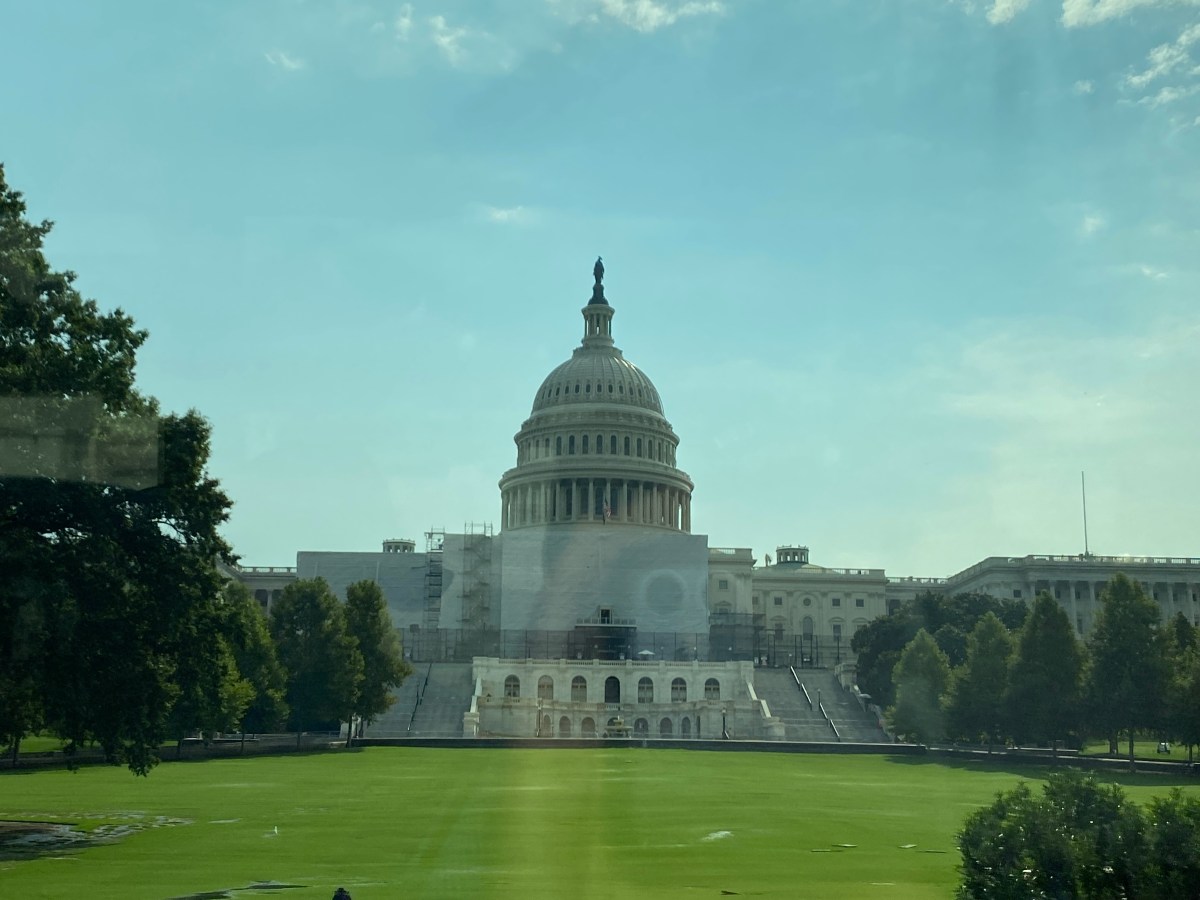
The cover photo for this post is the U.S. Capitol, the home of the Senate and House of Representatives. I took this photo while touring Washington, DC in August 2022.

“On January 6, 2021, a crowd stormed the 16-acre United States Capitol Building complex in Washington, D.C., hoping to overturn the results of the 2020 presidential election. Rioters scaled the walls and smashed the windows of the U.S. Capitol as Congress voted to certify the state-by-state results, halting the count until January 7.

The final figures for the material repair of the U.S. icon, including mental health counseling for traumatized staffers, members of Congress, and Capitol employees, came in at $30 million.

 Antique period-appropriate mahogany kept by the U.S. Forest Service for 100 year was required to repair the damaged window and door frames, while another $25,000 was needed to restore six damaged sculptures and two paintings from the House’s collection.

The damages would have been much worse, notes Smithsonian Magazine, had quick-thinking staffers not worked to reverse the HVAC system and blow out the tear gas and fire extinguisher residue filling the halls of the building, while others worked to hide the House’s ceremonial silver mace from 1841 and silver inkstand from 1819.

According to (Architect of the Capitol) Blanton, the AOC had received a $300 million appropriation from Congress solely for new windows and a camera system on top of the $30 million for repairs.

Although the reinforced windows are still being designed, Blanton did point out that a number of security upgrades have already been implemented. Both interior and exterior doors have been reinforced, damaged windows have been repaired, and security kiosks and lighting around the Capitol have been upgraded, all outside of the $300 million.”

(This is quoted and edited for length from an article at The Architect’s Newspaper, January 6, 2022)

Exploring the HEART of Health

I’d love for you to follow this blog. I share information and inspiration to help you turn health challenges into health opportunities.

Add your name to the subscribe box to be notified of new posts by email. Click the link to read the post and browse other content. It’s that simple. No spam.

I enjoy seeing who is new to Watercress Words. When you subscribe, I will visit your blog or website. Thanks and see you next time.

Dr. Aletha

Dr. Aletha -at the Lincoln Memorial looking toward the Washington Monument in Washington DC

How the President Shapes Federal Health Programs

This post, part two of a series, outlines the extensive role of the federal government in U.S. health policy, primarily through the Department of Health and Human Services (HHS). It discusses the executive branch’s involvement in health regulation, funding, and policy formation, emphasizing the significance of HHS programs and leadership roles.

This is the second post in a series helping us understand the federal government’s role in health policy in the United States. In short, its role is extensive and expensive. You can read the first post here.

The Constitution does not specifically say the government controls or provides healthcare. The Preamble hints with “promote the general welfare”.

Considering how basic and unorganized medical science was in the late 18th century, it’s not surprising they did not consider it in the plans for the new government.

I am publishing a series of posts based on

Congress and the Executive Branch and Health Policy

by Julie Jovner at KFF, an independent source for health policy research, polling, and news, an endowed national nonprofit organization.

Ms. Jovner’s article explains how the three branches of government work together, why the Department of Health and Human Services (and therefore its Secretary) is so important, and the budgeting and regulation processes.

This series is nonpartisan and objective. I made minimal edits to improve readability but retain meaning. I insert comments in parentheses to add clarity.

The photos are for illustration only and are not in the KFF article.

The Executive Branch

This post focuses on the executive branch of government, The White House including the President and his Cabinet, especially the Secretary of the Department of Health and Human Services.

The President

The executive branch carries out the laws made by Congress and operates the federal health programs, often filling in details Congress has left out through rules and regulations.

Federal workers in the health arena provide direct patient care, regulate how others provide care, set payment rates and policies, conduct medical or health systems research, regulate products sold by the private sector, and manage the billions of dollars the federal government spends on the health-industrial complex.   

Although most of the executive branch’s health policies are implemented by the Department of Health and Human Services (and to a smaller extent, the Departments of Labor and Justice), over the past several decades the White House itself (through the President) has taken on a more prominent role in policy formation.

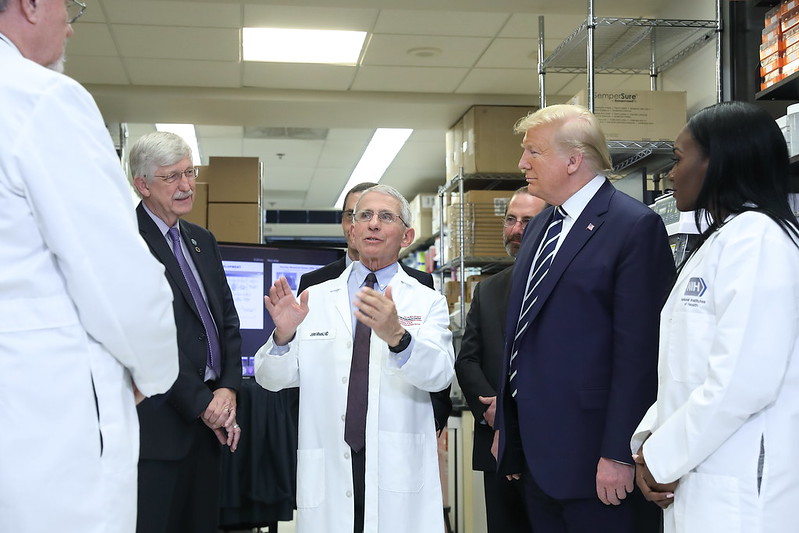
President Donald Trump visited NIH on March 3, 2020 and toured the National Institute of Allergy and Infectious Diseases’ Vaccine Research Center (VRC) to learn about research on a vaccine for the novel coronavirus SARS-CoV-2.

Department of Health and Human Services (HHS)

Most federal health policy is made through the Department of Health and Human Services except for several key areas.

Exceptions include the 

  • Veterans Health Administration, run by the Department of Veterans Affairs;
  •  TRICARE, the health insurance program for active-duty military members and dependents, run by the Defense Department; and the 
  • Federal Employees Health Benefits Program (FEHB), which provides health insurance for civilian federal workers and families and is run by the independent agency the Office of Personnel Management.   

The health-related agencies within HHS are roughly divided into the resource delivery, research, regulatory, and training agencies that comprise the U.S. Public Health Service and the health insurance programs run by the Centers for Medicare and Medicaid Services (CMS).  

The Surgeon General oversees the U.S. Public Health Service (USPHS) Commissioned Corps, an elite group of over 6,000 uniformed officers who are public health professionals. The USPHS mission is to protect, promote, and advance the health of our nation.

The U.S. Public Health Service

Ten of the 13 operating divisions of HHS are part of the U.S. Public Health Service, which also plays a role in U.S. global health programs. They are:  

  • The Administration for Strategic Preparedness and Response (ASPR)
  • The Advanced Research Projects Agency for Health  (ARPA-H)
  • The Agency for Healthcare Research and Quality (AHRQ)  
  • The Agency for Toxic Substances and Disease Registry (ATSDR)  
  • The Centers for Disease Control and Prevention (CDC)  
  • The Food and Drug Administration (FDA)  
  • The Health Resources and Services Administration (HRSA)  
  • The Indian Health Service (IHS)  
  • The National Institutes of Health (NIH)  
  • The Substance Abuse and Mental Health Services Administration (SAMHSA)  

CMS

The Centers for Medicare and Medicaid Services (CMS) is by far the largest operating division of HHS. It oversees not just the Medicare and Medicaid programs, but also the federal Children’s Health Insurance Program (CHIP) and the health insurance portions of the Affordable Care Act(ObamaCare).

Together, the programs under the auspices of CMS account for nearly a quarter of all federal spending in fiscal 2023, cost an estimated $1.5 Trillion in fiscal 2023, and served more than 170 million Americans – more than half the population.  

KFF’s website content is licensed under a Creative Commons Attribution-NonCommercial-NoDerivatives 4.0 International (CC BY-NC-ND 4.0) license that allows for the sharing of our information with proper attribution and without alteration.

End of KFF article

The President’s Cabinet and other Agency Heads

As you can imagine, the leadership organization of HHS is large and complex. At the top is the Secretary, who is a member of the President’s Cabinet , approved by the Senate.

Other key leadership positions, all of which are appointed by the President include

  • U.S. Surgeon General
  • Director of the CDC
  • Commissioner of Food and Drugs (FDA)
  • Director of the NIH
  • Director of the National Library of Medicine
  • Administrator of CMS
James H. Shannon Building (Building One), NIH campus, Bethesda, MD

Looking ahead-Congress

In the next post in this series, we will consider Congress’s role in overseeing these agencies and, most importantly, funding them.

“How Congress oversees the federal health care-industrial complex is almost as byzantine as the U.S. health system itself.

Jurisdiction and responsibility for various health agencies and policies is divided among more than two dozen committees in the House and Senate.”

KFF

Exploring the HEART of Health

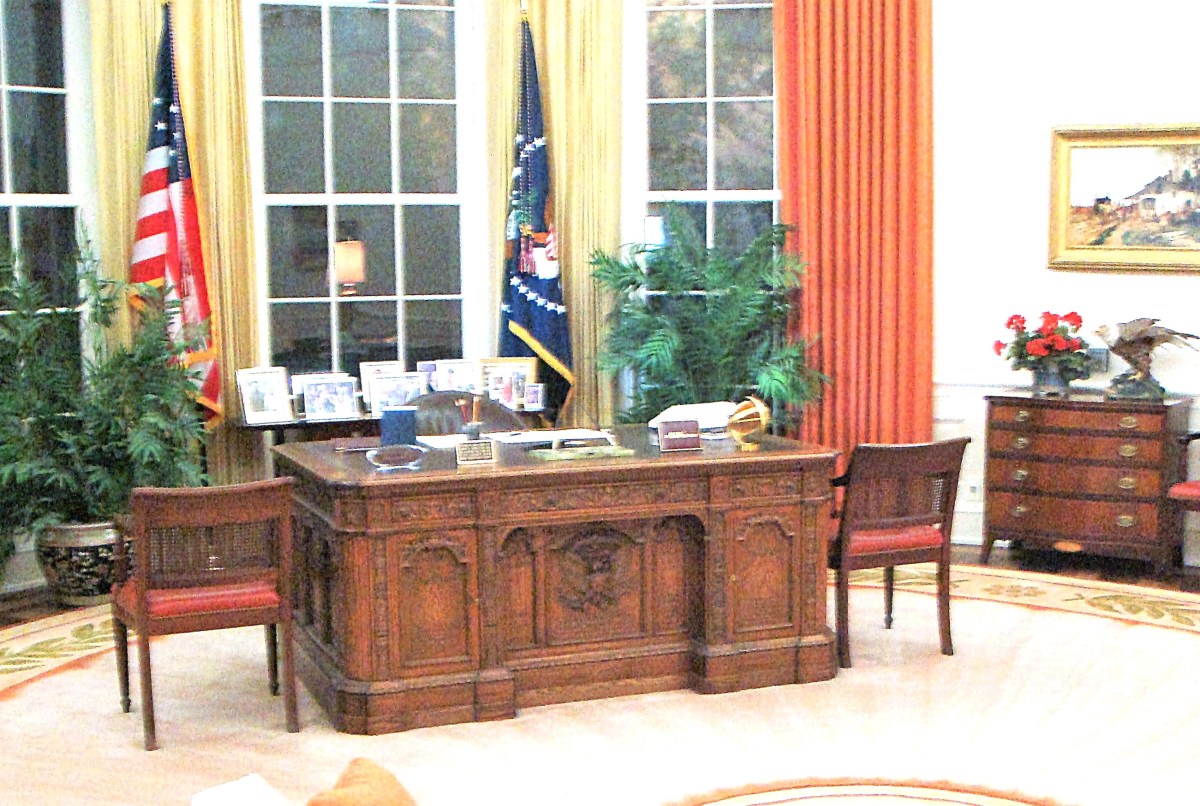
I took the cover photo for this post at the Reagan Presidential Library in California. It is a replica of the Oval Office during his administration.

Thanks for getting through another post that’s maybe more informative than inspiring. I hope you learned something.

I’d love for you to follow this blog. I share information and inspiration to help you turn health challenges into health opportunities.

Add your name to the subscribe box to be notified of new posts by email. Click the link to read the post and browse other content. It’s that simple. No spam.

I enjoy seeing who is new to Watercress Words. When you subscribe, I will visit your blog or website. Thanks and see you next time.

Dr. Aletha