Usually we think of fasting as avoiding food for the purpose of prayer. The emptiness of our stomachs reminds us to pray. Isaiah 58 speaks of a fasting God may honor most of all.
Isaiah 58:4-9, NLT
“…you are fasting to please yourselves.
Even while you fast, you keep oppressing your workers.
What good is fasting when you keep on fighting and quarreling? This kind of fasting will never get you anywhere with me. (God).
You humble yourselves by going through the motions of penance, bowing your heads like reeds bending in the wind. You dress in burlap and cover yourselves with ashes.
Is this what you call fasting? Do you really think this will please the Lord?
No, this is the kind of fasting I (God) wants:
Free those who are wrongly imprisoned; lighten the burden of those who work for you. Let the oppressed go free, and remove the chains that bind people.
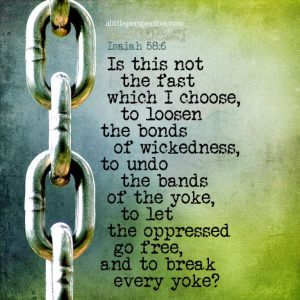
graphic compliments of Christine Miller at alittleperspective.com
Share your food with the hungry, and give shelter to the homeless. Give clothes to those who need them, and do not hide from relatives who need your help.
Remove the heavy yoke of oppression. Stop pointing your finger and spreading vicious rumors!
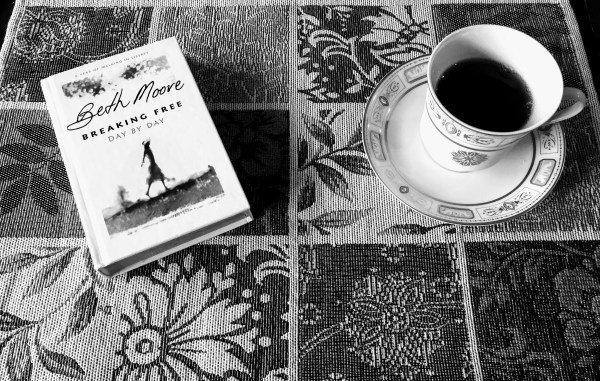
Read what Beth said about fasting in this daily devotional book:
“Usually we think of fasting as avoiding food for the purpose of prayer. The emptiness of our stomachs reminds us to pray. Isaiah 58 speaks of a fasting God may honor most of all.
What is God proposing that we fast from?
What do we have to give up or fast from to reach out to the oppressed?
Whatever our answer, we know if we pour out our lives to satisfy the needs of the oppressed, God will be faithful to satisfy our needs.”
I have enjoyed this daily devotional book. The daily entries are short and easy to read; an inspirational way to start or end my day.
My Reader Rewards Club is a great way to earn free books and Bibles for yourself, friends, and family! Your journey to earning free faith-based products starts HERE. (When you sign up through these links, I can earn free books too.)
As a member, you’ll have access to inspiring literature, Bibles, special promotional offers, and much more. Earning points is easy—you’ll receive 25 points just for signing up!
I think the best medical books are those about real people who face real health challenges that are often life changing or even life threatening. There is nothing like experiencing a serious illness or injury to make you an expert about it.
I read lots of books for my own pleasure and to review for this blog. Although health/medicine can be a genre in itself, many different types of books and media can illustrate medical science.
Some are fiction including drama, comedy, and often science fiction. One I have reviewed here is
But as helpful and interesting as these are, I think the best medical books are those about real people who face real health challenges that are often life changing or even life threatening. There is nothing like experiencing a serious illness or injury to make you an expert about it.
And when the person with the problem writes or tells the story, we don’t just learn about it, we feel the emotions it provokes also.
Share your story
I have reviewed several of these “medical memoirs” here and will likely continue to do so. In a way, we are all living our own health journeys and many of you could offer reflections on how you and your family deal with your unique medical challenges.
If you are willing to share the perspectives you have gained through a health issue or medical experience, contact me; I would love to read it, and maybe share it here with my other readers. Your remarks may remain anonymous if you prefer.
Ms. Maynard’s story opened with a failed marriage/bad divorce saga with adult children torn between the two parents, persistent anger and bitterness, and attempts to ease the pain with a series of bad choices in lovers. Equally sad was her telling of a complicated and ultimately failed adoption attempt.
Finally she and we can breath a sigh of relief when she meets a man and seems to have found true love at last. But that comes to an abrupt halt when he is diagnosed with cancer.
From then on she poignantly describes a life turned upside down as she enters new territory as a caregiver. As she relates how their lives changed, we the readers are changed also, learning to recognize what is truly important in life. As Ms. Maynard writes,
“success, money, beauty, passion, adventure, possessions- have become immaterial. Breathing would be enough.”
Read this book if you want your assumptions about life and death to be challenged and changed. You may read an excerpt at this link
Dr. Pietro Bartolo practices medicine on the tiny Italian island of Lampedusa, in the Mediterranean Sea. Lampedusa, known for its friendly people, sunny skies, pristine beaches, and turquoise waters famous for fishing, seems an idyllic place to live, work, and visit.
But for the past 20 years, Dr.Bartolo has cared for not just residents and tourists, but for hundreds of refugees- people who risk their lives crossing the Mediterranean from northern Africa, fleeing poverty and political unrest. The lucky ones land on shore injured and sick. The unlucky ones wash ashore dead, having died en route or drowning after falling from a capsized or wrecked boat, sometimes only a few feet from shore.
In this memoir, Dr. Bartolo shares the stories of many of these people, giving them the names and faces that we don’t see watching news stories about the refugee crisis. He also shares his own life story of growing up on the island, leaving for medical school, and returning to raise a family and to practice medicine.
Dr. Bartolo’s story was also told in the documentary film FIRE AT SEA
He never expected to become the front-line help for hundreds of desperate people. With no specific training on how to manage an avalanche of desperate, sick, and injured refugees, and with little resources, he manages to put together a system for triaging, evaluating, and treating these people, then sending them on for more advanced medical care or to immigration centers in Europe.
For the less fortunate, he serves as medical examiner, to determine the cause of death for those who do not make it to Lampedusa alive; sometimes taking body parts to extract DNA to identify them, so families can be notified. He states he has never grown comfortable to this aspect of his job.
As a physician myself, I marvel at Dr. Bartolo’s caring and commitment to people who will never be able to repay him for his sacrifice. He approaches his work as a mission of mercy, and treats every person with the utmost respect, no matter their circumstance. Some of the people he treats become almost like family; he has even tried to adopt a couple of orphaned children but cannot due to legalities.
Dr. Bartolo’s story reads like a conversation. I think you will like him, and admire him for his dedication and selfless service. His life should encourage all of us to consider what we can each do to lessen someone else’s suffering.

















 watercress words by Dr Aletha