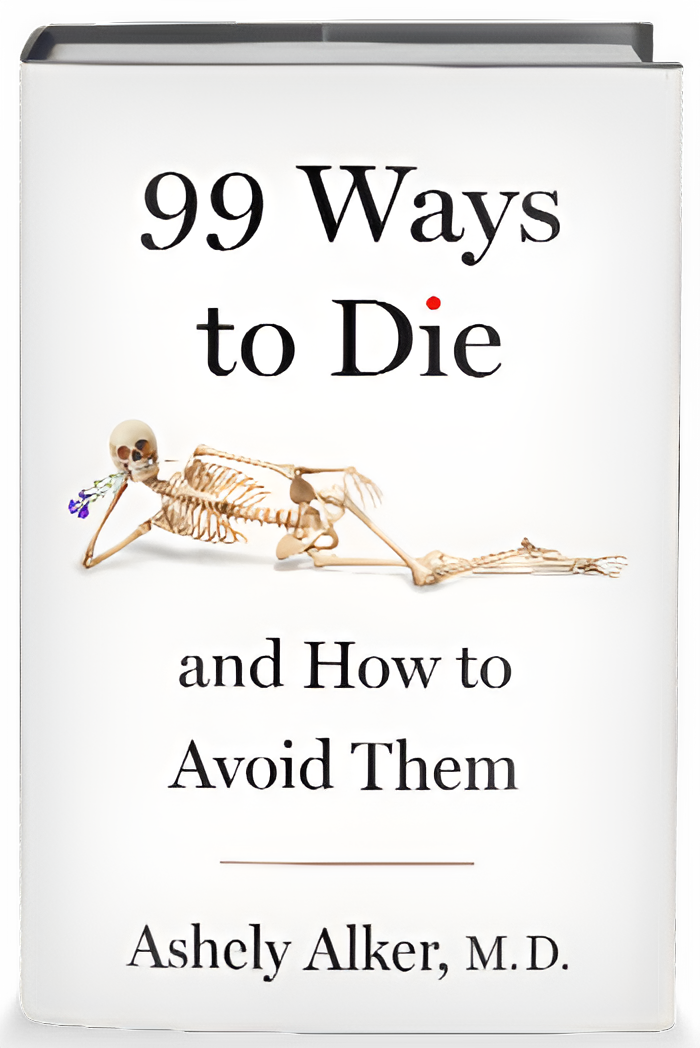
In this post I review “99 Ways to Die and How to Avoid Them.” Dr. Ashely Alker, an emergency physician, humorously outlines various health risks and preventive measures. Combining personal anecdotes with medical insights, she emphasizes the importance of awareness in avoiding fatal incidents and advises readers to prioritize health habits over misinformation, and seeking medical care as soon as possible.
Thank you, NetGalley and publisher, for sending this book for review consideration.
Why would a medical doctor write about ways to die? Aren’t they supposed to keep people alive?
Yes, and that’s why Dr. Ashely Alker, a “death escapologist”, wrote 99 Ways to Die. As an emergency medicine specialist, she says this book is bad for business. Reading it, and following her advice, may keep you out of her emergency room. Better yet, it may save your life.
Dr. Adler briefly shares her pre-medical life and education, including overseas study for a master’s degree in public health. She relates personal experiences with illness and the healthcare system, which led her to medical school and residency.
The table of contents reads like a textbook of emergency medicine, in that it includes both illnesses and situations that can lead to illness. Some of them you have no doubt heard of.
Heart Attacks
Cancer
Ebola virus
Nuclear blast radiation
But have you heard of
Schistosomiasis,
Mad Cow disease,
Venomous agent X,
Takotsubo cardiomyopathy
And you’ve heard of but may not believe can be deadly.
Influenza,
Measles,
High Blood Pressure,
Pregnancy,
Health Influencers (yes, she really wrote this)
She devotes ample discussion to infections, both bacteria, viral, fungi, and even parasites. One whole chapter is on vaccine-preventable infections (obviously, she advocates vaccination)
One of the top five frequent causes of death is accidental trauma, which is often overlooked in discussions of preventive medicine. Not Dr. Adler. She details the ways things like drugs, animals, vehicle crashes, crime, sports, weather, and war can harm and kill us. And don’t forget the dangers of food and water!
You may be thinking this book must be highly technical. She does use scientific names and terms, which she explains in simple language. Her tone is engaging and conversational. She is blunt, sometimes humorous, but always perfectly serious.
She shares stories of her own patients with these conditions; details changed for privacy. Is some of it gory or scary? Maybe, depending on your comfort level and how much you want to know about the human body and how it can be misused and abused.
Disease and death affect all of life and history, as she points out in discussing the impact of the influenza epidemic of 1918 and the COVID-19 pandemic of 2020. I found her discussion of the atomic bombs dropped on Hiroshima and Nagasaki, Japan in World War II particularly poignant.
The initial blasts killed over 200,000 civilians, with many more dying later from radiation illness. In her review of biological and chemical warfare, she suggests we consider carefully who we put into power.
From this book, you will learn that health is more than knowing your blood pressure and cholesterol. Our risk of disease is more due to where and how we live, and our socioeconomic status. The most important number for your health may be your zip code in the United States.
None of us expect to die from an automobile collision, hypothermia, homicide, drowning, tornado, poisoning, insect bite, or war, but we might and she explains how to avoid it. Common sense things-wear a seat belt, dress for the weather, apply insect repellent, don’t believe medical misinformation you read online. Learn CPR and save someone else’s life.
I’m a physician and worked in ERs, but I still learned from her book. So, I believe you will also. Her main takeaway is to value and care for your body, you only have one. As she wrote in her dedication
Note: She does not intend this book to replace advice from your own personal physician. References to CDC recommendations are to those issued before January 1, 2025.
The Author
Ashely Alker, M.D., M.Sc., is an emergency medicine physician on a mission to improve public health. While completing her master’s degree, Dr. Alker studied at Harvard School of Public Health’s multinational institute in Cyprus. She lived near the United Nations Green Zone and worked in humanitarian affairs at the Unit for the Rehabilitation of Victims of Torture.
After graduating from the George Washington University School of Medicine, Dr. Alker served as a healthcare advisor for a member of the US Congress. During her residency in emergency medicine at the University of California, San Diego, Dr. Alker became a technical consultant and medical screenwriter, improving medical accuracy on over twenty shows, including TV and film for Netflix, Hulu, HBO, and Disney.
Her nonprofit, Meaningful Media, connects writers, artists, and reporters with certified public health experts to develop scientifically accurate messaging.
Images in this Post
The book image and Dr. Alker’s photo are from her website.
What do you think?
What do you think about a physician writing a book about dying?
What is the most unusual, bizarre, or unexpected cause of death that you know about?
How will reading this review and/or the book impact your idea of what will cause your own death?
Exploring the HEART of Health
I’d love for you to follow this blog. I share information and inspiration to help you transform challenges into opportunities for learning and growth.
Add your name to the subscribe box to be notified of new posts by email. Click the link to read the post and browse other content. It’s that simple. No spam.
I enjoy seeing who is new to Watercress Words. When you subscribe, I will visit your blog or website. Thanks and see you next time.
Use this search box for related posts on this blog or other topics of interest to you.
I’m glad to learn that states are mandating insurance coverage for non-opioid pain medications. Advocates push for laws that eliminate higher copayments for non-opioids. Despite challenges, bipartisan support is growing, driven by healthcare concerns regarding opioid dependence and addiction.
This information is current as of the date of original publication or update but may have changed by the time you read this. Do not use this information for diagnosis or treatment purposes. Before making health decisions, discuss with a qualified healthcare professional.
Pain Treatment: A Problem for Doctors and Patients
When I was practicing medicine, pain was one of the most difficult problems to manage. I had to balance the need to relieve a person’s pain while not creating dependence or addiction.
Sometimes patients came to me already on chronic opioids for pain. I had to decide whether to continue them or change the person to another treatment, which can be hard to do. Sometimes patients came to me requesting “something” for pain. Only by checking the state pharmacy database did I learn they were already receiving prescriptions for opiates from other physicians, sometimes several.
In my long medical career, there have been few non opiate alternatives for severe pain. So I am pleased to learn of a new drug which is exactly that. Unfortunately, its use may be limited due to cost. This article explains how states are trying to circumvent that problem.
(For the purpose of this article, consider the terms narcotic, opiate, and opioid as referring to the same type of drug.)
(edited for readability and clarity, no change to content)
More states are requiring their Medicaid programs and health insurance companies to cover non-opioid pain medications as an alternative to opioids, which can be cheaper for insurers but also more addictive for patients.
Advocates, providers, medical associations, and state lawmakers are pushing for parity in coverage. That means prohibiting insurers from charging higher copayments for non-opioids than they do for opioids, and barring them from requiring prior authorization or step therapy — mandating that patients try other medications first — before they will cover non-opioid drugs.
At least eight states have enacted such laws: Arkansas, Illinois, Louisiana, Maine, Massachusetts, Oklahoma, Oregon, and Tennessee. In states that are still considering legislation, the efforts have been bipartisan, pushed by lawmakers in some Democratic-controlled states, Colorado and New York, and some Republican-leaning states, Kentucky and Missouri.
The issue has gained momentum in recent years, as leading medical associations such as the American Society of Regional Anesthesia and Pain Medicine have urged providers not to prescribe opioids as the first-line treatment for pain.
Meanwhile, bipartisan legislation introduced in Congress last year aims to increase Medicaid Part D enrollees’ access to non-opioid pain medications. It’s been referred to a committee.
Dr. Patrick Giam, president of the American Society of Anesthesiologists, said the organization “believes it is important that insurance plans make non-opioid therapies as accessible to patients as opioid-based therapies.”
drugs to treat pain
The U.S. Food and Drug Administration has encouraged non-opioid pain relief alternatives.
acetaminophen, such as Tylenol and other brands, and
other medications.
(affiliate links)
Opioids include
oxycodone,
codeine,
morphine and
fentanyl.
suzetrigine-Journavx
Last year, the agency approved a new drug called suzetrigine, under the brand name Journavx, the first non-opioid pain relief medication in a new class of analgesic drugs. The drug, which is available in tablets, can be prescribed for acute pain after surgery or injury. Vertex Pharmaceuticals, the manufacturer, is one of the funders of Voices for Non-Opioid Choices, which has been lobbying for the bills.
In Missouri, where GOP-sponsored legislation would prohibit insurance companies from denying coverage of a prescribed non-opioid or requiring a higher copayment for a non-opioid, the Missouri Insurance Coalition has argued that the measure would increase health care costs and effectively create “a monopoly” for Journavx. Each tablet can cost around $15 per tablet out-of-pocket. But lawmakers pointed to non-opioid alternatives.
Why non-opioids often cost more
Newer non-opioid drugs entering the market are more expensive than opioids because there isn’t yet a generic alternative, explained Sterling Elliott, an Illinois clinical pharmacist and lecturer at Northwestern University’s Feinberg School of Medicine and a board member of Voices for Non-Opioid Choices.
Generic opioids are amongst the cheapest medications that you’ll find flowing through the American pharmaceutical supply,
Sterling Elliott, clinical pharmacist
“The price is so high for a lot of things because the price for generic opioids is so low. Generic opioids are amongst the cheapest medications that you’ll find flowing through the American pharmaceutical supply,” Elliott said. “When you get a new entrant into the pain market, the marketplace factors are set up to drive the price up.”
Elliott added that some insurance plans don’t cover prescription-strength NSAIDs such as ibuprofen because they’d rather people pay out-of-pocket for lower strength, over-the-counter versions of those drugs.
In New York, Democratic Assembly member Phil Steck, the cosponsor of a bipartisan bill that hasn’t received a hearing, said challenging the insurance companies isn’t easy.
“You’re trying to tell insurers what to do,” Steck said. “Those are usually difficult undertakings. … Our experience is that the [legislature’s] insurance committee is very difficult to deal with, and so it hasn’t been pursued as much as we would like.”
Coverage of non-opioids can vary widely across insurance plans, explained clinical pharmacist Emma Murter, who co-chairs the advocacy committee of the Society of Pain and Palliative Care Pharmacists.
“There are so many [non-opioid] medications that can be used for chronic pain,” Murter said. “It isn’t gut-instinct obvious, what is and isn’t covered. It’s very Wild West, chaotic.”
When it comes to filling prescriptions, Murter said, she often has to “fight and appeal for some of these non-opioid therapies” with insurance companies.
Dima Qato, associate professor of clinical pharmacy at the University of Southern California, said non-opioid pain prescription meds are less common on insurance companies’ “preferred” drug lists. Because insurers may favor the less expensive opioids, that can result in higher copayments or consumers paying more out-of-pocket.
That was the case for Chris Fox, the Washington lobbyist who serves as executive director of Voices for Non-Opioid Choices. Fox has traveled to state capitals around the country to lobby for the bills. Recently, he had a personal experience with pain medications following oral surgery.
“For everything but the non-opioid, my out-of-pocket expectation was $0,” he said. He was charged $30 out-of-pocket for the non-opioid.
His oral surgeon wasn’t familiar with the availability of the new first-in-class non-opioid suzetrigine, Fox added. When he asked the doctor for a prescription for it, the surgeon wrote it but also prescribed an opioid along with an antibiotic.
“He prescribed me hydrocodone to go along with it, just in case, because he wasn’t as familiar with [suzetrigine],” Fox said.
Preventing addiction
As he spoke with Stateline by phone, Fox was driving to the local sheriff’s office to drop off the hydrocodone, which he didn’t take following his surgery.
“We’ve neglected the opportunity, I would say, to prevent opioid addiction where we can, which is in those patients that will develop a newly persistent opioid use pattern following exposure to an opioid that they get for medical reason,” Fox said.
Although opioid overdose deaths have declined, the drugs still kill about 200 Americans a day.
Health care professionals at hospitals also run into issues with lower reimbursement rates for some non-opioids.
Dr. Joseph Smith, an anesthesiologist at a Virginia surgical center who has practiced for three decades, pointed to a nerve-block pain pump as an example. Administering a brand-name version of the drug could cost up to $400 for all the equipment, he said. Smith, like Elliott, sits on the board of Voices for Non-Opioid Choices.
“So the hospital is like, ‘Well, I can spend $400 or I can spend 25 cents on a narcotic pill,’” Smith said.
Smith treats many young teen athletes with sports injuries. Research has shown post-surgery narcotic use can increase risk of addiction.
“My goal when I get a 14-year-old or 15-year-old in here is to never have them try a narcotic, never have them exposed to narcotics,” he said.
This story was originally produced by Stateline, which is part of States Newsroom, a nonprofit news network which includes Oklahoma Voice, and is supported by grants and a coalition of donors as a 501c(3) public charity.
It is shared here under a Creative Commons License.
Tolerance vs. Dependence vs. Addiction
Long-term use of prescription opioids, even as prescribed by a doctor, can cause some people to develop a tolerance, which means that they need higher and/or more frequent doses of the drug to get the desired effects.
Drug dependence occurs with repeated use, causing the neurons to adapt so they only function normally in the presence of the drug. The absence of the drug causes several physiological reactions, ranging from mild in the case of caffeine, to potentially life threatening, such as with heroin. Some chronic pain patients are dependent on opioids and require medical support to stop taking the drug.
Drug addiction is a chronic disease characterized by compulsive, or uncontrollable, drug seeking and use despite harmful consequences and long-lasting changes in the brain. The changes can result in harmful behaviors by those who misuse drugs, whether prescription or illicit drugs.
While the initial choice to use a drug is often voluntary, the powerful effects of addiction makes it very hard to stop, even if someone wants to.
When drugs or alcohol are used so often that they have significant negative effects on your life, this is called a substance use disorder.
It causes intense cravings for alcohol or drugs, and can include:
Using illegal drugs like heroin or cocaine, or excessive alcohol drinking.
Using prescription drugs in ways other than prescribed, or using someone else’s prescription.
Using drugs repeatedly changes the brain, including the parts that help exert self-control. That’s why someone may not be able to stop using drugs, even if they know the drug is causing harm, or want to stop.
If you live outside the United States, contact your local source of medical care or search online for substance use treatment in your country.
Exploring the HEART of Health
I’d love for you to follow this blog. I share information and inspiration to help you transform challenges into opportunities for learning and growth.
Add your name to the subscribe box to be notified of new posts by email. Click the link to read the post and browse other content. It’s that simple. No spam.
I enjoy seeing who is new to Watercress Words. When you subscribe, I will visit your blog or website. Thanks and see you next time.
Search this blog for related posts on this topic or other issues you care about.






 watercress words by Dr Aletha