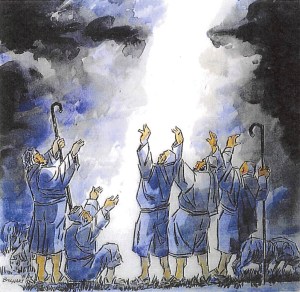
That night there were shepherds staying in the fields nearby, guarding their flocks of sheep.
Suddenly, an angel of the Lord appeared among them, and the radiance of the Lord’s glory surrounded them. They were terrified, but the angel reassured them.
The late Bill Hart was a professional artist. He served in the United States Army during World War II and was part of the force which invaded and liberated France in 1944. You can read Bill’s story at this link.
The composer- George Handel
These verses from the Bible book Luke are sung in Handel’s musical Messiah musical. We usually associate Messiah with Christmas, but Handel intended it to be performed at Easter.
“Handel got the lyrics from a preacher named Charles Jennens, who wrote out the whole piece as a collage of Bible verses designed to tell a story about the Messiah.”
If you have ever attended a live performance of Messiah, you probably stood up during the Hallelujah Chorus. That tradition dates back to King George II of England who according to tradition, was so moved during this song that he stood to his feet. Since he was the king, everyone had to stand with him.
“And I heard as it were the voice of a great multitude, and as the voice of many waters, and as the voice of mighty thunderings, saying,
Alleluia: for the Lord God omnipotent reigneth.
And the seventh angel sounded; and there were great voices in heaven, saying,
The kingdoms of this world are become the kingdoms of our Lord, and of his Christ; and he shall reign for ever and ever.
And he hath on his vesture and on his thigh a name written,
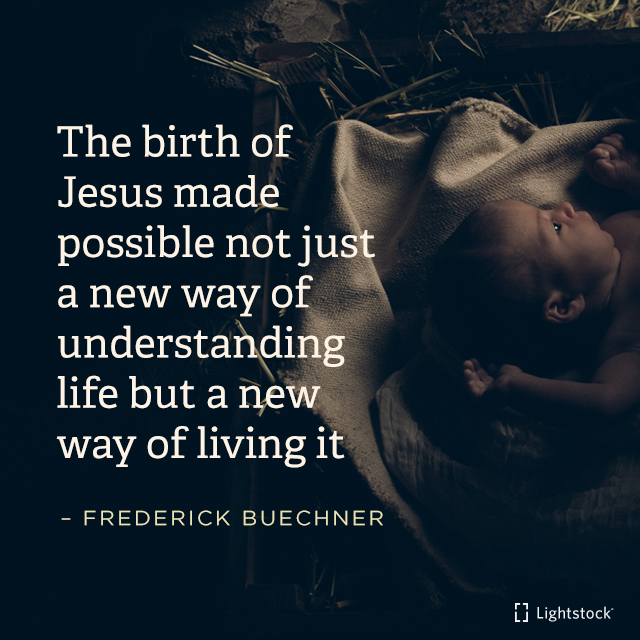
Carl Frederick Buechnerwas an American writer and theologian. He died in 2022 at 96 years old.(affiliate link) graphic credit Lightstock.com (affiliate link)
Often referred to as the Hallelujah Chorus, this passage is the most recognized part of Handel’s Messiah. We associate Messiah with Christmas, but Handel wrote it to be performed at Easter. He drew the words of the songs from Scripture, choosing passages that tell the story of God sending Jesus to earth to redeem His people.
If you have ever attended a live performance of Messiah, you probably stood up during the Hallelujah Chorus. That tradition dates back to King George II of England who according to tradition, was so moved during this song that he stood to his feet. Since he was the king, everyone had to stand with him.
The “Hallelujah Chorus,” from George Frideric Handel‘s Messiah, is such an iconic piece of music that it’s easy to take its exuberance and its greatness for granted.
Composer-conductor Rob Kapilow joins Performance Today host Fred Child to examine the structure of Handel’s popular little chorus and discover why the music has such a powerful grip on singers and listeners.
I’d love for you to follow this blog. I share information and inspiration to help you transform challenges into opportunities for learning and growth.
Add your name to the subscribe box to be notified of new posts by email. Click the link to read the post and browse other content. It’s that simple. No spam.
I enjoy seeing who is new to Watercress Words. When you subscribe, I will visit your blog or website. Thanks and see you next time.
We usually associate Messiah with Christmas, but Handel wrote it to be performed at Easter. He drew the words of the songs from Scripture, choosing passages that tell the story of God sending Jesus to earth to redeem His people.
An angel announced the birth of the Savior in Luke 2, bringing joy and a sign of hope. The text from Isaiah 9:6, referenced in Handel’s Messiah, highlights the significance of this birth, which inspired Handel’s composition in 1741. The piece, however, was originally intended for Easter, not Christmas.





 watercress words by Dr Aletha