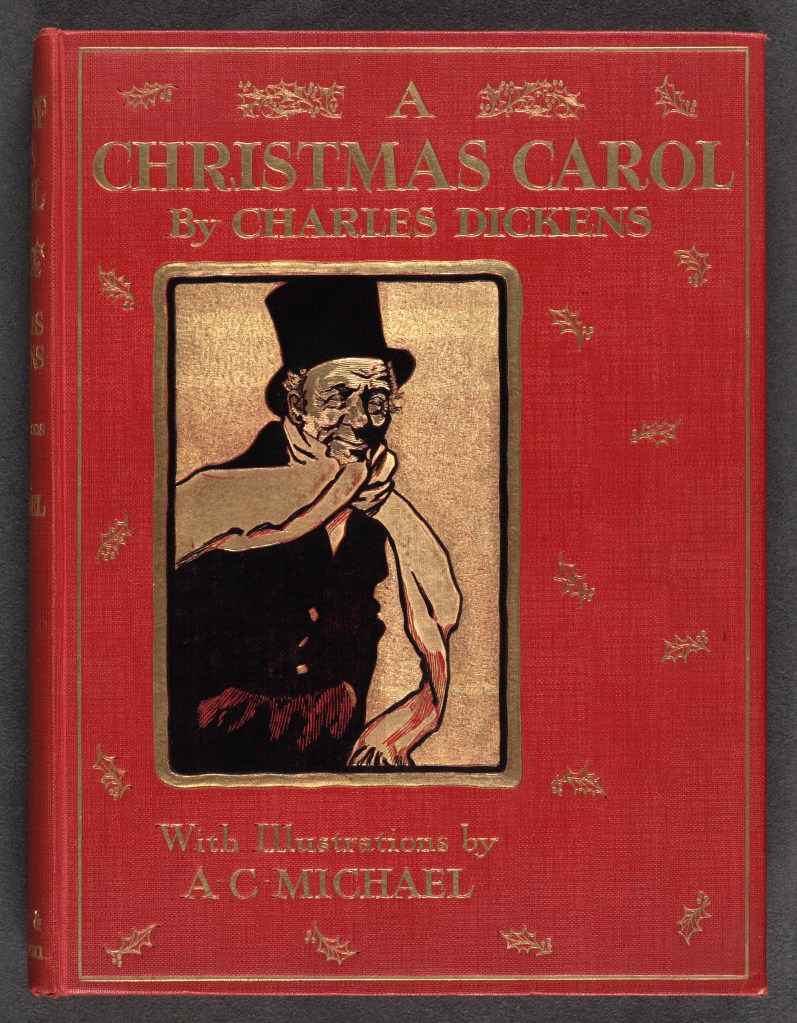
In this post I send holiday wishes while reflecting on Charles Dickens’ “A Christmas Carol.” It summarizes the story of Ebenezer Scrooge, a miser who embraces the spirit of Christmas. The tale highlights themes of love, family, and redemption, and I wish the same to you.
Merry Christmas and welcome to Watercress Words, where we explore the HEART of Health.
My family and I attended a stage presentation of Charles Dickens’ story, A Christmas Carol, where this photo was taken
Dr. Aletha and Raymond Oglesby
The story was written by the English author Charles Dickens in the mid-19th century, but it continues to touch hearts almost 200 years later.
Spoiler alert-here’s the story, skip if you don’t want to know
Ebenezer Scrooge is a miserly man who despises Christmas. Scrooge started a business with Jacob Marley, who was very similar to Scrooge, but since Marley died Scrooge runs the business alone, treating one of his staff members, Bob Cratchit, very poorly.
One night Scrooge is visited by the ghost of Jacob Marley, who warns Scrooge that if he does not become kinder he will have an awful fate after death. Marley tells Scrooge that in the coming nights he will be visited by three more ghosts. Initially Scrooge fails to take the warning seriously but as the ghostly visits become more terrifying, Scrooge begins to realise that he must change his ways.
By the end of the story Scrooge has completely transformed, having learnt the importance of charity, friendship and generosity. Christmas is now his favourite time of the year and he does all he can to help Bob Cratchit and his family.
Watch A Christmas Carol
There have been multiple screen versions of the story, including some animated adaptations. Do a search and find one, probably for free.
Dickens’ A Christmas Carol is about loneliness, greed, selfishness, anger, fear, regret, and death.
But it also teaches us the value of family, friends, caring, giving, receiving, charity, and forgiveness. It is about second chances and starting over. Ultimately, in this timeless classic, love wins.
However you spend Christmas and whoever you spend it with, I wish you peace, joy, hope, and love.
Warmest wishes, Dr. Aletha
Charles Dickens, English author, Lightstock.com, affiliate link
Exploring the HEART of Health
I’d love for you to follow this blog. I share information and inspiration to help you transform challenges into opportunities for learning and growth.
Add your name to the subscribe box to be notified of new posts by email. Click the link to read the post and browse other content. It’s that simple. No spam.
I enjoy seeing who is new to Watercress Words. When you subscribe, I will visit your blog or website. Thanks and see you next time.
Use this search box for related posts on this blog or other topics of interest to you.
This post talks aboit giving, how and why. It contrasts the self-awareness of generosity, illustrated through characters like George Bailey from “It’s a Wonderful Life” and Ebenezer Scrooge from “A Christmas Carol.” Both highlight life’s impact through generosity.
updated December 20, 2025
“Watch out! Don’t do your good deeds publicly, to be admired by others, for you will lose the reward from your Father in heaven.
When you give to someone in need, don’t do as the hypocrites do—to call attention to their acts of charity! ….they have received all the reward they will ever get.
But when you give to someone in need, don’t let your left hand know what your right hand is doing.
Give your gifts in private, and your Father, who sees everything, will reward you.”
Have you ever made a charitable donation online or by mail, where they asked you to check a box “make my donation anonymous”? is that what the Bible means by “giving gifts in private”.
And be rewarded?
The Bible scripture passage quoted above, from Jesus’ Sermon on the Mount, seems to tell us we should give in secret, not letting anyone else know.
But Bible scholars interpret it less literally. Considering it in the context of the whole sermon, they suggest we shouldn’t give just to impress people nor brag about what we give, not that it always has to be secretive (although sometimes it should be.)
Giving from the Left or Right
I don’t think Jesus was making a political statement here. Nor was he just using hyperbole, an exaggerated statement or claim not meant to be taken literally. But I do think he was using it to make a point.
Because not knowing one side of one’s body is a real thing.
Hemispatial Neglect
People with the syndrome of hemispatial neglect experience reduced awareness of stimuli on one side of space. This may occur after damage to the brain due to a stroke or trauma.
People with hemispatial neglect are often unaware of their condition. Friends or relatives might suggest they look to their neglected side but that instruction misunderstands the problem they have with navigating the space around them… people are not aware that something is missing, so why would they seek it out?
A single image of a human brain using a magnetic resonance imaging (MRI) machine.
Source: Dr. Leon Kaufman. University Of California, San Francisco
Creator: Unknown Photographer
used courtesy National Cancer Institute
So imagine not knowing what’s on the left side of your body. Well, that’s how generous we should be; give (as if) we don’t know what we gave.
(Obviously, if we take that too literally, and waste our money,we limit our ability to be generous; we still need to be financially prudent. )
The man who didn’t know what he had given
Every year at Christmas time a classic movie makes its way to network television and streaming services. Like many famous movies, the script was adapted from a book, or rather a short story titled “The Greatest Gift”.
George was a man who had a good life until things started going wrong, so badly that he concluded his life had been a failure and he had never done anything right or good in his entire life. He even contemplated suicide.
That is until a mystery “person” came along and showed him how the world would have been without George’s life and good deeds. Poverty, crime, unemployment, alcohol abuse, and even deaths would have occurred had it not been for George’s life. And he had no idea!
His left hand didn’t know what his right hand had done.
Of course you know I’m talking about George Bailey from the classic movie It’s a Wonderful Life, released in January 1947, nominated for 5 Academy Awards, and considered one of the best films ever made. But most people like it because it’s a feel-good movie that can make you laugh and cry.
Of course, Ebenezer Scrooge of Charles Dickens’ A Christmas Carol didn’t have George’s problem. He knew exactly what he had done to help others-nothing!
It took dying (almost) and three scary visitors to show Ebenezer how stingy his hands had been, never giving anything away, and convincing him that generosity was better than miserliness and loneliness. At the end of the story, both of his hands were busy passing out food and gifts to strangers, friends, and family.
Here is a post about Charles Dickens, a renowned English writer, of “A Christmas Carol” and “The Pickwick Papers.” His storytelling introduced terms like Pickwickian syndrome, reflecting his influence on culture and health. Dickens also advocated for children’s hospitals through powerful speeches, merging his literary talent with social responsibility .
Therefore, because God is so generous to us, we’re to be lavishly generous to others. Who has been “lavishly generous” to you?
Sharing the HEART of generosity and giving
I’d love for you to follow this blog. I share information and inspiration to help you transform challenges into opportunities for learning and growth.
Add your name to the subscribe box to be notified of new posts by email. Click the link to read the post and browse other content. It’s that simple. No spam.
I enjoy seeing who is new to Watercress Words. When you subscribe, I will visit your blog or website. Thanks and see you next time.














 watercress words by Dr Aletha