The Point of It All, by Charles Krauthammer-a review

I admired and followed Dr. Charles Krauthammer’s writing and was sad when he passed away this year.So I was pleased to learn that he has published a new book, The Point of It All. He started the book prior to his illness and finished it with the help of his son Daniel, who wrote the introduction and edited it.

If you wondered why Pulitzer prize winning journalist Charles Krauthammer quit his medical career to write a political column for the Washington Post newspaper, you’ll learn the answer in his newest and sadly last book. He explained

“I left psychiatry to start writing…because I felt history happening outside the examining room door. I wanted to…because some things matter, some things need to be said, some things need to be defended.”

THE POINT OF IT ALL :
A Lifetime of Great Loves and Endeavors

Dr. Charles Krauthammer died in 2018. In 2016 he started a new book but in 2017 was diagnosed with cancer. Treatment was initially successful, but multiple serious complications kept him hospitalized for many months during which he continued writing with his son Daniel’s and his wife Robyn’s help.

But the cancer recurred and this time further treatment would not be successful. We can thank Daniel for honoring his father’s dying wishes and finishing the book and facilitating the publication of The Point of It All.

Daniel wrote a helpful introduction to the book, explaining how it was put together. He also offered some personal reflections about his relationship with his father, and some insight into Dr. Krauthammer’s character and personality that he tended to keep private.

“My father’s writing…is not just thought-provoking but also feeling-provoking. His writing opens the mind, combining passion with intelligence, beauty with concreteness. “

Book outline

The book collects some of Dr. Krauthammer’s Washington Post columns, transcripts of speeches he gave, and text of a book on foreign policy that he was writing but had not published.

Most casual readers of Krauthammer will want to read Part I-People, where he discusses such diverse topics as

  • Ronald Reagan
  • Thomas Jefferson
  • Australia
  • Memorials
  • Chess and Sports
  • The space program
  • Medicine
  • Part II -Man and Society
  • Part III-Politics, Foreign and Domestic
  • Part IV-Competing Visions-America’s Role and the Course of World History
  • Part V-Speaking in the First Person


You can read the book straight through, or skip around, reading whatever chapter titles catch your attention. It was hard for me to pass up titles like

  • Why I love Australia
  • Man vs. Computer:Still a Match
  • Pluto and Us
  • They Die with Their Right On
  • Thought Police on Patrol
  • Just Leave Christmas Alone
  • The Climate Pact Swindle
  • Beauty and Soul

My favorite part of this book was the shortest-Part V, the few essays he wrote about himself, something Daniel said he didn’t like to do and would not have included.

“I’ve never wanted to make myself the focus of my career.”

And so in Beauty and Soul, he credits his wife of over 40 years with his success.

Her (Robyn’s) beauty and soul have sustained me these many years. I was merely the scribe.

Dr. Krauthammer, upon accepting a writing award

THE POINT OF IT ALL-A BOOK REVIEW

As a physician, I am intrigued and inspired knowing  Dr. Krauthammer completed medical school and residency after and despite sustaining a spinal cord injury which caused quadriplegia (paralysis from the neck down, preventing use of his arms and legs).   (This no doubt made his treatment and recovery from cancer surgery all the more difficult.) 

According to his son Daniel, his father also did not like to publicize or dwell on his or anyone else’s disability. He preferred to focus on what he could do, not on what he couldn’t do.

This excerpt is from a Washington Post column that is included in this book.

After watching videos in which  The price of fetal parts was discussed over lunch, Dr. Krauthammer wrote

“Abortion critics have long warned that the problem is not only the obvious — what abortion does to the fetus — but also what it does to us.

It’s the same kind of desensitization that has occurred in the Netherlands with another mass exercise in life termination: assisted suicide. It began as a way to prevent the suffering of the terminally ill. It has now become so widespread and wanton that one-fifth of all Dutch assisted-suicide patients are euthanized without their explicit consent.

ultrasound image of a 4 month old fetus
a prenatal ultrasonographic image of fetus at the four-month point in its gestation; public domain image used courtesy of the CDC/ Jim Gathany

There is more division about the first trimester because one’s views of the early embryo are largely a matter of belief, often religious belief.

One’s view of the later-term fetus, however, is more a matter of what might be called sympathetic identification — seeing the image of a recognizable human infant and, now, hearing from the experts exactly what it takes to “terminate” its existence.

The role of democratic politics is to turn such moral sensibilities into law. This is a moment to press relentlessly for a national ban on late-term abortions.”

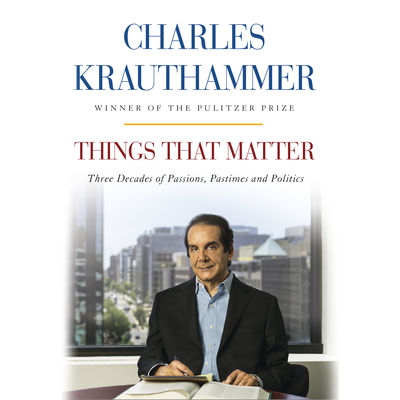
THINGS THAT MATTER: Three Decades of Passions, Pastimes and Politics

My review of his memoir THINGS THAT MATTER has been one of my most viewed posts. If you haven’t read it I recommend it also.

Charles Krauthammer-THINGS THAT MATTER

I enjoyed listening to  Dr. Krauthammer’s memoir THINGS THAT MATTER: Three Decades of Passions, Pastimes, and Politics  

This book is a collection of  his more memorable opinion pieces as well as a memoir of his life, including medical school, his life-changing injury, psychiatric medical practice, his  journalism career, hobbies (chess and baseball) and life with his family.

A life with no regrets

Dr. Krauthammer wrote his last piece for The Washington Post barely two weeks before his death and that post concludes his final book. Dr. Krauthammer wrote,

“I leave this life with no regrets. It was a wonderful life — full and complete with the great loves and great endeavors that make it worth living. I am sad to leave, but I leave with the knowledge that I lived the life that I intended.”

Thanks for reviewing the thoughts and feelings of the late Charles Krauthammer with me. Please share your reactions to Dr. Krauthammer’s work and share this post with your friends.

Thanks for exploring the HEART of health with me.

Dr. Aletha

Women’s health – meds to control pain and prevent disease

This post reviews drugs for women’s health issues. Elagolix treats endometriosis pain but not infertility. Elagolix and ulipristal may help with uterine fibroids. Prasterone relieves dyspareunia and improves sexual desire. Botox and monoclonal antibodies prevent migraine pain. HPV vaccine prevents cervical cancer, and Shingrix prevents shingles more effectively.

updated May 2, 2024

In this post, I review drugs that treat conditions exclusive to or common in women. These are broad topics so I have linked to several authoritative sources.

This information is current as of the date of original publication or update but may have changed by the time you read this. Do not use this information for diagnosis or treatment purposes. Before making health decisions, discuss with a qualified healthcare professional.

Photo by rawpixel.com on Pexels.com

Relieving the pain of endometriosis

Women with endometriosis suffer infertility, excessive bleeding, painful periods, and pelvic pain unrelated to periods. In endometriosis, uterine tissue grows outside the uterus.

Endometriosis can be difficult to diagnose, requiring invasive procedures to discover. Treatment depends on the goal, whether pregnancy, pain relief, or both. Short of surgery, hormonal therapy has been the mainstay of treatment.

A hormonal drug, elagolix, brand name Orilissa, is the first of its kind specifically developed and approved to treat “moderate to severe” endometriosis pain. It does not help with infertility.


Stop bleeding fibroids

Researchers are studying elagolix and another hormonal drug ulipristal for treating uterine fibroids. Fibroids are growths within the uterine that can cause pain and excessive bleeding. Initial trials show both of these drugs can significantly decrease bleeding and pain. However, neither is currently FDA-approved for treating fibroid.

Easing dyspareunia

After menopause many women develop atrophy of the vagina, making it thin, dry, and easily irritated, leading to painful sex, or dyspareunia. An intravaginal medication, prasterone, brand name Intrarosa, can help relieve the discomfort. Studies show it may also help improve sexual desire and arousal, but it is not labeled for this.

Manufactured by AMAG Pharmaceuticals, it is for “moderate to severe” symptoms. Also known as DHEA, it is a steroid that transforms into estrogen in the vagina, administered as a once-daily vaginal insert at bedtime, applied with an applicator.

Other options for treating vaginal atrophy symptoms are oral or vaginal estrogen and/or vaginal lubricants.

Prevention of migraine pain and disability

Migraine, although not exclusive to women, occurs more frequently in them than in men. For infrequent headaches, non-prescription pain relievers are effective and recommended. But for severe, frequent, or persistent symptoms prevention is recommended to improve quality of life.

Botox, onabotulinumtoxin A, has been FDA-approved for treating chronic migraine, meaning patients with frequent headaches and other migraine symptoms for at least 3 months.

Yes the same drug used to treat wrinkles, Botox, can prevent migraine. For migraine, the drug is injected into the upper facial muscles by a physician specifically trained in its use.

A calcitonin gene-related peptide (CGRP) receptor is responsible for transmitting migraine pain. Monoclonal antibodies bind to the receptor, blocking the pain.

The antibodies are produced in a laboratory but work like antibodies naturally produced by the body. These drugs are given by injection.

  • Erenumab-Aimovig
  • Galcanezumab-Emgality
  • Fremanezumab-Ajoovy

Gepant drugs also block the CGRP receptors, both preventing and relieving migraine. These are in pill form so are taken by mouth.

  • Rimegepant-Nurtec ODT
  • Ubrogepant-Ubrelvy 

I also discuss migraine in this post.

Preventing cervical cancer with the HPV vaccine

Infection with the HPV, human papillomavirus, causes genital warts and changes in the cervix called CIN which can lead to cervical cancer.

According to a review of clinical trials by Cochran, vaccination against this virus effectively prevents infection and thus fewer cases of CIN. Since a significant percentage of CIN progresses to cancer, we can expect fewer women will develop invasive cervical cancer, the 4th most common cancer in women worldwide.

The vaccine, Gardasail 9, originally approved for use in females ages 9 to 26 years, received FDA approval for use up to age 45 years.

Stopping shingles with the zoster vaccine

And speaking of vaccines, a new zoster (shingles) vaccine, Shingrix, prevents the painful rash much more effectively than the original vaccine Zostavax. It ranges in effectiveness from 91% to 97% at preventing shingles, depending on age. The first vaccine was 51% effective.

Zoster is a reactivation of the varicella virus that causes chickenpox. It causes a painful rash known as shingles; the pain may continue after the rash is gone. It can happen at any age, but symptoms tend to be worse in older persons.

exploring the HEART of women’s health

I’d love for you to follow this blog and follow me on social media.

I share information and inspiration to help you transform challenges into opportunities for learning and growth.

Add your name to the subscribe box to be notified of new posts by email. Click the link to read the post and browse other content. It’s that simple. No spam.

I enjoy seeing who is new to Watercress Words. When you subscribe, I will visit your blog or website. Thanks and see you next time.

Dr. Aletha