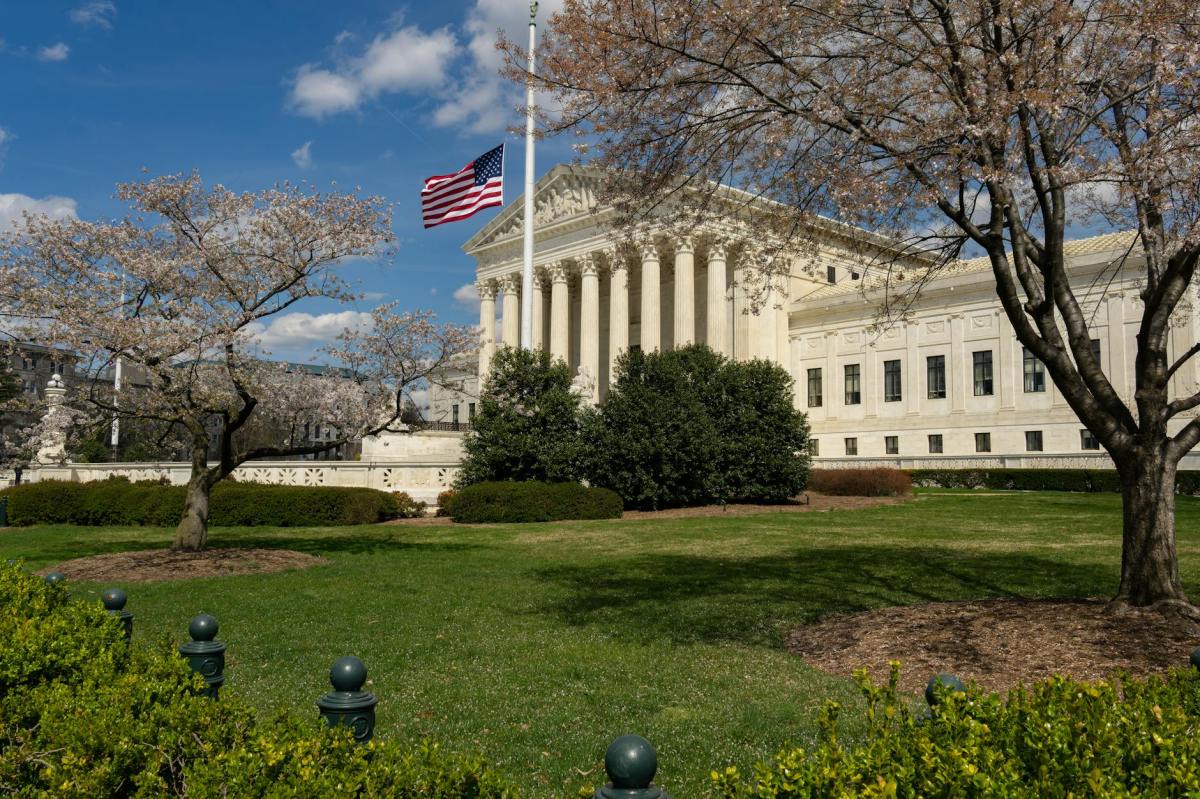
The United States Supreme Court is the highest level of the judiciary branch of the United States government. Currently, there are 9 justices on the court.
Out of 115 justices that have served on the court, only six have been women. The first woman justice, Sandra Day O’Conner, was appointed in 1981. She was followed by Ruth Bader Ginsburg. Now serving are Sonia Sotomayor, Elena Kagan, Amy Coney Barrett, and Ketanji Brown Jackson.
The justices usually keep a low profile and we hear little about their decisions except for high-profile cases, such as the recent one concerning presidential authority to impose tariffs, where they ruled the president does not.
One of the justices who ruled in the majority, Amy Coney Barrett, recently spoke at a public event in Santa Fe, New Mexico. It was profiled in this article from States Newsroom that I share with you. She explained how judges make decisions, especially ones that don’t make sense to some people. According to Justice Barrett, it’s a matter of “standing up for the law.”
‘You are always going to disappoint one side’: Justice Coney Barrett talks SCOTUS during NM visit
by Julia Goldberg, Oklahoma Voice
March 9, 2026
United States Supreme Court Justice Amy Coney Barrett did not envision a career as a judge. Rather, the former law professor and mother of seven children, was “really more thinking about how to balance a career as a lawyer and being kind of a two-career family and having young children in the house as well,” she said Sunday afternoon during an event in Santa Fe.
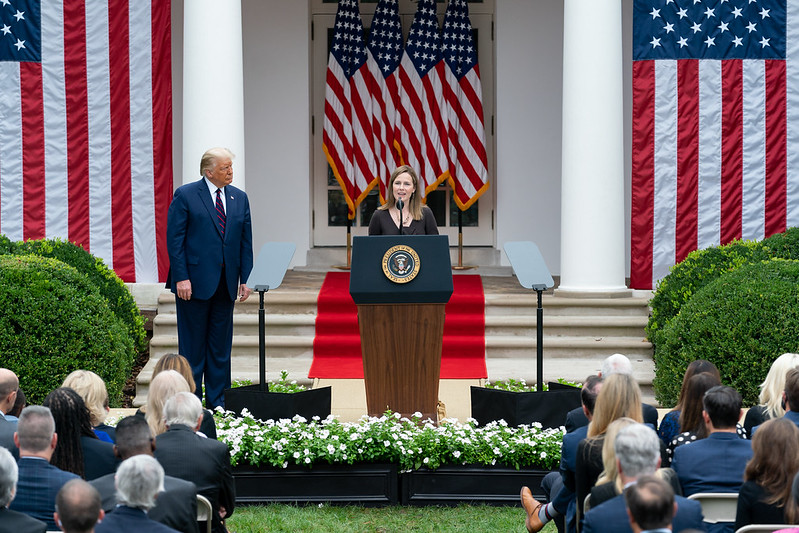
Nonetheless, a judge she became, serving on the Seventh Circuit Court of Appeals and then joining the Supreme Court in 2020 after being nominated by President Donald Trump.
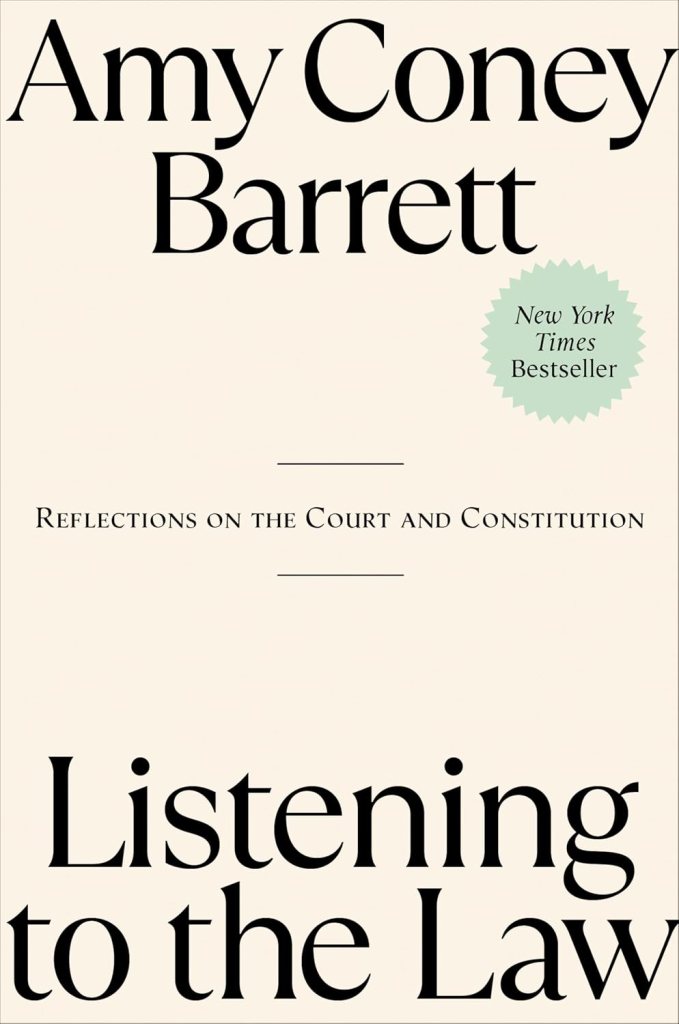
Barrett’s appearance — her first trip to the city, she said — came via an event presented by St. John’s College and the University of New Mexico School of Law. The Q&A format, with questions posed by David F. Levi, a former U.S. District Court judge, largely hewed to the outline of Barrett’s book Listening to the Law: Reflections on the Court and Constitution. (affiliate link)
read or listen to sample
Barrett mostly avoided speaking directly to more controversial topics. Tickets were free, but attendees also had the option of purchasing a $20 ticket that included a pre-signed copy of Barrett’s book, which she has been discussing at public events since last year.
Protesters in the dozens, however, showed up to the theater and stayed outside, throughout, loudly denouncing Barrett’s presence in Santa Fe, and her actions on the court, with particular emphasis on her role in overturning federal abortion rights in June of 2022.
Court talk
Barrett wrote her book, she said, to answer common questions she receives about how SCOTUS functions, and to provide the public a better sense of the behind-the-scenes work of deciding law.
“One of the things that I do with the court as a form of civic education is I will speak to groups that come to the court, sometimes schools, sometimes they’re visitors from other countries, and interestingly, across all of those groups, the questions are similar,” she noted.
“How does the court get cases? How do you decide cases? Do the justices get along? I can’t talk to everyone who comes through the court or answer every single letter in detail, but I could write a book that explained the Constitution and the law and the court, and in that way, could invite people in.”
Barrett also insisted that the justices do, in fact, get along.
“Federal judges have life tenure,” she said, “which means as long as you’re in good behavior, you have the job for life, and that’s designed to insulate you from the political process. The president can’t fire you if he doesn’t like a decision that you make, and the same goes for Congress.
The way that I have described it to people is to say it’s kind of like an arranged marriage with no option of divorce. I didn’t pick my colleagues, and my colleagues didn’t pick me; somebody else picked us, and then we’re all kind of thrust upon one another, but we’re all there for the long haul. We’re all there for good. So it serves us best to all get along.” That being said, she added, “I also genuinely like my colleagues.”
Being a judge
In response to questions about what qualities best serve a judge, Barrett said over her decade as one, she’d “really grown to appreciate” the need for judges to have “strong character, because I think you need to have a judge that can withstand pressure from the outside.” The “nature of the enterprise,” she said, “is you are always going to disappoint one side. If you can’t steel yourself to following the law where it leads, regardless of whether it earns you enemies, then you’re not a very good judge.”
She described herself as “fortunate to have friends and family who don’t really care about the decisions I make..who love me regardless. But that’s not true of everyone, right?” Being a judge means “you really have to be willing to be lonely, honestly. You have to be prepared to lose friends, and you have to be prepared to be criticized. And I don’t know that I really fully appreciated that before I became a judge.”
Politics on the bench
Barrett has angered people on both sides of the political spectrum. As a Trump appointee, she is generally considered one of the court’s conservative justices.
In addition to voting to overturn Roe v. Wade, which in turn upended access to abortion across the country, she also sided with the court’s conservative majority to expand gun rights and curtail affirmative action.
On the other hand, she has also voted to limit the president’s authority in some cases, such as siding against the president in the court’s recent tariff case. The New York Times, in an analysis last year, found Barrett to be the Republican-appointed justice “most likely to be in the majority in decisions that reach a liberal outcome.”
When asked about the perception that the court is divided in such partisan ways, Barrett said she found it “extremely frustrating, because none of the nine of us on the court would describe our job as political or describe ourselves as being engaged in the enterprise of delivering partisan results.”
Rather, she said, her “power as a judge is constrained” by Article Three of the Constitution, which established the judicial branch.
“I’m not free to disregard what the Constitution requires, what statutes say, because I might think that it’s unjust,” she said, noting that any number of issues coming before the court might engender strong feelings, such as immigration or the death penalty. “Even friends or family will say, ‘When you get this case, you need to do this. You need to stand up for the little guy,’ or that sort of thing. But I can’t think about my job that way, because what I have to do is stand up for the law.”
Barrett describes herself as an originalist and a textualist, meaning she adheres to the meaning of the Constitution at the time it was written. She also touched on the legal principle of stare decisis, which means abiding by the historical precedents already established in the law.
During her confirmation hearing in 2020, Barrett declined to describe Roe v. Wade as a “super-precedent” case, which she described as “cases that are so well settled that no political actors and no people seriously push for their overruling.” During Sunday’s talk, Barrett did not reference the 1973 Roe v. Wade case specifically, but spoke generally about the doctrine of stare decisis, noting that it means, “that once a case is decided, we generally don’t overrule it, unless a series of factors shows that that precedent has is not only wrong, but is also unworkable.”
‘We’ve all heard her rhetoric before’
The protesters outside the Lensic, whose numbers swelled as the event drew near, appeared disinterested in Barrett’s legal theories. Many were there, they told Source NM, simply because Barrett’s role in overturning abortion rights had caused irreparable harm.
“She’s caused women across, especially the South in the United States, to die because they haven’t had access to abortion,” Lizzie Nutig, a leader from the activist group Dare to Struggle, said. “She’s caused women to stay in abusive relationships…some women experience horrid medical things from having pregnancies that get complicated. We really see her as someone that shouldn’t have a platform to speak. We’ve all heard her rhetoric before. We don’t need to hear it again.”
Janet Williams, president of the Santa Fe Chapter of the National Organization for Women, said she was “angry” at Barrett’s decision overturning Roe v. Wade, and perceived it as a reversal of what Barrett had said during her confirmation hearings. “To me that was a flip flop, and I didn’t like it.”
Dia Winograd, 80, wore a hanger around her neck inscribed with the words, “You can only ban safe abortions.”
“I never thought I’d have to be back out here,” she said.
Joel Aalberts, executive director of the Lensic, told Source NM the protesters were expected and that one of the reasons the Lensic welcomed the event is that “discussion is an essential part of the democracy.”
That being said, in his introduction to the event, Aalberts cautioned audience members that the protests needed to stay outside. Whether out of obedience or friendliness to Barrett, attendees abided.
Learning to disagree
Barrett also insisted, in response to a pre-selected question from a student at one of the sponsor schools, that her Catholic faith does not “color” her work on the court.
“I don’t take my faith to work in the sense that I, you know, pray about how a decision should be decided, or…call up the Pope on the phone and say, ‘What are you thinking about this case?’ We live in a country that’s very diverse. The First Amendment grants everybody the freedom to have whatever religion they choose, or no religion at all. And so I see it as antithetical to what my job would be, to try, in any way, to impose my faith on other people, or conceive of my job as part of, you know, a mission of my faith.”
While not speaking directly to her own controversial decisions, let alone the protesters outside the theater’s front door, Barrett did acknowledge the country’s partisan divide, and earned some audience laughter when she herself laughed a bit when asked to explain the optimism about the country she expresses in her book.
“It’s easy to have rose-colored glasses on about times being better before and our being in a uniquely difficult and hostile point in American history,” she said, before going on to cite other difficult times in U.S. history, such as the civil war, and the uprising and political assassinations in the 1960s.
“I think we’ve survived some pretty rancorous times,” Barrett said. “We’ve survived a lot of rifts in our country and the Constitution, we have the oldest living written constitution in the world, and it has survived through all of that. And I choose to treat past as predictive of the future. I think we have a lot of people who love America. I think the 250th anniversary can inspire us, and I think we can build on what prior generations have given us and carry it forward.”
Justice Barrett
This story was originally produced by Source New Mexico, which is part of States Newsroom, a nonprofit news network which includes Oklahoma Voice, and is supported by grants and a coalition of donors as a 501c(3) public charity.
About Santa Fe
Santa Fe is the capital of New Mexico and is known for its arts, nature, and music. It is also the home of Santa Fe National Cemetery, the resting place of thousands of men and women who have served in the United States Armed Forces. I took this photo while visiting the area.

Images in this Post
Images added for illustration and were not affiliated with the original publication.
For Your Thoughts
How do you feel about cases being based on the “law” and historical precedents? When and how should they be overruled?
What other laws seem to be “super-precedent but might be challenged, such as birth-right citizenship? Should they be reconsidered?
What do you think about the “partisan divide” in the United States? Are you as optimistic as Justice Barrett about our future?
Exploring the HEART of Health
I’d love for you to follow this blog. I share information and inspiration to help you transform challenges into opportunities for learning and growth.
Add your name to the subscribe box to be notified of new posts by email. Click the link to read the post and browse other content. It’s that simple. No spam.
I enjoy seeing who is new to Watercress Words. When you subscribe, I will visit your blog or website. Thanks and see you next time.
Use this search box for related posts on this blog or other topics of interest to you.
Dr. Aletha
- About Dr. Aletha
- How to Use this Site
- Make Your Life Easier
- Search by Category
- Share the HEART of health
- my Reader Rewards Club
- RoboForm Password Manager









 watercress words by Dr Aletha