updated March 5, 2025
What is a good life? An article in JAMA, the Journal of the American Medical Association, answered it this way.
“everyone seeks a good life. Health is an essential component, but a good life also involves productive work, emotional and spiritual well-being, supportive social relationships, and a clean and safe environment. “
The Good Life-Working Together to Promote Opportunity and Improve Population Health and Well-being JAMA, April 26, 2016
How faith and community make us better humans
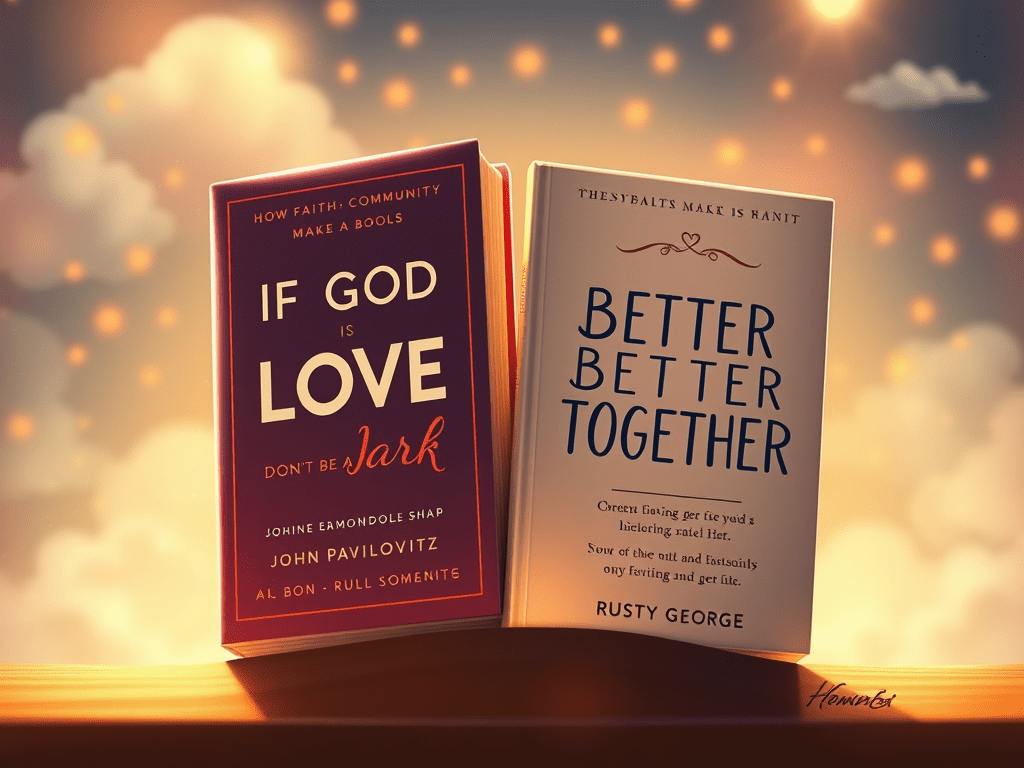
In these books , two pastor authors make a case for Christians to follow Jesus and his teachings more authentically and intentionally, as individuals and with each other . By doing so, we can have more satisfactory relationships while nurturing our own emotional and spiritual well-being.
In If God is Love, Don’t be a Jerk, John Pavlovitz looks at how we act toward others. In Better Together Rusty George considers how we see ourselves. I think they end up at the same place- a good life as better humans.
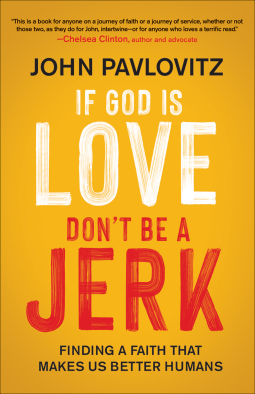
If God is Love, Don’t Be a Jerk :Finding a Faith That Makes Us Better Humans
by John Pavlovitz
I was intrigued by the title of John Pavlovitz’s book, If God Is Love, Don’t Be a Jerk. A book about love sounded innocent enough. Many Christian living books want to make us feel better about ourselves. Not this one, rather this book’s message may leave you feeling worse about yourself.
Most of us don’t want to be “jerks”, we want to be “better humans.” John challenges us to examine our assumptions about God, Jesus, church, and love- especially love for those who look, think, believe, and behave differently from us. In his view, most in the evangelical, conservative Christian world act like jerks.
John spares no group or dogma; he calls out racism, homophobia, misogyny, nationalism, and Trumpism. He names the “greatest sin of the American evangelical church”-parochial self-centered existence.
John deplores self-righteousness while sounding self-righteous himself at times. He admits he is angry but suggests it is a righteous anger on behalf of those who are marginalized, oppressed, and discriminated against.
John shares his own rocky faith journey which led him away from traditional mainstream Christianity into a belief system that interprets the Bible more liberally and emphasizes strong commitment to social justice issues.
Initially I was irked by his attitude but eventually came to recognize his anguish over what he sees as the failings of the Church and individual Christians-lack of genuine love. The book’s tone changes as he concludes by pleading with us to be more tender hearted, empathetic, merciful-in other words more like Jesus.
I wished he had said more of this at the beginning, as some of his earlier chapters were strong enough in their rebuke to turn away the very people who most need to read them. But if readers are willing to stick with him, and hear his heart as well as his head, it might cause a revolution in the Church as well as the nation and the world.
John Pavlovitz’s words may not change your mind but may move your heart if you are open and willing.
Listen to an Audible sample here.
You can also find John at his website
JOHN PAVLOVITZ- Stuff That Needs To Be Said
Better Together: Discover the Power of Community
By Rusty George
Whether you are an introvert, extrovert, or somewhere in-between, Rusty’s book Better Together: Discover the Power of Community will have something that speaks to your heart.

Rusty George is the Lead Pastor of RLC-Real Life Church in Valencia California. The church, founded 15 years ago, has now grown to 6000 attendees over three campuses.
Drawing on his personal experience as an introvert, husband, and father of two daughters, as well as his experience as a youth pastor and lead pastor, he makes a case for living, worshiping, and serving in community; we cannot make it alone he teaches. In a non-threatening, easy going style, he encourages us to exchange a “selfie” existence to partnering with others.
Rusty outlines three major benefits of community life- to connect with God, overcome weaknesses, and leave a legacy- by drawing from The Bible, especially the Psalms, Hebrews, James, and Revelation.
He explains how major Bible characters-Nehemiah, John, Esther, David, and especially Jesus-lived by these principles.
Rusty admits his mistakes trying to do life apart from community and shares the times where his attempts to overcome his introversion were successful.
“In every instance where I wanted to run from, I decided to run toward community. “
Throughout the book he sprinkles quotes from noted Christian authors-C.S. Lewis, Eugene Peterson, Tony Campolo, Max Lucado, and Dallas Willard.
At the end of each of the twelve chapters are discussion questions suitable for a class or small group study. Notes and references for each chapter appear at the book’s end.
In Better Together, Rusty George hopes you will learn to
“Let people in on your “impossible” dream. They just might help you achieve it.”
Learn more about Rusty at
Pastor Rusty George
exploring the HEART of spiritual health
The book links are affiliate links and if you shop through them this blog receives a small commission used to fund blog fees (not to make me rich.)

I received complimentary digital copies of these books from NetGalley in exchange for writing a review.
Thank you for reading this post. Please follow this blog and me on social media.
I share information and inspiration to help you transform challenges into opportunities for learning and growth.
Add your name to the subscribe box to be notified of new posts by email. Click the link to read the post and browse other content. It’s that simple. No spam.
I enjoy seeing who is new to Watercress Words. When you subscribe, I will visit your blog or website. Thanks and see you next time.

Dr Aletha
- About Dr. Aletha
- How to Use this Site
- Make Your Life Easier
- Search by Category
- Share the HEART of health
- my Reader Rewards Club
- RoboForm Password Manager