
Dr. Charles Krauthammer- a physician to know- in memoriam

As a physician, I am intrigued and inspired knowing Dr. Krauthammer completed medical school and residency after and despite sustaining a spinal cord injury which caused quadriplegia (paralysis from the neck down, preventing use of his arms and legs).

I don’t remember the first time I read an article by Charles Krauthammer but once I did, I never missed a chance to read more. Dr. Krauthammer passed away from cancer in 2018 and I among many mourn his passing.

His Washington Post syndicated column appeared in my local newspaper on Saturdays;  I would read it aloud at breakfast so my husband and I could discuss it. Invariably, there would be one or two words or phrases we didn’t understand so I would look up the definition- this despite  both of us having graduate degrees.  We were alternately entertained, enlightened, and enthralled by his way with words.

As a physician, I am intrigued and inspired knowing  Dr. Krauthammer completed medical school and residency after and despite sustaining a spinal cord injury which caused quadriplegia (paralysis from the neck down, preventing use of his arms and legs).   (This no doubt made his treatment and recovery from cancer surgery all the more difficult.)  In his memoir, he explained how a caring professor did whatever it took to help him get through medical school after his injury, including lectures at his bedside while he was still hospitalized.

DR. CHARLES KRAUTHAMMER-IN MEMORIAM-WWW.WATERCRESSWORDS.COM

He did not use “M.D.” or the title “Dr.” after he changed his career from psychiatry to journalism, but I think he should have, he earned it.  He mostly wrote about politics and social issues but occasionally would address medical issues. (These and others in this post are affiliate links to Dr. Krauthammer’s books and others.  )

Here are excerpts from a sampling of  articles that deal with medical topics;  I encourage you to read them in their entirety.


After watching videos in which  The price of fetal parts was discussed over lunch, Dr. Krauthammer wrote

“Abortion critics have long warned that the problem is not only the obvious — what abortion does to the fetus — but also what it does to us. It’s the same kind of desensitization that has occurred in the Netherlands with another mass exercise in life termination: assisted suicide. It began as a way to prevent the suffering of the terminally ill. It has now become so widespread and wanton that one-fifth of all Dutch assisted-suicide patients are euthanized without their explicit consent.

ultrasound image of a 4 month old fetus
a prenatal ultrasonographic image of fetus at the four-month point in its gestation; public domain image used courtesy of the CDC/ Jim Gathany

There is more division about the first trimester because one’s views of the early embryo are largely a matter of belief, often religious belief. One’s view of the later-term fetus, however, is more a matter of what might be called sympathetic identification — seeing the image of a recognizable human infant and, now, hearing from the experts exactly what it takes to “terminate” its existence.

The role of democratic politics is to turn such moral sensibilities into law. This is a moment to press relentlessly for a national ban on late-term abortions.”


After Another massacre, another charade  he said this about guns and laws about them.
gun metal barrel
Photo by Somchai Kongkamsri on Pexels.com

“So with the Roseburg massacre in Oregon. Within hours, President Obama takes to the microphones to furiously denounce the National Rifle Association and its ilk for resisting “common-sense gun-safety laws.” His harangue is totally sincere, totally knee-jerk and totally pointless. At the time he delivers it, he — and we — know practically nothing about the shooter, nothing about the weapons, nothing about how they were obtained.

In the final quarter of his presidency, Obama can very well say what he wants. If he believes in Australian-style confiscation — i.e., abolishing the Second Amendment — why not spell it out? Until he does, he should stop demonizing people for not doing what he won’t even propose.”


In this tongue-in-cheek (pardon the pun)  post Food fads: Make mine gluten free he “preaches skepticism” about most current dietary advice.

“Exhibit A for medical skepticism, however, remains vitamin C. When Linus Pauling, Nobel laureate in chemistry (not nutrition), began the vitamin-C megadose fad to fend off all manner of disease, the whole thing struck me as bizarre. Yes, you need some C to prevent scurvy if you’re seven months at sea with Capt. Cook and citrus is nowhere to be found. Otherwise, the megadose is a crock. Evolution is pretty clever. For 2 million years it made sure Homo erectus, neanderthalensis, sapiens, what have you, got his daily dose without having to visit a GNC store.

Sure enough, that fashion came and went. But there are always new windmills to be tilted at. The latest is gluten.

various types of bread
Photo by Pixabay on Pexels.com

Now, if you suffer from celiac disease, you need a gluten-free diet. How many of us is that? Less than 1 percent. And yet supermarket shelves are groaning with products proclaiming their gluten-freedom. Sales are going through the roof.”

Exploring the HEART of health with Dr. Charles Krauthammer

I enjoyed listening to  Dr. Krauthammer’s memoir THINGS THAT MATTER: Three Decades of Passions, Pastimes, and Politics  
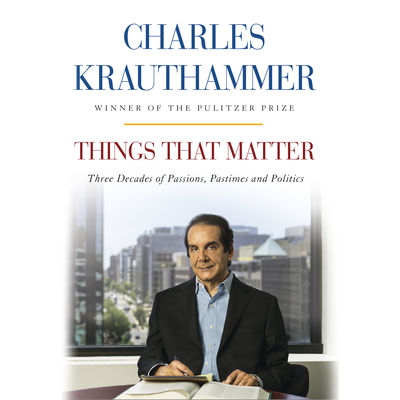
Charles Krauthammer-THINGS THAT MATTER
available as an audiobook from the iTunes Store

His book is a collection of  his more memorable opinion pieces as well as a memoir of his life, including medical school, his life-changing injury, psychiatric medical practice, his  journalism career, hobbies (chess and baseball) and life with his family.

According to Amazon-

Now, finally, the best of Krauthammer’s intelligence, erudition and wit are collected in one volume.”

Dr. Aletha
in memoriam

In his last piece for The Washington Post, barely two weeks before his death, Dr. Krauthammer wrote,

“I leave this life with no regrets. It was a wonderful life — full and complete with the great loves and great endeavors that make it worth living. I am sad to leave, but I leave with the knowledge that I lived the life that I intended.”

I am sad he left, but grateful that he shared his “intelligence, erudition, and wit” with the world.  May we all find the loves and endeavors that make life worth living and live intentional lives as well as he did.


Tributes to Dr. Krauthammer, a few of many

from the NATIONAL REVIEWCharles Krauthammer, R.I.P.

from THE NEW YORK TIMES – The Example of Charles Krauthammer

from the WEEKLY STANDARDThe Quick Wit of Charles Krauthammer

Please share this post and share about your recollections of  Dr. Krauthammer’s work.

Hemingway’s study- chaos and creativity

This entire house, and especially the narrative of his life (as related to us by our verbose tour guide) is itself a study of a man whose life and career was largely shaped by mental illness.

Ernest Hemingway wrote some of his popular novels, including To Have and Have Not, in the study of his Key West Florida home.

The house, on the National Register of Historic Places, has been preserved as it was when he and his wife Pauline lived there and is open to visitors, like myself, when I visited there a couple of years ago.

the study of Ernest Hemingway, with a cat sleeping on the floor

Chaos

This entire house, and especially the narrative of his life (as related to us by our verbose tour guide) is itself a study of a man whose life and career was largely shaped by mental illness.

Ernest Hemingway displayed mood swings and abused drugs and alcohol. Despite numerous psychiatric hospital stays where he was treated with ECT, electroconvulsive therapy, he struggled with chronic depression.

He died from a self-inflicted gunshot wound to his head in 1961.

CATWALK

Creativity

While dealing with mental illness and traumatic brain injuries, he continued to write prolifically and successfully, winning the Nobel Prize for literature in 1954 for The Old Man and the Sea.

He wrote acclaimed novels, several of which became major movies. His personal life was not so successful; three of his four marriages ended in divorce.

photos of Ernest Hemingway displayed at his Key West home

Ernest Hemingway’s novels and movies 

(an affiliate link, if you use it, at no additional cost, this blog will earn funding.)

The challenge of mental illness

Mental illness often runs in families. Ernest’s father, Dr. Clarence Hemingway, a gynecologist, suffered from manic-depression and died by suicide.  Ernest and his siblings likely inherited it from their father.

2016-06-16 10.05.16

Sadly, it did not end with him. His granddaughter, Margaux Hemingway, a fashion model and actress, dealt with depression, alcoholism, and bulimia.

She died from an apparent intentional drug overdose at age 42.

Her sister Mariel reflected on her family’s troubled history in

Finding My Balance 

“A lonely life”

SOLITARYWRITER

Ernest Hemingway could not attend the ceremony to receive his Nobel Prize. He wrote a short speech which was read by John C. Cabot, the Ambassador to Sweden. In that speech he wrote, 

“Writing, at its best, is a lonely life. Organizations for writers palliate the writer’s loneliness but I doubt if they improve his writing. He grows in public stature as he sheds his loneliness and often his work deteriorates. For he does his work alone and if he is a good enough writer he must face eternity, or the lack of it, each day.”

HEMINGWAY'S STUDY-CHAOS AND CREATIVITY

Hemingway’s cats

At least 40 to 50 cats live on the grounds of the Hemingway House;  many of them are descendants of Ernest Hemingway’s cats. They live peaceful, serene lives, far different from the people who lived there long ago.

What you should know about suicide from the

 NIH: National Institute of Mental Health

  • Suicide is the tenth most common cause of death in the United States.
  • People may consider suicide when they are hopeless and can’t see any other solution to their problems.
  • Suicide may occur with  serious depression, alcohol or substance abuse, or a major stressful event.
  • People who have the highest risk of suicide are white men.
  • Women  and teens report more suicide attempts.
  • Therapy and medicines can help most people who have suicidal thoughts. Treating mental illnesses and substance abuse can reduce the risk of suicide.
  • If someone talks about suicide, you should take it seriously.
  • Urge them to get help from their doctor or the emergency room, or call the

Crisis Lifeline -call 988

988lifeline.org

available 24/7

A psychiatrist, Dr. Melissa Welby says this about managing bipolar disorder(a form of chronic depression).

“A key to managing bipolar disorder is to recognize early relapse warning signs. Medication will minimize, but not eliminate, mood swings for many people coping with bipolar disorder. “

On her blog she offers offers these 

Keys to Coping with Bipolar Disorder

Understanding mental illness

I hope you will use the following links to resources to help you, your family, or anyone you know who does or may suffer from mental illness. There is help and most importantly, there is hope.

Warning signs of mental illness

“Major mental illnesses such as schizophrenia or bipolar disorder rarely appear “out of the blue.” Most often family, friends, teachers or individuals themselves begin to recognize small changes or a feeling that “something is not quite right” about their thinking, feelings or behavior before one of these illnesses appears in its full-blown form.”

Technology and the future of mental health treatment

“Excitement about the huge range of opportunities has led to a burst of app development. There are thousands of mental health apps available in iTunes and Android app stores, and the number is growing every year. However, this new technology frontier includes a lot of uncertainty. There is very little industry regulation and very little information on app effectiveness, which can lead consumers to wonder which apps they should trust.” (affiliate link used)

Suicide prevention

“The most important thing to remember about suicidal thoughts is that they are symptoms of a treatable illness associated with fluctuations in the body’s and brain’s chemistry. They are not character flaws or signs of personal weakness, nor are they conditions that will just go away on their own. “

exploring the HEART of health in travel

Thanks for joining me to tour the unique home of Ernest Hemingway, using photos I took myself.

Please consider helping support this blog by using my affiliates. You’ll find links in the side bars, on the home page, and on the resource page.

Thank you for following  and sharing Watercress Words.

man and woman with Key West visitor sign
My husband and I upon arriving in Key West, Florida the farthest south city in the U.S.A.
Dr. Aletha