Living life, facing death-a review of A Beginner’s Guide to the End

Even as a physician, I was surprised at the claim that only 10% to 20% of us will die without warning. The rest of us will know we have something that will likely take our life. And even if we don’t, we all know we will die eventually, although we tend to think and act as if it’s a well kept secret, and maybe it is.

View post to subscribe to site newsletter.

by B.J. Miller, M.D. and Shoshana Berger

This book’s tag line sums up the content of this book perfectly. I have reviewed other books about death on this blog; they were more biographical, philosophical, and spiritual and touched less on the practical. This book is on the other end of the spectrum; more practical, but also philosophical ,and spiritual. ( And I mean spiritual in a broad sense, not necessarily religious.)

The book begins with a brief biographical section where each author shares their reason for writing a book about death. Dr. Miller, a palliative care physician, had a life-threatening injury. He writes,

I got close enough to see something of death and come back from the ledge, only to realize that it’s in and around us all the time.

Ms. Berger, an editorial director, took care of her dying father. She wrote,

I remember those years as being full of anxiety and grief but also as a time of drawing closer.
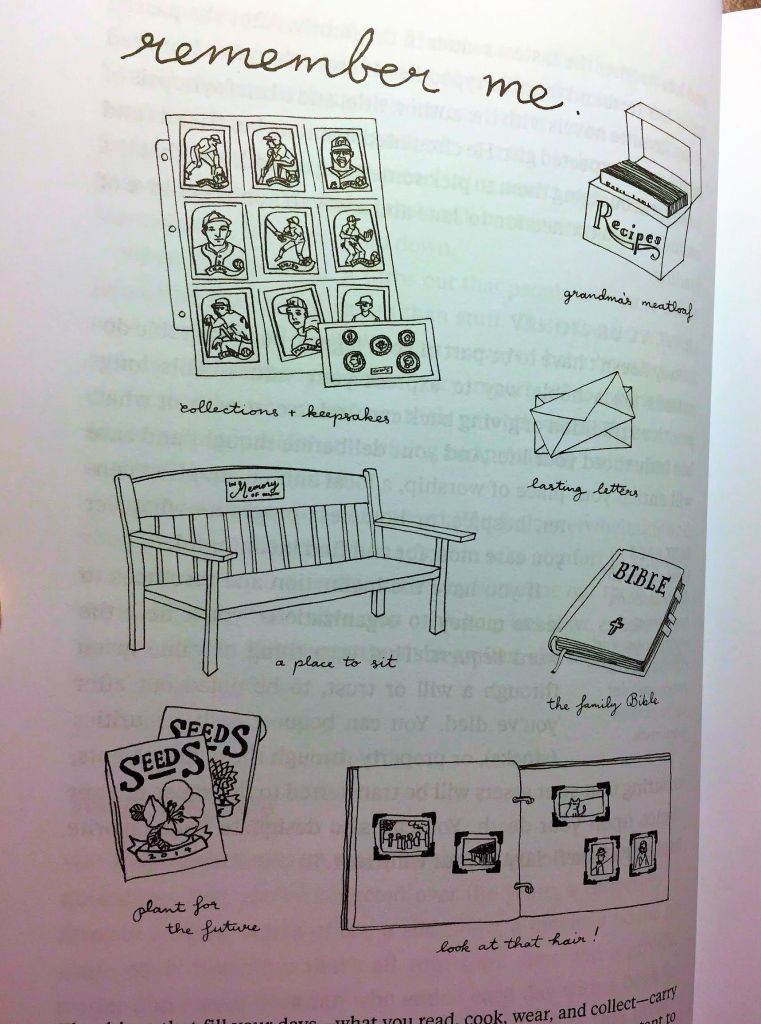
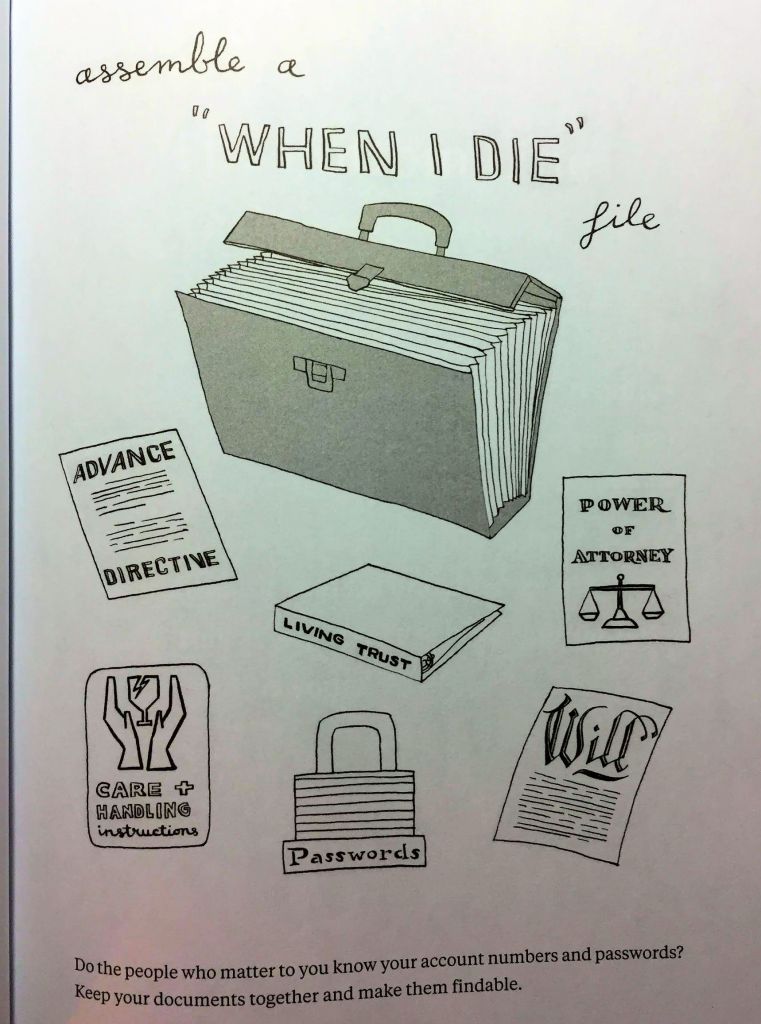
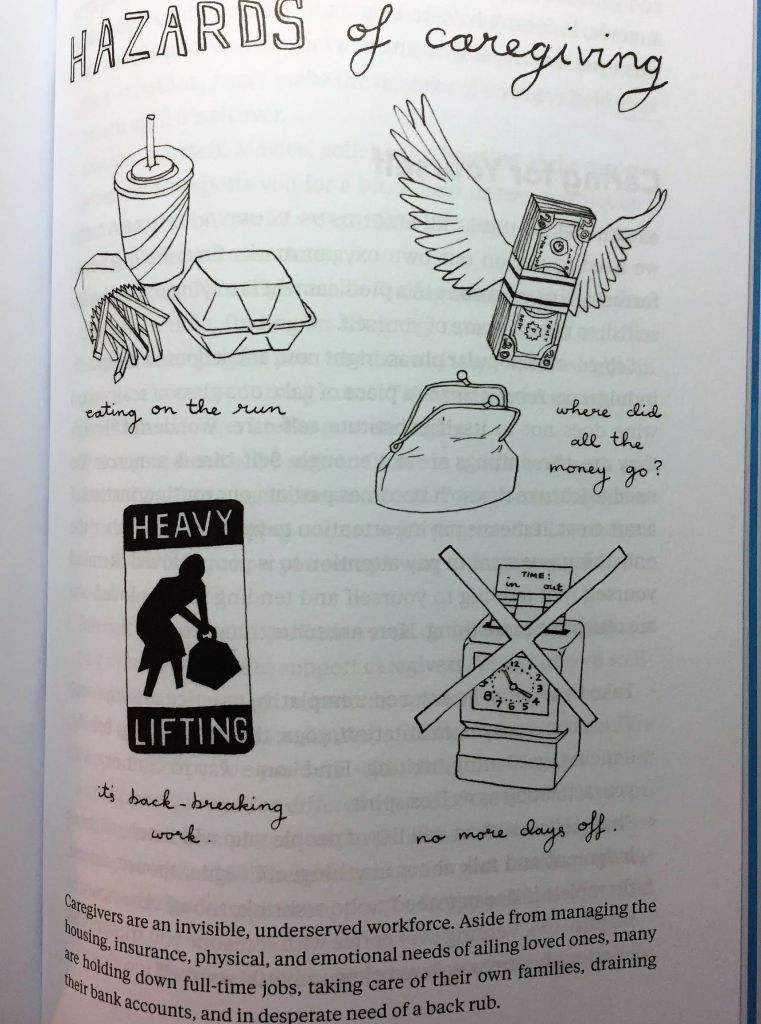
an illustration from the book

How the book unfolds

The book consists of 5 sections that mimic the progression from life to illness to death. Even as a physician, I was surprised at the claim that only 10% to 20% of us will die without warning. The rest of us will know we have something that will likely take our life. And even if we don’t, we all know we will die eventually, although we tend to think and act as if it’s a well kept secret, and maybe it is.

The sections are as follows

  • PLANNING AHEAD
  • DEALING WITH ILLNESS
  • HELP ALONG THE WAY
  • WHEN DEATH IS CLOSE
  • AFTER

Although you could read the book straight through, you might want to skip to sections you need at whatever stage you are in. Chapter titles clearly tell you what to expect from their content. Here are some examples-

  • Yes, There’s Paperwork.
  • Can I Afford to Die?
  • I’m Sick
  • Love, Sex, and Relationships
  • Hospital Hacks
  • Care for the Caregiver
  • It’s Your Body and Your Funeral
  • Grief
  • How to write a Eulogy and an Obituary
  • Celebrating a Life

There are no photographs, charts, graphs, or info graphics, but scattered throughout are illustrative sketches that convey helpful information in a non threatening way. I have used some screenshots of a few of them to illustrate this post.

The authors conclude the book with Last Words, Acknowledgments, Resources (an extensive list), Notes, and Index.
Read this book

As much as I hope you don’t need it right now, unfortunately you do need it right now. So whatever stage of living, or dying, you or a loved one may be in, you will find something helpful here.

Find the book at your local library like I did, or get it from one of these book sellers; this would be a good book to keep on hand. (These affiliate links pay a commission to support this blog, while you pay nothing extra. )

Dr. Miller’s TED talk on WHAT REALLY MATTERS AT THE END OF LIFE

Here is another post from this blog about the dying experience

What books teach us about dying

an excerpt-

I reviewed these books  because understanding how other people and their families have faced death may relieve our dread, anxiety, or fear  about dying and death. Often it is not death itself that we fear but the dying process -the pain , disability, dependence, isolation, unfulfilled dreams.

In an essay  for JAMA, Dr. Zachary Sager, a geriatric and palliative care physician in Boston Massachusetts, described his response to  working with dying patients-

“I witnessed how people could be simultaneously resilient and fragile. I was moved by the connectedness between individuals.

I accept that death offers not only the expected reflection on life and mourning but an opportunity for a unique form of growth and healing. ”

The books I reviewed share  common themes, and events yet are each unique as are the people in them who demonstrate both resilience and fragility.

sharing the HEART of life and death

Dr. Aletha

A time to be born, and a time to die-what books teach us about dying

The books I reviewed share  common themes, and events yet are each unique as are the people in them who demonstrate both resilience and fragility. 

There is a time for everything,
    and a season for every activity under the heavens:

    a time to be born and a time to die,

Ecclesiastes 3, NIV

Holy Bible, New International Version®, NIV® Copyright ©1973, 1978, 1984, 2011 by Biblica, Inc.® Used by permission. All rights reserved worldwide.

Birth and death are the only medical events that all humans share. We can anticipate and celebrate the births of other people but not our own.

However we all can anticipate our own death although most of the time we don’t want to.  Unless we deal with a chronic life threatening disease or  are  diagnosed with a terminal illness, or thrust into a life-threatening situation such as combat or a natural disaster,  most of us don’t consider  about how or when we will die. But in truth we all will die.

I have reviewed several books about death here . Not because I  wanted to write about death but because several good books deal with death sensitively and thoughtfully.

Books about death are sometimes written by a person who is facing death. Relatives write after a loved one dies- a child ,a spouse ,a parent. The motivation for writing these books varies as does the motivation for reading them.

I reviewed these books  because by understanding how other people and their families have faced death it may relieve our dread, anxiety, or fear  about dying and death. Often it is not death itself that we  fear but the dying process -the pain , disability, dependence, isolation, unfulfilled dreams.

In an essay  for JAMA, Dr. Zachary Sager, a geriatric and palliative care physician in Boston Massachusetts, described his response to  working with dying patients-

“I witnessed how people could be simultaneously resilient and fragile. I was moved by the connectedness between individuals.

I accept that death offers not only the expected reflection on life and mourning but an opportunity for a unique form of growth and healing. ”

The books I reviewed share  common themes, and events yet are each unique as are the people in them who demonstrate both resilience and fragility.

I am posting excerpts from my reviews with a link to the entire piece. I welcome and encourage your comments about these books as well as any about how you  have navigated death in your family.

A 90 year old woman says “yes” to life

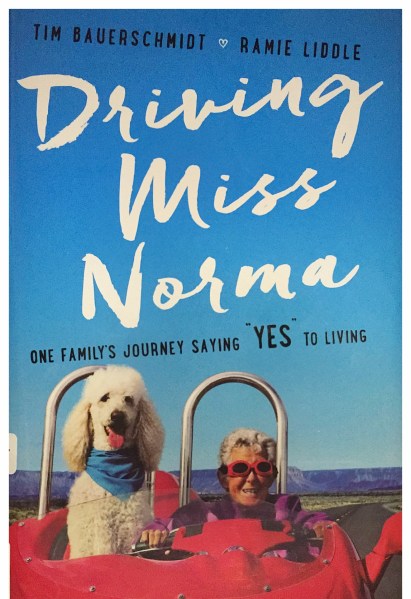
Driving Miss Norma tells the story of Norma Bauerschmidt, a WWII WAVE veteran, wife, and mother. She was still in good health at 90 years of age, until she was diagnosed with cancer.

Her doctor recommended surgery to be followed by chemotherapy, and warned her the treatment and recovery would be long and difficult. She told him no, she would rather “hit the road” with her son and daughter-in-law and enjoy her life, seeing and doing things she had not had a chance to do before. And her doctor agreed, saying that is just what he would do.

Driving Miss Norma - a book cover

Tim, her son, and Ramie, his wife, had already been living a nomadic life, travelling the country with their standard poodle Ringo in an Airstream travel  trailer they parked in campgrounds and  Walmart parking lots. They enjoyed travelling, seeing new places, meeting new people. They wondered how adding a 90 year old woman to their wandering lifestyle would work.

Driving Miss Norma- a book review

A young mother who chose life

A few months after their baby Indiana’s birth, Joey  faced the recurrence of cervical cancer diagnosed and treated years before. Despite more surgery, radiation and chemo the cancer persisted until further treatments were futile and and likely to cause more suffering. Joey decided to leave their Nashville farm,her horses, chickens and gardens, to move home to Indiana to spend her remaining time with her extended family.

To Joey, With Love

Faced with the persistence of the cancer

“Joey decided to come home-not to die, but to live.”

To Joey, With Love- a movie review

A physician who faces his own mortality

Dr. Paul Kalanithi was a 36-year-old resident physician who had, as he wrote, “reached the mountaintop” of anticipating a promising career as a neurosurgeon and neuroscientist. He had a loving wife, a supportive family and professors who respected his knowledge and skill. He seemed destined to be sought after, well paid, productive, successful, and  famous.

WHEN BREATH BECOMES AIR- a book

(note: a neurosurgeon treats  brain, spinal cord and nerve  diseases such as brain tumors that can be cured or improved with surgery,)

Unfortunately, “the culmination of decades of striving evaporated” when he was diagnosed with an aggressive form of lung cancer for which the prognosis was bleak, even with treatment. He was admitted to the very hospital where he trained as a neurosurgery resident, now  to learn what it is like to be a patient with a potentially terminal illness.

When Breath Becomes Air- reflections from Dr. Lucy Kalanithi

Thank you for joining me to remember and honor Norma, Joey, and Paul. I appreciate their families’ generosity in sharing their stories and the HEART of health.

Dr. Aletha stethoscope with a heart