Learn how to understand your doctor and make yourself understood
Turn your ear toward wisdom, and stretch your mind toward understanding. Call out for insight, and cry aloud for understanding. Seek it like silver; search for it like hidden treasure. Then you will understand the fear of the Lord, and discover the knowledge of God. The Lord gives wisdom; from his mouth come knowledge and understanding.
Wisdom will enter your mind, and knowledge will fill you with delight.
“Medical staff talk to you, but they might as well be speaking a foreign language. Whether they’re explaining your condition or giving instructions for the next steps of your care, their words go into your ears like a secret message you can’t decode. You know they’re talking about your body, but the disconnect to your brain leaves you helpless and frustrated.
a prayer-
I’m so thankful for the doctors and medical staff You’ve charged with my care. Even though I don’t always understand their words, it’s comforting to know You’ve given them the knowledge they need to treat my condition. “
Learn how to understand your doctor and make yourself understood with these previous posts-
“You may think your doctor knows exactly what you mean, but sometimes we are left trying to read between the lines of what you tell us. We doctors need to understand our patients’ expectations, concerns and obstacles.”
“You may think doctors make a diagnosis based on lab tests or xrays. But much of the time, those tests only confirm what we already suspect based on your symptoms.
Exploring the HEART of Health
Thank you for reading this post. Please follow this blog and me on social media.
I share information and inspiration to help you transform challenges into opportunities for learning and growth.
Add your name to the subscribe box to be notified of new posts by email. Click the link to read the post and browse other content. It’s that simple. No spam.
I enjoy seeing who is new to Watercress Words. When you subscribe, I will visit your blog or website. Thanks and see you next time.
Mammograms are not perfect tests. They can miss some cancers, and they can find lesions that may look like cancers but are not actually cancers (false-positive results), resulting in additional testing and procedures. They can also find very low-risk cancers that would never have caused any health problems if they were never found or treated (overdiagnosis).”
This information is current as of the date of original publication or update but may have changed by the time you read this. Do not use this information for diagnosis or treatment purposes. Before making health decisions, discuss with a qualified healthcare professional.
In this post I want to remind you of recommendations for breast cancer screening. Currently, the only test recommended for screening is mammography.
No other test has evidence that its use will decrease breast cancer deaths, although they may be useful for diagnosis in women who have breast symptoms.
These guidelines for screening apply only to women at average risk of breast cancer, which is most women. They do not apply to women who have ever been diagnosed and/or treated for breast cancer, or to women who currently have symptoms related to their breasts, such as a lump, pain, discharge, or skin changes.
Guidelines for screening come chiefly from two organizations- The American Cancer Society (ACS) and the United States Preventive Services Task Force (USPSTF). Other organizations such as the American Academy of Family Physicians (AAFP) , of which I am a member, usually follow their recommendations .
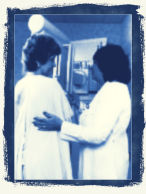
image used courtesy of the Public Health Image Library, CDC
“Mammograms are not perfect tests. They can miss some cancers, and they can find lesions that may look like cancers but are not actually cancers (false-positive results), resulting in additional testing and procedures. They can also find very low-risk cancers that would never have caused any health problems if they were never found or treated (overdiagnosis).”
guidelines from the ACS
Offer annual screening to women age 40 to 44 years.
Perform a mammogram annually in women 45 to 54 years.
Perform a mammogram annually or every other year starting at age 55 years.
Continue screening mammography as long as a woman’s overall health is good, with a life expectancy of 10 years or longer.
Routine breast exams by either the patient or a physician are not recommended.
Guidelines from the U.S. Preventive Services Task Force (USPSTF)
For ages 40-49 years, individualize the decision to screen every 2 years
For ages 50-74 years, screen every 2 years
For ages 75 years and older there is no recommendation.
Both organizations recommend that physicians discuss the decision to screen or not to screen with patients and base the decision after considering possible harms versus potential benefit.These are guidelines for physicians to apply to each individual patient, not hard and fast rules.
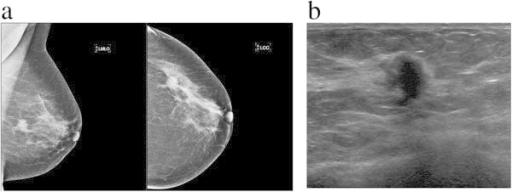
a mammogram revealing a breast cancer image source- National Library of Medicine, Open-i
Screening guidelines are not used for high risk women- women with
a history of previous breast cancer or ovarian cancer
a suspected or confirmed genetic mutation , BRCA, known to increase breast cancer risk
a history of radiation to the chest
a close family history of breast history, usually meaning parent, sibling, child, grandparent, aunt/uncle, or first cousin.
graphic courtesy of the CDC, U.S. Department of Health and Human Services
Screening guidelines also do not apply to women with breast symptoms suggestive of cancer.
a lump in the breast or axilla (armpit)
pain, especially in only one breast
nipple discharge
persistent rash or skin changes over the breast
These women need appropriate diagnostic testing which might include
“Both women and men can get breast cancer, though it is much more common in women. Other than skin cancer, breast cancer is the most common cancer among women in the United States.”
“You should talk to your doctor about the benefits and drawbacks of mammograms. Together, you can decide when to start and how often to have a mammogram.”
“Each woman also has different personal values, especially toward the idea of unnecessary medical tests and treatments.
Talk to your doctor if you are younger than 50 years and have questions about whether you should get a mammogram.”
Exploring the HEART of Health
Thank you for reading this post. Please follow this blog and me on social media.
I share information and inspiration to help you transform challenges into opportunities for learning and growth.
Add your name to the subscribe box to be notified of new posts by email. Click the link to read the post and browse other content. It’s that simple. No spam.
I enjoy seeing who is new to Watercress Words. When you subscribe, I will visit your blog or website. Thanks and see you next time.