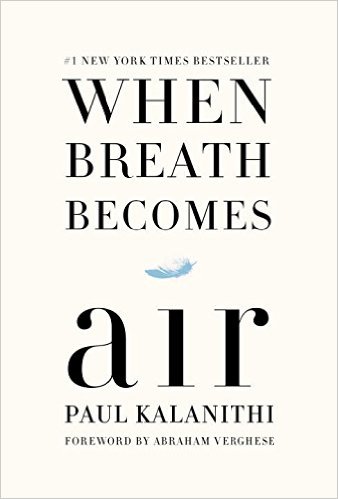
When Breath Becomes Air
by Paul Kalanithi, M.D.,
Dr. Paul Kalanithi was a 36-year-old resident physician who had, as he wrote, “reached the mountaintop” of anticipating a promising career as a neurosurgeon and neuroscientist. He had a loving wife, a supportive family and professors who respected his knowledge and skill. He seemed destined to be sought after, well paid, productive, successful, and famous.
(note: a neurosurgeon treats brain, spinal cord and nerve diseases such as brain tumors that can be cured or improved with surgery,)
Unfortunately, “the culmination of decades of striving evaporated” when he was diagnosed with an aggressive form of lung cancer for which the prognosis was bleak, even with treatment. He was admitted to the very hospital where he trained as a neurosurgery resident, now to learn what it is like to be a patient with a potentially terminal illness.


Dr. Kalanithi faced his diagnosis with the same resolve, fortitude, and determination that served him well through medical school and a grueling neurosurgery residency. After his first round of treatment he was able to return to the operating room as a doctor, not a patient.
Prior to entering medicine, Dr. Kalanithi had studied literature, earning degrees in English literature as well as human biology. He also completed a doctorate in history and philosophy of science and medicine at Cambridge.
Thus, when he realized he was facing his own death, he turned to his first love of writing to chronicle his experience and to explore “what makes human life meaningful?” And as he explored the meaning of what life is all about, he also explored the inevitability of death.
“I began to realize that coming in such close contact with my own mortality had changed both nothing and everything. Before my cancer was diagnosed, I knew that someday I would die, but I didn’t know when. After the diagnosis, I knew that someday I would die, but I didn’t know when.
But now I knew acutely. The problem wasn’t really a scientific one. The fact of death is unsettling. But there is no other way to live.”
Dr. Kalanithi passed away without completing his book, although his wife writes in the epilogue, “When Breath Becomes Air is complete, just as it is.” She and his parents kept their promise to have his book published after his death. She writes, “Paul was proud of this book, which was a culmination of his love for literature.”
Even before I finished reading this book, I felt as if I knew Paul and his wife Lucy. As someone who also enjoys writing, I can understand and appreciate his desire to preserve and share this experience.
This memoir is not so much a diary of what happened to Dr. Kalanithi as what happened within him as he confronted his own mortality and chose not to let it define the remainder of his life.
On the copyright page, “Death and Dying” is included in the list of categories for this book. However, you will not find “how to die” instructions here. Instead, you will learn how one man and his family chose to live despite knowing that he would soon die.
His wife, Dr.Lucy Kalanithi, spoken publicly about her husband, his illness, his death, and the memories he left her and us through his book. Listen as she reflects on his legacy in this interview .
from the book
“In the end, it cannot be doubted that each of us can see only a part of the picture….Human knowledge is never contained in one person. It grows from the relationships we create between each other and the world, and still it is never complete. And Truth comes somewhere above all of them, where, as at the end of that Sunday’s (scripture) reading,
“The sowers and reapers can rejoice together. For here the saying is verified that ‘One sows and another reaps.’ I sent you to reap what you have not worked for; others have done the work, and you are sharing the fruits of their work.”
(note: the referenced scripture is from the Bible, John chapter 4, verses 36-38, precise version unidentified)
When Breath Becomes Air was published by Random House.





 watercress words by Dr Aletha