Introducing you to the Daily Audio Bible this year
If you’re making new year’s resolutions about eating, exercising, saving money, or listening to your spouse better, here is one I hope you will try.
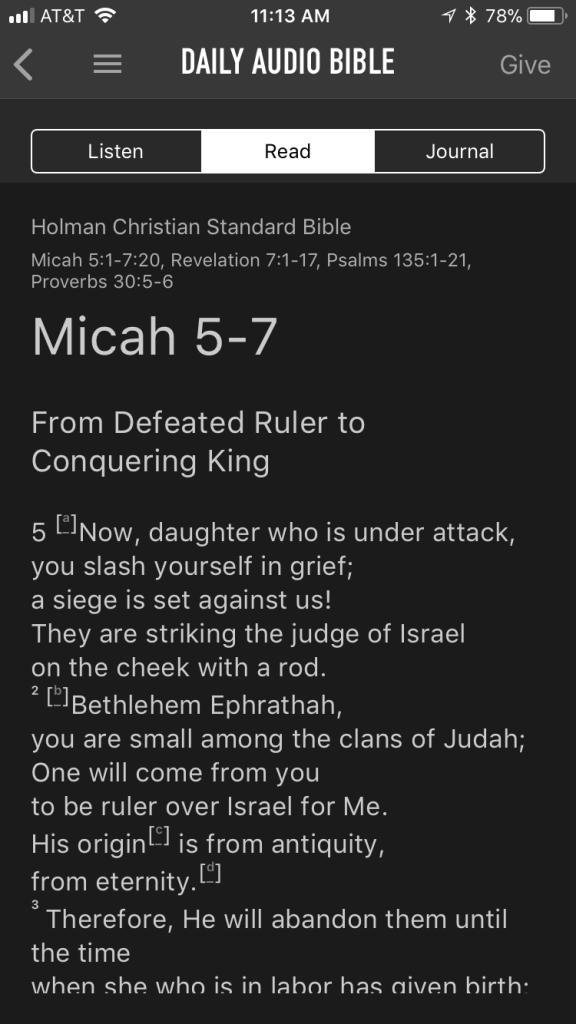
Listen to or read the Bible this year. There are many ways to read the Bible but I invite you to join me in listening to the Bible at Daily Audio Bible.
Brian Hardin reads the Bible every single day- a selection from the
Old Testament,
New Testament,
Psalms, and
Proverbs
so that he completes the Bible in one year. He and his team offer a unique Bible reading/listening opportunity.
If you don’t know much about the Bible, don’t worry. You will when the year is over.
Brian doesn’t just read the Bible; he
explains it,
points out its relevance to our world today,
encourages us to apply it to our lives and
to share its good news with our friends and family.
Besides English, several other languages are available, including Spanish, French, Chinese, Arabic, Portuguese, and Japanese.
There are special versions for
KIDS and TEENS,
a daily Psalm and a daily Proverb
and a Chronological version-reading the books of the Bible in the order the events happened.
With some versions, you can also read along while you listen and you can enter your thoughts in a journal. You can bookmark favorites.It even checks off the episodes you have listened to.
In all that we do we have the goal of irreversible change.
It’s not education, though that certainly happens,
it’s not inspiration, though that may be a result and
it’s not encouragement, though we hope it happens…
It’s irreversible change – the transformation of hearts and lives that in turn empowers an awake and alert heart to influence those within their sphere of influence for irreversible change.
One of the best parts -DAB offers this wonderful opportunity free of charge.
You pay nothing for the app and use of the web site.
Of course, it costs money to produce something of this quality; generous donations and the sale of books and other items on the website fund the project.
So please use the links above to check it out- you have nothing to lose. I’ll check in with you in a few weeks to ask how it’s going or you can let me know now.
Brian Hardin is a music producer, ordained minister and author of several books including
(These are affiliate links which may pay a commission to support this blog.)
I admired and followed Dr. Charles Krauthammer’s writing and was sad when he passed away this year.So I was pleased to learn that he has published a new book, The Point of It All. He started the book prior to his illness and finished it with the help of his son Daniel, who wrote the introduction and edited it.
I admired and followed Dr. Charles Krauthammer’s writing and was sad when he passed away this year.
Spanning the personal, political and philosophical — including never-before-published speeches and a major new essay about the effect of today’s populist movements on the future of global democracy — this is the most profound book yet by the legendary writer and thinker.
My review of his memoirTHINGS THAT MATTER has been one of my most viewed posts. If you haven’t read it I recommend it as well as his newest and unfortunately his last work. I know it’s on my list to read in 2019.
In memory of Charles Krauthammer, M.D.
I don’t remember the first time I read an article by Charles Krauthammer but once I did, I never missed a chance to read more. Dr. Krauthammer recently passed away from cancer and I among many mourn his passing.
His Washington Post syndicated column appeared in my local newspaper on Saturdays; I would read it aloud at breakfast so my husband and I could discuss it.
Invariably, there would be one or two words or phrases we didn’t understand so I would look up the definition- this despite both of us having graduate degrees. We were alternately entertained, enlightened, and enthralled by his way with words.
As a physician, I am intrigued and inspired knowing Dr. Krauthammer completed medical school and residency after and despite sustaining a spinal cord injury which caused quadriplegia (paralysis from the neck down, preventing use of his arms and legs). (This no doubt made his treatment and recovery from cancer surgery all the more difficult.)
In his memoir, he explained how a caring professor did whatever it took to help him get through medical school after his injury, including lectures at his bedside while he was still hospitalized.
He did not use “M.D.” or the title “Dr.” after he changed his career from psychiatry to journalism, but I think he should have, he earned it. He mostly wrote about politics and social issues but occasionally would address medical issues. (These and others in this post are affiliate links to Dr. Krauthammer’s books. )
excerpts from a sampling of his Washington Post columns that discuss medical issues.
After watching videos in which The price of fetal parts was discussed over lunch, Dr. Krauthammer wrote
“Abortion critics have long warned that the problem is not only the obvious — what abortion does to the fetus — but also what it does to us. It’s the same kind of desensitization that has occurred in the Netherlands with another mass exercise in life termination: assisted suicide. It began as a way to prevent the suffering of the terminally ill. It has now become so widespread and wanton that one-fifth of all Dutch assisted-suicide patients are euthanized without their explicit consent.
a prenatal ultrasonographic image of fetus at the four-month point in its gestation; public domain image used courtesy of the CDC/ Jim Gathany
There is more division about the first trimester because one’s views of the early embryo are largely a matter of belief, often religious belief. One’s view of the later-term fetus, however, is more a matter of what might be called sympathetic identification — seeing the image of a recognizable human infant and, now, hearing from the experts exactly what it takes to “terminate” its existence.
The role of democratic politics is to turn such moral sensibilities into law. This is a moment to press relentlessly for a national ban on late-term abortions.”
“So with the Roseburg massacre in Oregon. Within hours, President Obama takes to the microphones to furiously denounce the National Rifle Association and its ilk for resisting “common-sense gun-safety laws.” His harangue is totally sincere, totally knee-jerk and totally pointless. At the time he delivers it, he — and we — know practically nothing about the shooter, nothing about the weapons, nothing about how they were obtained.
In the final quarter of his presidency, Obama can very well say what he wants. If he believes in Australian-style confiscation — i.e., abolishing the Second Amendment — why not spell it out? Until he does, he should stop demonizing people for not doing what he won’t even propose.”
he “preaches skepticism” about most current dietary advice.
Photo by Pixabay on Pexels.com
“Exhibit A for medical skepticism, however, remains vitamin C. When Linus Pauling, Nobel laureate in chemistry (not nutrition), began the vitamin-C megadose fad to fend off all manner of disease, the whole thing struck me as bizarre. Yes, you need some C to prevent scurvy if you’re seven months at sea with Capt. Cook and citrus is nowhere to be found. Otherwise, the megadose is a crock. Evolution is pretty clever. For 2 million years it made sure Homo erectus, neanderthalensis, sapiens, what have you, got his daily dose without having to visit a GNC store.
Sure enough, that fashion came and went. But there are always new windmills to be tilted at. The latest is gluten.
Now, if you suffer from celiac disease, you need a gluten-free diet. How many of us is that? Less than 1 percent. And yet supermarket shelves are groaning with products proclaiming their gluten-freedom. Sales are going through the roof.”
His book is a collection of his more memorable opinion pieces as well as a memoir of his life, including medical school, his life-changing injury, psychiatric medical practice, his journalism career, hobbies (chess and baseball) and life with his family.
“I leave this life with no regrets. It was a wonderful life — full and complete with the great loves and great endeavors that make it worth living. I am sad to leave, but I leave with the knowledge that I lived the life that I intended.”
I am sad he left, but grateful that he shared his “intelligence, erudition, and wit” with the world. May we all find the loves and endeavors that make life worth living and live intentional lives as well as he did.
exploring the HEART of health
Dr. Aletha
Use these links to share the heart of health wherever you connect.