A time to be born, and a time to die-what books teach us about dying

The books I reviewed share  common themes, and events yet are each unique as are the people in them who demonstrate both resilience and fragility. 

There is a time for everything,
    and a season for every activity under the heavens:

    a time to be born and a time to die,

Ecclesiastes 3, NIV

Holy Bible, New International Version®, NIV® Copyright ©1973, 1978, 1984, 2011 by Biblica, Inc.® Used by permission. All rights reserved worldwide.

Birth and death are the only medical events that all humans share. We can anticipate and celebrate the births of other people but not our own.

However we all can anticipate our own death although most of the time we don’t want to.  Unless we deal with a chronic life threatening disease or  are  diagnosed with a terminal illness, or thrust into a life-threatening situation such as combat or a natural disaster,  most of us don’t consider  about how or when we will die. But in truth we all will die.

I have reviewed several books about death here . Not because I  wanted to write about death but because several good books deal with death sensitively and thoughtfully.

Books about death are sometimes written by a person who is facing death. Relatives write after a loved one dies- a child ,a spouse ,a parent. The motivation for writing these books varies as does the motivation for reading them.

I reviewed these books  because by understanding how other people and their families have faced death it may relieve our dread, anxiety, or fear  about dying and death. Often it is not death itself that we  fear but the dying process -the pain , disability, dependence, isolation, unfulfilled dreams.

In an essay  for JAMA, Dr. Zachary Sager, a geriatric and palliative care physician in Boston Massachusetts, described his response to  working with dying patients-

“I witnessed how people could be simultaneously resilient and fragile. I was moved by the connectedness between individuals.

I accept that death offers not only the expected reflection on life and mourning but an opportunity for a unique form of growth and healing. ”

The books I reviewed share  common themes, and events yet are each unique as are the people in them who demonstrate both resilience and fragility.

I am posting excerpts from my reviews with a link to the entire piece. I welcome and encourage your comments about these books as well as any about how you  have navigated death in your family.

A 90 year old woman says “yes” to life

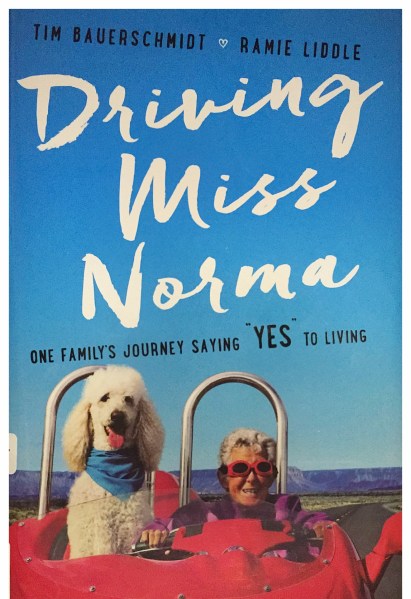
Driving Miss Norma tells the story of Norma Bauerschmidt, a WWII WAVE veteran, wife, and mother. She was still in good health at 90 years of age, until she was diagnosed with cancer.

Her doctor recommended surgery to be followed by chemotherapy, and warned her the treatment and recovery would be long and difficult. She told him no, she would rather “hit the road” with her son and daughter-in-law and enjoy her life, seeing and doing things she had not had a chance to do before. And her doctor agreed, saying that is just what he would do.

Driving Miss Norma - a book cover

Tim, her son, and Ramie, his wife, had already been living a nomadic life, travelling the country with their standard poodle Ringo in an Airstream travel  trailer they parked in campgrounds and  Walmart parking lots. They enjoyed travelling, seeing new places, meeting new people. They wondered how adding a 90 year old woman to their wandering lifestyle would work.

Driving Miss Norma- a book review

A young mother who chose life

A few months after their baby Indiana’s birth, Joey  faced the recurrence of cervical cancer diagnosed and treated years before. Despite more surgery, radiation and chemo the cancer persisted until further treatments were futile and and likely to cause more suffering. Joey decided to leave their Nashville farm,her horses, chickens and gardens, to move home to Indiana to spend her remaining time with her extended family.

To Joey, With Love

Faced with the persistence of the cancer

“Joey decided to come home-not to die, but to live.”

To Joey, With Love- a movie review

A physician who faces his own mortality

Dr. Paul Kalanithi was a 36-year-old resident physician who had, as he wrote, “reached the mountaintop” of anticipating a promising career as a neurosurgeon and neuroscientist. He had a loving wife, a supportive family and professors who respected his knowledge and skill. He seemed destined to be sought after, well paid, productive, successful, and  famous.

WHEN BREATH BECOMES AIR- a book

(note: a neurosurgeon treats  brain, spinal cord and nerve  diseases such as brain tumors that can be cured or improved with surgery,)

Unfortunately, “the culmination of decades of striving evaporated” when he was diagnosed with an aggressive form of lung cancer for which the prognosis was bleak, even with treatment. He was admitted to the very hospital where he trained as a neurosurgery resident, now  to learn what it is like to be a patient with a potentially terminal illness.

When Breath Becomes Air- reflections from Dr. Lucy Kalanithi

Thank you for joining me to remember and honor Norma, Joey, and Paul. I appreciate their families’ generosity in sharing their stories and the HEART of health.

Dr. Aletha stethoscope with a heart

Sleep Practices for Restful Nights

In this post I review options to improve our sleep. Daylight Saving Time can disrupt sleep, akin to jet lag. Chronic insomnia involves difficulty sleeping regularly, potentially linked to medical conditions. Treatment begins with addressing underlying issues and adopting sleep hygiene practices, such as exercise and routine. Cognitive Behavioral Therapy for Insomnia (CBT-I) is effective for persistent cases.

updated March 7, 2025

If you live somewhere that observes Daylight Saving Time, you may notice a disruption in your sleep for a few days after we “spring forward” in March and when we “fall back” to standard time in November.

Like jet lag from travel, these time changes can interrupt our sleep schedule for a few days. And if you already have trouble sleeping, it’s even more of a problem.

Here’s a review of what sleep professionals recommend to help. But for persistent or severe problems, see your own doctor to get started.

This information is current as of the date of original publication or update. It may have changed by the time you read this. I invite you to fact-check what you read here.

Please do not use this information for diagnosis or treatment purposes. Before making health decisions, discuss with your physician or other qualified healthcare provider.

This content is for your “information and inspiration”, and does not imply my endorsement or recommendation.


person sleeping on a couch
Sometimes getting a good night’s sleep can be a challenge.


(Affiliate links are used in this post. You don’t pay more to shop through these links; this blog may earn a small commission, which funds its existence. )

What is Chronic Insomnia?

Most of us have trouble sleeping occasionally, but if you persistently have difficulty with sleep, you may have a medical condition associated with sleep disturbances. These include

  • sleep apnea
  • restless legs syndrome
  • depression and/or anxiety
  • post-traumatic stress disorder

Some people have true chronic insomnia, meaning persistent sleep difficulty not due to some other cause. There are various criteria to diagnose chronic insomnia but in general include

  • difficulty falling or staying asleep
  • at least 3 nights per week for at least 1-3 months
  • with impairment of daytime function, such as fatigue/sleepiness, poor concentration, irritability, school or work dysfunction
EXPERT ADVICE TO SLEEP WELL EVERY NIGHT

How can you sleep better with chronic insomnia? 

The first step for chronic or occasional insomnia is to identify and treat any underlying medical issues that cause poor sleep. In addition to the ones mentioned above these include

  • painful conditions
  • heartburn (gastroesophageal reflux)
  • congestive heart failure
  • lung diseases like asthma cause nighttime breathing difficulty
  • menopausal night sweats

Sleep specialists recommend non-drug management of chronic insomnia and reserve sleep medications for more resistant cases. 

Sleep meds were one of the 7 drugs that are overused in my previous post.

a bed with ornate headboard
photo by Dr. Aletha- at the Hemingway house, Key West, Florida

(Read more about Ernest Hemingway’s preserved Florida home at this post)

Hemingway’s study- chaos and creativity


Behaviors for better sleep

Experts recommend sleep hygiene , basically lifestyle changes, as the initial treatment. Some people have developed bad habits in regards to sleep that need to be unlearned and new behaviors put in place.

For optimal sleep, you should

  • Engage in regular exercise- moderate intensity , tai chi , yoga and low-impact aerobic exercise
  • Avoid evening large meals
  • Limit caffeine, tobacco, and alcohol
  • Use the bedroom only to sleep and for sex
  • Maintain a regular bedtime-awake schedule
  • Avoid daytime naps
  • Avoid distracting stimuli at bedtime-watching television, using electronic devices, talking on the phone
  • Stay in bed only while sleep

Dim the lights for better sleep

The light from electronic devices- clocks, thermostats, televisions, monitors-can disturb your sleep even after you turn off your phone and tablets. This light can be blocked by stick on light blocking covers than can block out the majority of it.

Light from my clock made it hard for me to fall asleep before I discovered these products. With them I fall asleep easier, and can fall back asleep if I wake up.

Maintaining a regular schedule helps to set or reset your sleep/wake cycle. So go to bed at the same time every night and wake up at the same time every morning.

However, if you can’t  sleep, rather than lie in bed awake, you should get up, do a non-stimulating activity, then return to bed when sleepy.

woman typing on a laptop keyboard.
Using a computer, laptop, or tablet before going to bed can impair sleep.

If you have persistent sleep loss, consider more intensive therapy by a professional.

Cognitive behavior therapy for insomnia , CBT-I, significantly improves chronic insomnia and daytime functioning and is recommended as first-line therapy.

CBT-I combines cognitive therapy with sleep restriction, relaxation training, and stimulus control.

Treatment typically requires 5-8 sessions conducted by a health professional trained in its use. Patients need to participate by keeping a sleep diary and writing down daily thoughts in a journal while continuing with the sleep hygiene practices mentioned above.

person writing in a spiral notebook
Writing thoughts in a journal is often encouraged in cognitive behavioral therapy. (photo from the Lightstock.com collection)


SleepPhones

Natural Sleep Aid Created By A Doctor. A family physician created SleepPhones to help patients fall asleep faster and stay asleep longer without resorting to drugs.(affiliate link)


SleepPhone

Manage stress, learn to relax

If you have occasional trouble sleeping due to stress,  relaxation techniques can help you.  Techniques include meditation, yoga, imagery, abdominal breathing and muscle relaxation techniques. These can reduce tension and anxious thoughts that inhibit sleep onset and maintenance.

5 steps to manage stress and strain

A college graduate receives a gift certificate for a book, choosing a technical manual for his engineering career. This post reflects on the need for coping mechanisms for life’s stressors, sharing five essential steps to manage stress and strain. These steps include maintaining a routine, seeking social support, focusing on the positive, staying active, and…


exploring the HEART of healthy sleep

I’d love for you to follow this blog. I share information and inspiration to help you transform challenges into opportunities for learning and growth.

Add your name to the subscribe box to be notified of new posts by email. Click the link to read the post and browse other content. It’s that simple. No spam.

I enjoy seeing who is new to Watercress Words. When you subscribe, I will visit your blog or website. Thanks and see you next time.

Dr. Aletha

The cover image of this post was created by JetPackAI available with WordPress.